
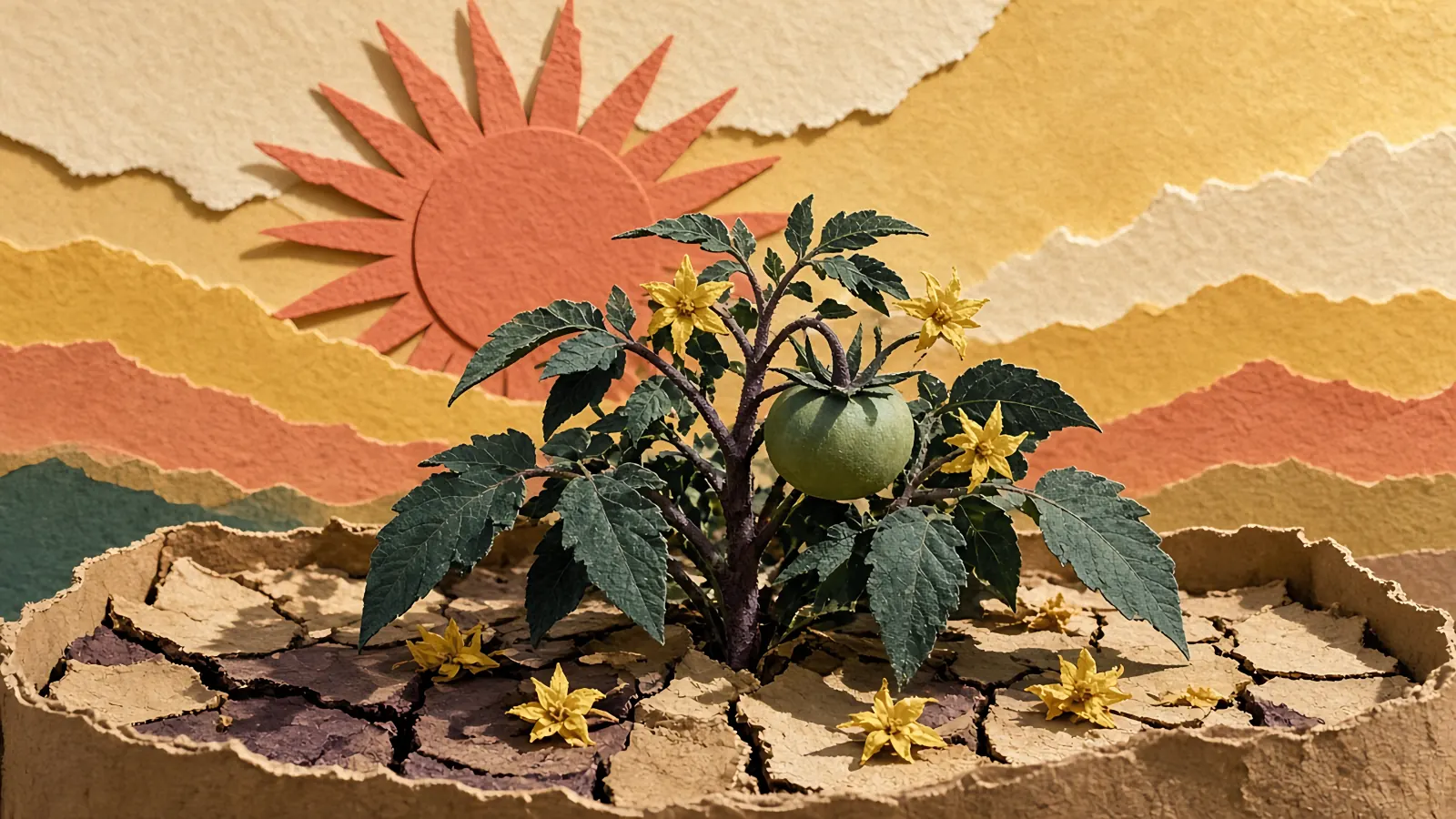
Tomato flowers fall off when it gets too hot. Once days run above about 85°F or nights stay above 70°F for a couple of days in a row, the pollen goes bad and the flower dries up and drops instead of turning into a tomato. Your plant is not sick. It starts setting fruit again when the weather breaks.
How hot is too hot, plant by plant
Every summer, gardeners find the same thing: a big healthy plant, covered in flowers, and not one tomato coming. The flowers turn papery, dry at the stem, and fall. Nothing is eating them and nothing is rotting them. It's the temperature.
Each crop has its own breaking point, and for most of them the night matters as much as the afternoon. Find yours below, then check your forecast — both numbers, the high and the low.
| Plant | It stops setting fruit when | What you actually see |
|---|---|---|
| Tomatoes | Days above 85°F, or nights above 70°F | Yellow flowers dry out and drop off, with no little green tomato behind them. Clemson puts the happy range at 70 to 85°F in the daytime, and says several days above that — or nights above 70°F — will make a plant drop its flowers. |
| Peppers | Days above 90°F, or nights above 75°F | Same story as tomatoes: blossoms fall and no pepper forms. NC State names peppers alongside tomatoes and beans, and points at nights above 75°F or days above 90°F. |
| Beans | Temperatures above 95°F, and worse if the soil is dry | Flowers drop off the vine. Minnesota Extension singles out green beans, and says dry soil makes it happen sooner. |
| Squash, cucumbers, melons | Days above 90°F with nights above 70°F | Plenty of flowers, no fruit. Minnesota Extension says these plants develop more male flowers than female ones in that heat — and only a female flower turns into a squash or a cucumber. |
| Lettuce, greens and beets | Several days above 75°F | Different problem, same weather. The plant shoots a stalk up out of the middle, the leaves turn bitter, and that plant is finished — Minnesota Extension calls it bolting, and says the bitterness after flowering is extreme in lettuce and spinach. Penn State names lettuce, leafy greens, beets, cabbage and celery. Fair warning though: heat is not the only trigger. Penn State points out that bolting is also set off by day length, so a long-day June can bolt a lettuce that never saw 80°F. |
Why heat does this: the pollen goes bad
A tomato flower has to pollinate itself to become a tomato. Nothing else will do it. The pollen has to come loose from inside the flower and land in the right spot, and that only works if the pollen is dry and dusty.
Heat ruins it. Clemson Extension puts it in one line: "Under these temperatures the pollen becomes tacky and nonviable, preventing proper pollination." NC State Extension says the same thing. Missouri Extension adds the other half — bad heat can stop the plant making healthy pollen in the first place.
So the flower opens and waits. Never gets pollinated. The plant lets it go. That's the falling flower. Not disease. Not bugs. Not something you did wrong.
The bees have a limit too. Minnesota Extension puts the good working range for many bee species at 60 to 90°F — so in a real hot spell the insects that help along your squash and cucumbers are also sitting it out.
How long it has to be hot before you lose anything
One hot afternoon is not a heat wave. This is the part almost nobody explains, and it's the difference between panicking on Tuesday and knowing you have until Thursday.
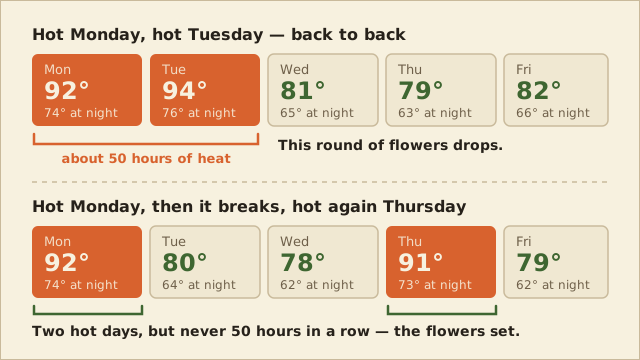
A tomato flower has roughly a fifty-hour window in which it can be pollinated — that's Minnesota Extension's number. Fifty hours is two days and the night in between. So the heat has to hold across that whole stretch, days and nights together, to cost you that round of flowers. Two hot days with a cool couple of days between them is not the same thing at all.
| How long the heat holds | What it costs you | What to do |
|---|---|---|
| One hot afternoon, then a cool night | Usually nothing. The night lets the plant recover and the next flowers open fine. | Water in the morning and get on with your day. |
| Two days and the night between | The flowers that were open in that window drop. You get a gap in your harvest about a month later, when those tomatoes would have been ripening. | Shade in the afternoon, water in the morning. Nothing to fix afterwards. |
| A week of it | More rounds of flowers lost, so a bigger gap. Alabama Extension is reassuring about a stretch this length though: "Short exposures, such as a week or less, should not cause much of a problem." Read the two together and it means you lose some flowers, not the plant and not the season. | Keep it watered and shaded. Don't pull anything. |
| Weeks on end | Alabama Extension: "The longer the plants are exposed to high air temperatures, the longer the condition will last and the more serious the effect on flowering." | In hot regions this is the summer gap. Plan a second planting for fall rather than fighting it. |
What to do when a hot spell is in the forecast
You cannot cool down a garden. What you can do is take the extra stress off the plant so the heat is the only thing it has to deal with — and get a little shade over the worst of the afternoon. Do it a day or two ahead. Not after the flowers have dropped.
- Water early, before the heat arrives. Soak the bed in the early morning. Penn State Extension makes the point that wet soil stays cooler than dry soil, and that sun-baked dry ground barely absorbs water at all — it just runs off. Water the ground, not the leaves. Don't drown it either: soggy, packed soil suffocates roots, and roots need more air in hot weather, not less.
- Put mulch down. A layer of straw, leaves, or plain unprinted cardboard over the soil holds the moisture in and takes a little heat out of the ground (Penn State). Skip black plastic — Penn State says it does the opposite and cooks the soil.
- Shade the afternoon sun. Shade cloth is black netting sold by how much light it blocks, and Penn State recommends 30% to 50% for most vegetables. Keep it off the leaves — the cloth gets hot enough to burn whatever it touches, and it will thrash the plant around in the wind. Tie it to poles or stakes above the plants. Missouri Extension suggests the same thing in a cheaper form: cheesecloth or shade fabric over a tomato that hasn't got enough leaves of its own.
- Block the wind if your garden gets it. Hot dry wind pulls water out of a plant faster than the roots can replace it, and NC State lists steady wind as a cause of dropped blossoms all on its own. A board, a fence panel, or a row of taller plants on the windward side is enough.
- Pick in the cool part of the day. Harvest early or late rather than at noon. Penn State: strong midday sun wilts what you just picked, so get it into the shade or the fridge quickly.
- Then leave the plant alone. Don't pull it, don't cut it back hard, and don't feed it heavily to make it perk up. NC State's advice on blossom drop is plain — when the weather moderates, the problem corrects itself, so it's probably best to just wait it out.
One thing to check before you blame the weather: too much high-nitrogen fertilizer causes dropped blossoms too, and it looks identical (NC State). If you have been feeding heavily and the plant is enormous and dark green with barely any fruit, that is a likelier culprit than a single hot week.
Crowding makes a hot, humid week worse — packed-in plants trap damp air and spread disease (Penn State). If you are planning next year's beds, our plant spacing calculator gives you the room each crop actually wants.
What doesn't work
There is a lot of advice out there for this, and some of it costs money for nothing.
Blossom-set sprays. These are sold for exactly this problem. NC State is direct about it: the hormone sprays help when the trouble is cold weather, not hot — "The sprays don't help with high temps" — and even when they do work, the fruit often comes out misshapen. If your problem is a heat wave, that is money spent on nothing.
Shaking the plant. Tapping a tomato to knock the pollen loose is a real trick and it works in cool, still weather. It does nothing in a heat wave, because the pollen itself has gone tacky and won't do its job however much you shake it (Clemson).
More fertilizer. A struggling plant looks like it needs feeding. It doesn't — it needs the weather to break. Missouri Extension's summary of hot-weather tomatoes is that there is little to do beyond keeping plants healthy, watered and adequately fed, and heavy nitrogen at this point can cause dropped blossoms all by itself (NC State).
Pulling it out and replanting. The plant is fine. Flower drop in heat is temporary, and a fresh transplant in August will hit the same wall with less root behind it.
The other things a hot week does to a tomato
Dropped flowers are the one people notice. Heat has a few other calling cards, and knowing them saves you from treating a weather problem as a disease.
Tomatoes that won't turn red
Red comes from two pigments the fruit makes as it ripens, and Missouri Extension says temperatures above 85°F slow or halt production of them. So in a hot spell your tomatoes sit there orange, yellowish, or blotchy, refusing to color up. Not the variety. Not a deficiency.
You can pick them at the first blush of color and finish them indoors on the counter, out of the sun. They color up better at room temperature than they will on the vine in a heat wave.
Pale, tough patches at the top of the fruit
Missouri Extension describes yellow shoulder — the top of the tomato stays yellow while the rest turns red, and the flesh underneath is tough and poorly flavored. Heat and nutrition both play a part, and some varieties show it far more than others.
There is a related one inside the fruit: a tough white core running down from the stem end, which Missouri Extension ties to heat stress and uneven feeding, and which gets worse when a thin, sparse plant leaves its fruit sitting exposed to full sun.
A brown, sunken patch on the bottom
That's blossom-end rot. It turns up most in hot weather. It's a calcium problem in the fruit, but Missouri Extension is clear that a lack of water is usually what causes it — heat pulls water out of the plant faster than it can move calcium to the fruit. Steady, even watering is the fix. Not a bottle of something.
Will it come back?
Yes. This is the part worth holding on to: a tomato plant keeps making new flowers the whole time. You lose the rounds that open during the hot stretch, not the ones that come after.
So when the weather breaks, fruit set starts again by itself — that is NC State's advice in full, to wait it out. What you'll notice is a gap in the harvest a month or so down the line, matching the week the flowers dropped. Then it picks back up.
If your summers do this every single year, the real fix is timing and variety, not heroics in July. Aim your main tomato crop to set before the worst of the heat and again as it eases, and for greens buy the slow-bolting or heat-tolerant varieties — Penn State recommends them for lettuce, greens, beets, cabbage and celery, and Minnesota Extension says the same for later spring lettuce plantings. Varieties differ on the tomato side too: Alabama Extension says that for some of them, night temperatures alone above 72°F "can be detrimental to flowering, even if day temperatures remain below 85 degrees F."
And it works the other way around in fall. Once the nights start dropping instead of climbing, the thing to watch is the first frost — that one is worth acting on, and our guide on protecting plants from frost covers what actually needs covering. See also our plant pages for tomatoes, peppers and leaf lettuce.
Heat and flower drop FAQ
Why are my tomato flowers falling off?
Almost always heat. Once days run above about 85°F or nights stay above 70°F for a couple of days in a row, the pollen turns tacky and won't pollinate the flower, so the plant drops it (Clemson, Alabama Extension). The plant is healthy and it starts setting fruit again when the weather cools.
Is it the hot days or the warm nights that do the damage?
Both, and the warm nights catch people out. Clemson says nights above 70°F "and or" days above 85°F will make a plant abort its flowers — either one can do it on its own. Alabama Extension goes further: for some varieties, night temperatures alone above 72°F "can be detrimental to flowering, even if day temperatures remain below 85 degrees F."
How long does it have to be hot before I lose flowers?
About two days and the night between them. A tomato flower has roughly a fifty-hour window in which it can be pollinated, and Minnesota Extension says a round of flowers is likely to drop during fifty-hour stretches of hot days and hot nights. A hot Monday followed by a cool Tuesday is not the same thing.
Should I cut the plant back or pull it out?
No. Flower drop from heat is temporary and the plant carries on making new flowers. NC State's advice is that when the weather moderates the problem corrects itself, so it's best to wait it out. Keep it watered and shaded and it will pick back up.
Do blossom-set sprays work in hot weather?
No. NC State says the hormone sprays sold for blossom drop help when the cause is cold weather, not heat — "The sprays don't help with high temps" — and the fruit they do set often comes out misshapen. Save your money in a heat wave.
My lettuce shot up a stalk in the heat. Is that the same thing?
Related, not identical. That is bolting: the plant rushes to flower, the leaves turn bitter and it stops making new ones. Minnesota Extension says several days above 75°F can set lettuce off, and that spinach and lettuce go extremely bitter once they flower. One caveat worth knowing — Penn State says bolting is also triggered by day length, not heat alone, so a long-day June can bolt a plant that never got especially hot. Either way that plant is done; pick what is worth picking and sow the next batch for fall.
Does this happen to peppers and beans too?
Yes. NC State lists tomato, bean and pepper together — nights above 75°F or days above 90°F stop them setting. Minnesota Extension puts green beans at around 95°F, sooner if the soil is dry, and says squash, cucumbers and melons over 90°F by day and 70°F at night make mostly male flowers, which never turn into fruit.
Why are my tomatoes not turning red in the heat?
Same cause, different symptom. Missouri Extension says temperatures above 85°F slow or halt the pigments that make a tomato red, so fruit sits there pale or blotchy. Pick them at the first hint of color and let them finish indoors at room temperature, out of direct sun.
Sources
Every planting date, depth, and temperature on this page traces to these university extension guides. Where they differ, the ranges above hold the whole spread.
- Alabama Cooperative Extension System — Blossom Drop in Tomato
- University of Minnesota Extension — How excessive heat affects the vegetable garden
- Clemson Cooperative Extension — Why Did My Tomatoes Stop Producing Fruit?
- NC State Extension (Burke County Center) — Blossom Drop
- University of Missouri Extension — Tomatoes struggle in summer heat
- Penn State Extension — Heat Proofing Your Vegetable Garden
- University of Minnesota Extension — Growing lettuce, endive and radicchio in home gardens
- University of Minnesota Extension — Growing cool-season crops
Why tomato flowers fall off in hot weather, what temperature it takes, how long the heat has to last, and what actually helps. Every number here traces to the US university extension pages listed above.
The frustrating thing about flower drop is that by the time you notice it, it already happened. The flowers came off three days ago and the gap in your harvest is a month away.
That's what GardenTrack is for: a garden app that knows what you planted and watches your forecast, so it tells you a hot spell is coming while there's still time to get shade over the bed — not afterwards. The free app is open now. Start free whenever you're ready.