


Frost and heat
Seed packets give you a frost date. GardenTrack tells you which plants to cover tonight.
It works out frost dates for your own backyard, and when frost or a hot spell shows up in your forecast, it tells you which of your plants it’s going to hit.
Free to start. No credit card required.
March · Setting up
Your frost dates come from your own yard, not the airport across town.
Type in your ZIP or your street, and GardenTrack works out when frost usually ends in spring and starts again in fall, right where you are.
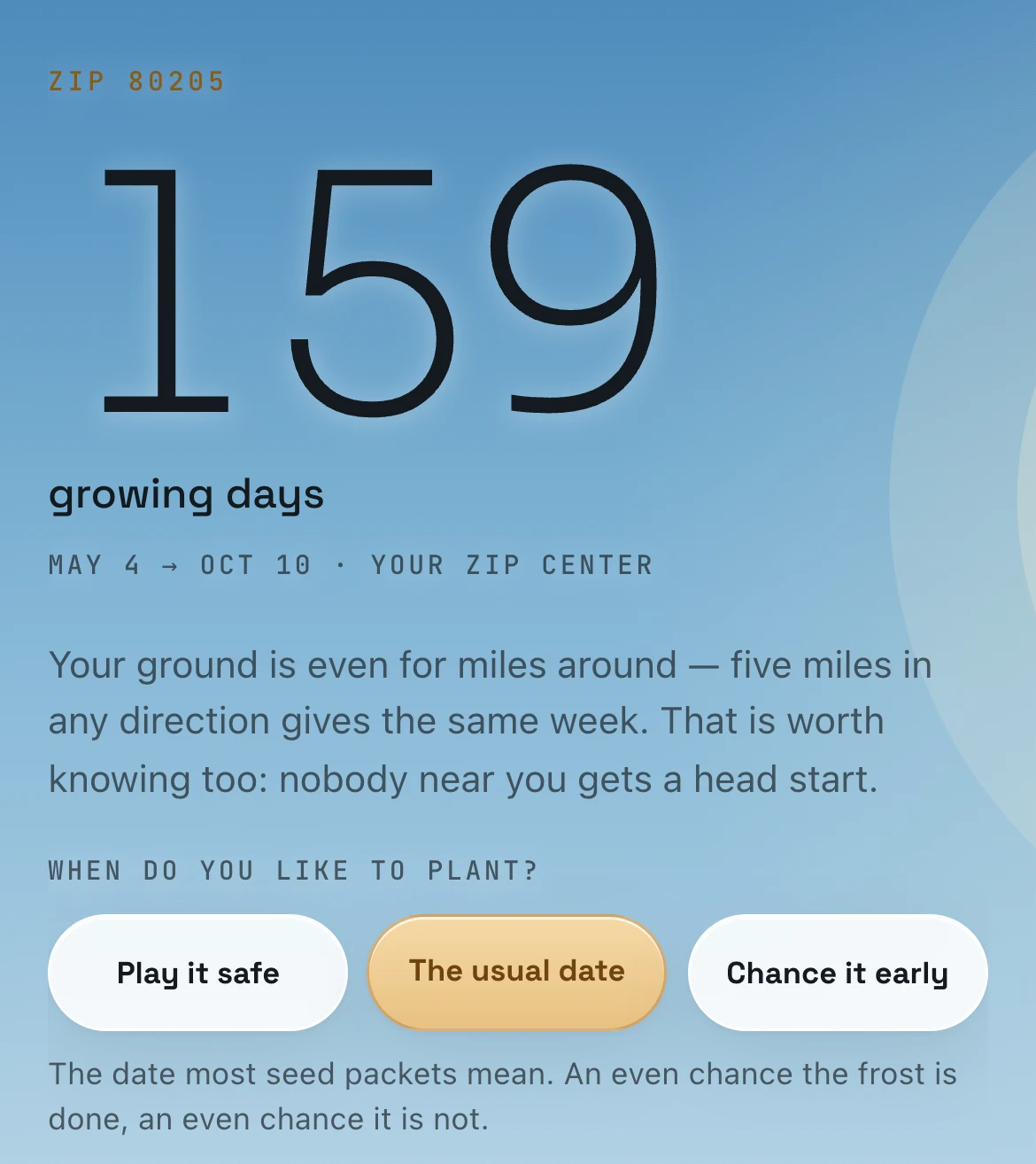
In Denver that’s about May 4 to October 10, which gives you 159 growing days. The dates come from 26 years of daily lows for your spot, from 1995 to 2020. Add your street and they get even closer.
March · Up in the foothills
Five miles down the road, your frost date can be two weeks different.
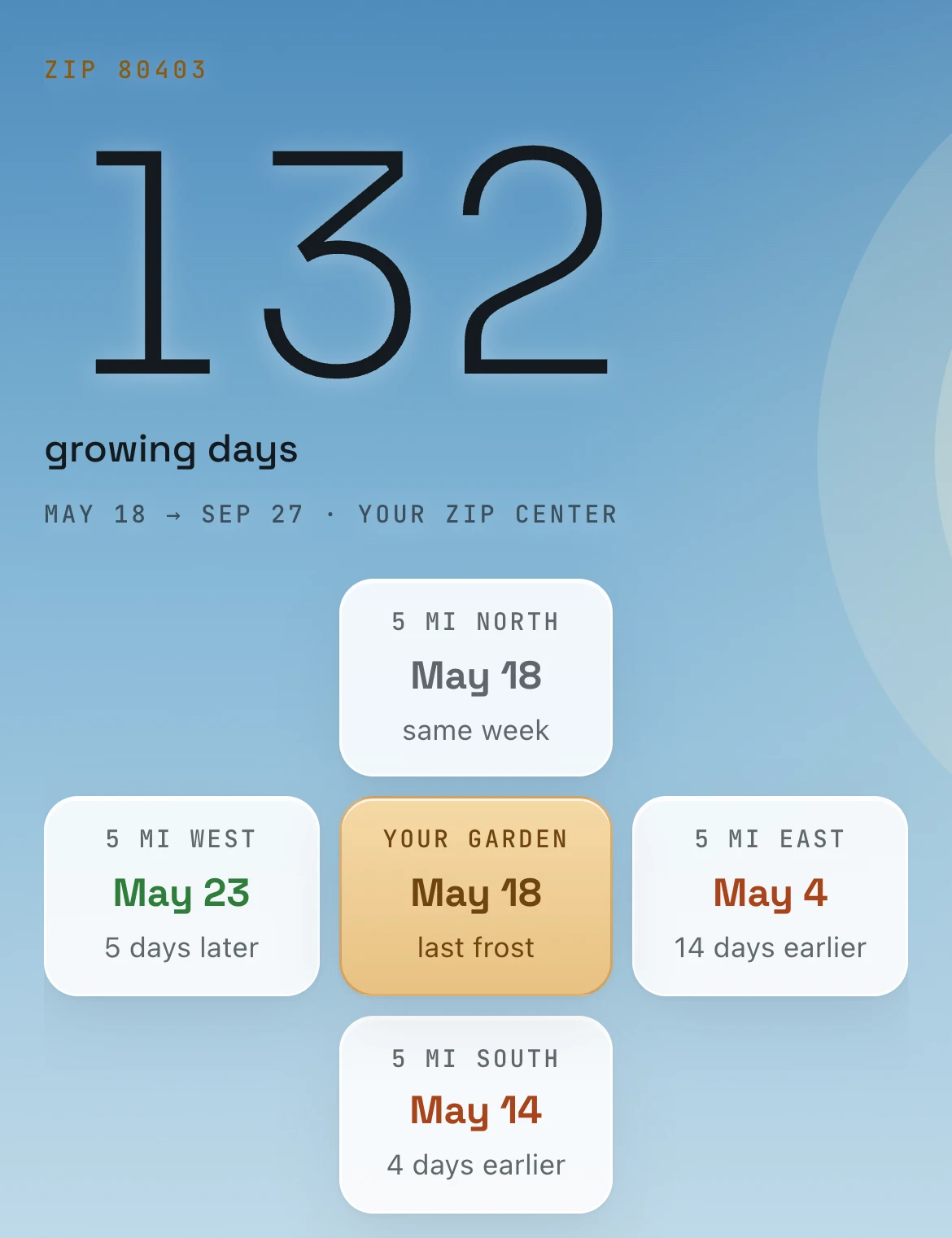
If the ground around you isn’t flat, the card also shows the last frost five miles north, south, east and west of you.
In Golden, just west of Denver, the last frost comes 14 days earlier five miles east, down on the plains. Go five miles west, up the hill, and it’s 5 days later. One date for the whole area can’t tell those apart. Down in Denver the ground’s flat, and the card says so. Five miles any way you go, it’s the same week.
March · Same screen
You decide how much of a gamble to take with frost.
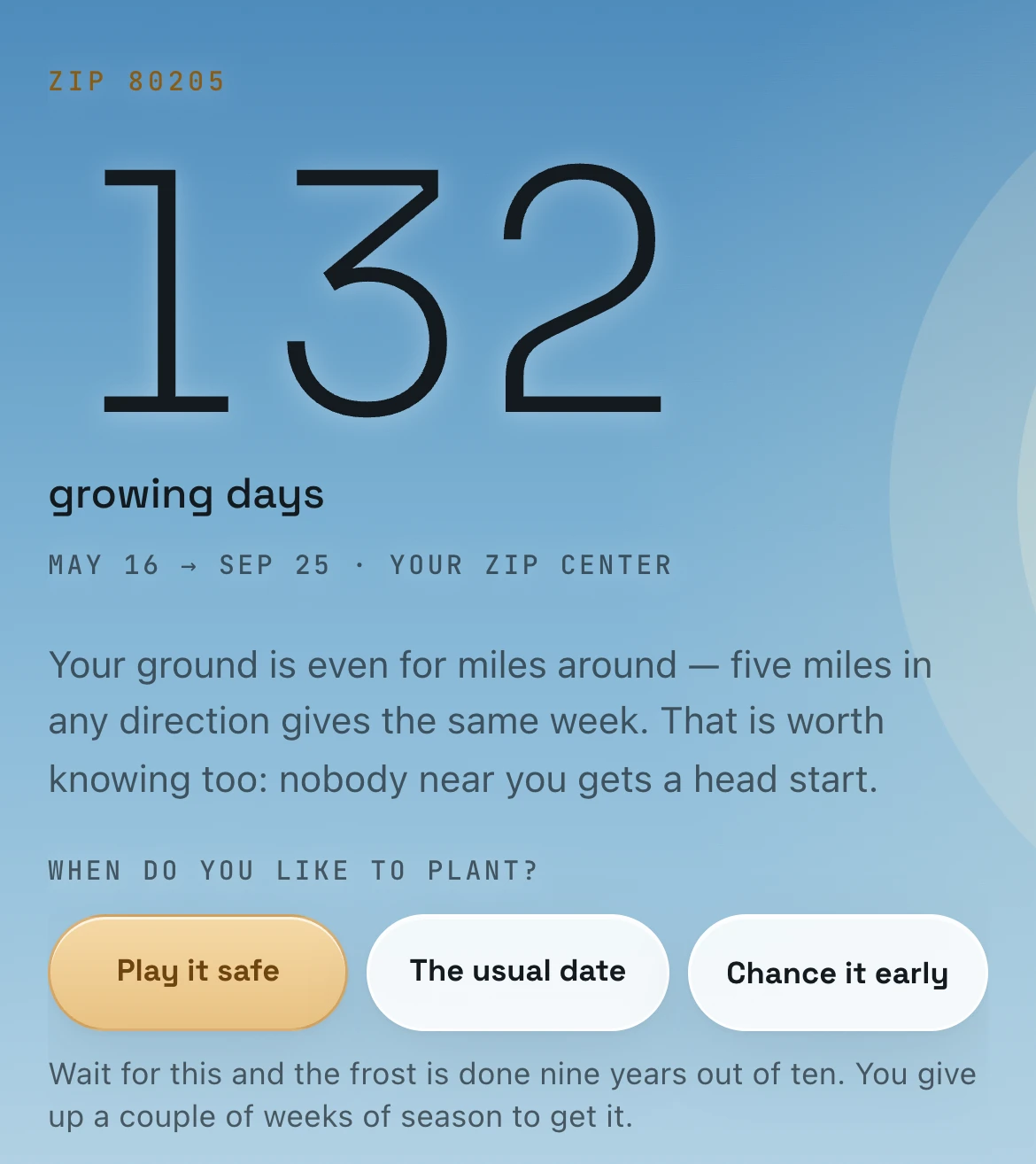
There are three choices, Play it safe, The usual date and Chance it early, and your spring and fall frost dates move with whichever one you pick.
Play it safe waits until the frost is done nine years out of ten, which is May 16 in Denver instead of May 4. It calls fall a little early too, so you end up with 132 growing days. The usual date is the one most seed packets mean, where there’s an even chance the frost is done. Chance it early gets you started sooner, but most years you’ll end up covering things at least once. And if you live somewhere frost is rare, it tells you that instead of making up a date.
July · Monday, 6:00 PM
GardenTrack spots a hot spell days out, then reminds you the evening before.
As soon as your forecast shows a hot spell your outdoor plants can’t take, Today warns you, with a heads-up like Hot in 3 days. Turn on notifications, and you get one about three days ahead that names the day and how hot it’s going to get, then another the evening before that says what to do about it.
Plants in pots come first, because you can pick those up and move them. A pot dries out a lot faster than open ground. For the ones in the ground, it tells you to shade them in the afternoon and water deeply in the morning. And if some of your plants don’t have a heat number, it tells you how many it couldn’t check.
GardenTrack
99°F, 4 days of it Shade Bell pepper, Jalapeño and 4 more through the afternoon, and water deeply in the morning. 2 more not checked.July · Tuesday, 7:00 AM
It explains what the heat will do, and it’s honest about what it can’t check.
Open the warning on Today and tap Why this?, and it tells you which plants are at risk, what this kind of heat does to them, and what helps.
In heat like this, the pollen on plants like tomatoes and peppers gets sticky, so the flowers fall off instead of turning into fruit. It isn’t a disease, so the card tells you to leave the plant alone. It’ll start setting fruit again once the weather breaks. Any plants it doesn’t have a heat number for are listed as not checked, which means it doesn’t know, not that they’re fine. On Today, GardenTrack shows the warning each morning from three days out and on the first hot day, then leaves it off until the heat breaks and comes back.
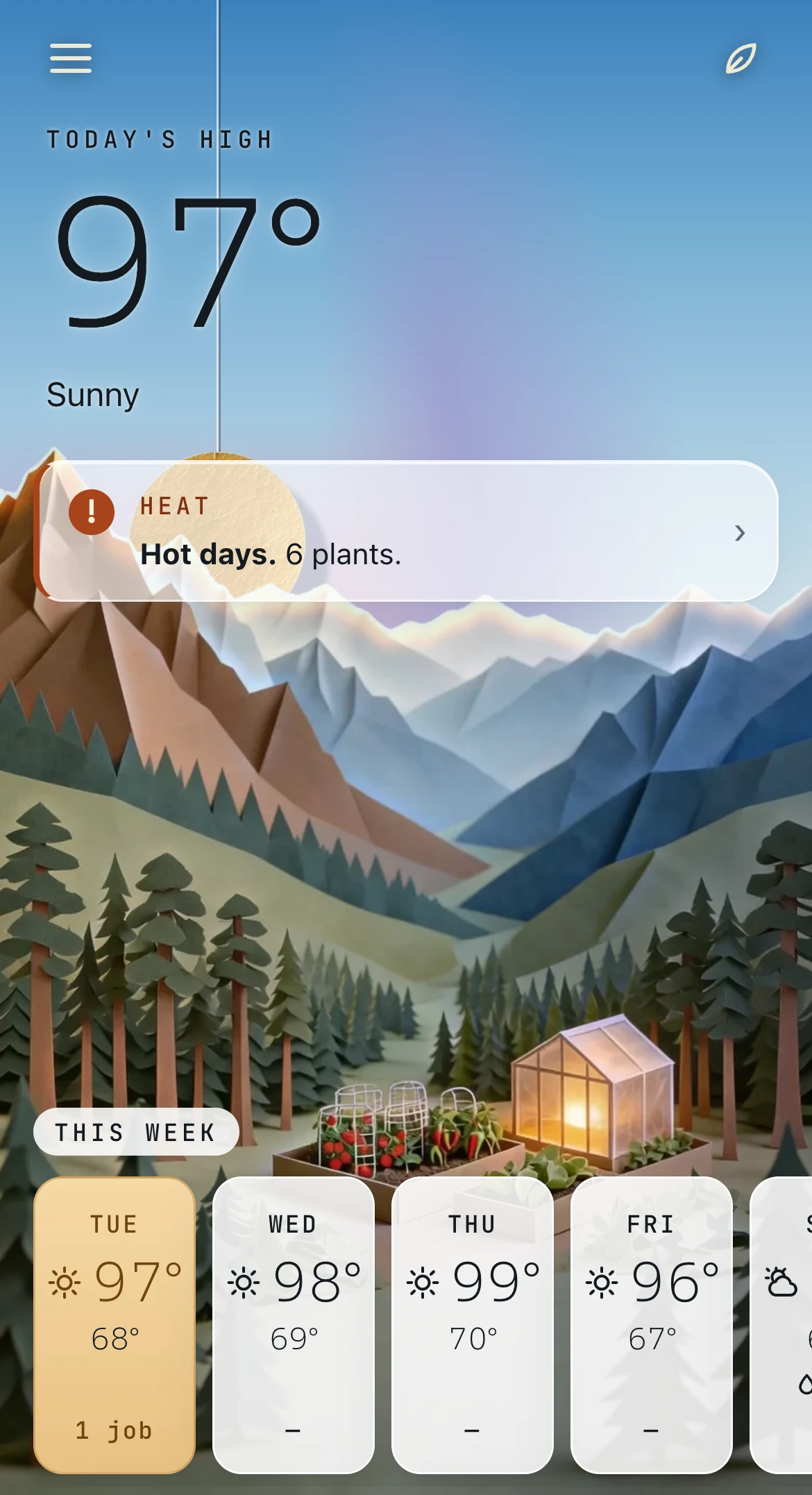
6 plants Today
Hot days
Around 99°F, and nights near 70°F.
Heat like that makes the flowers drop, so there is less fruit behind them. Shade in the afternoon helps, and water in the morning.
At risk: Bell pepper, Jalapeño, Sungold and 3 more.
Not in this: Radish and Basil. We hold no heat figure for them.
Got itSeptember · Monday, 7:00 AM
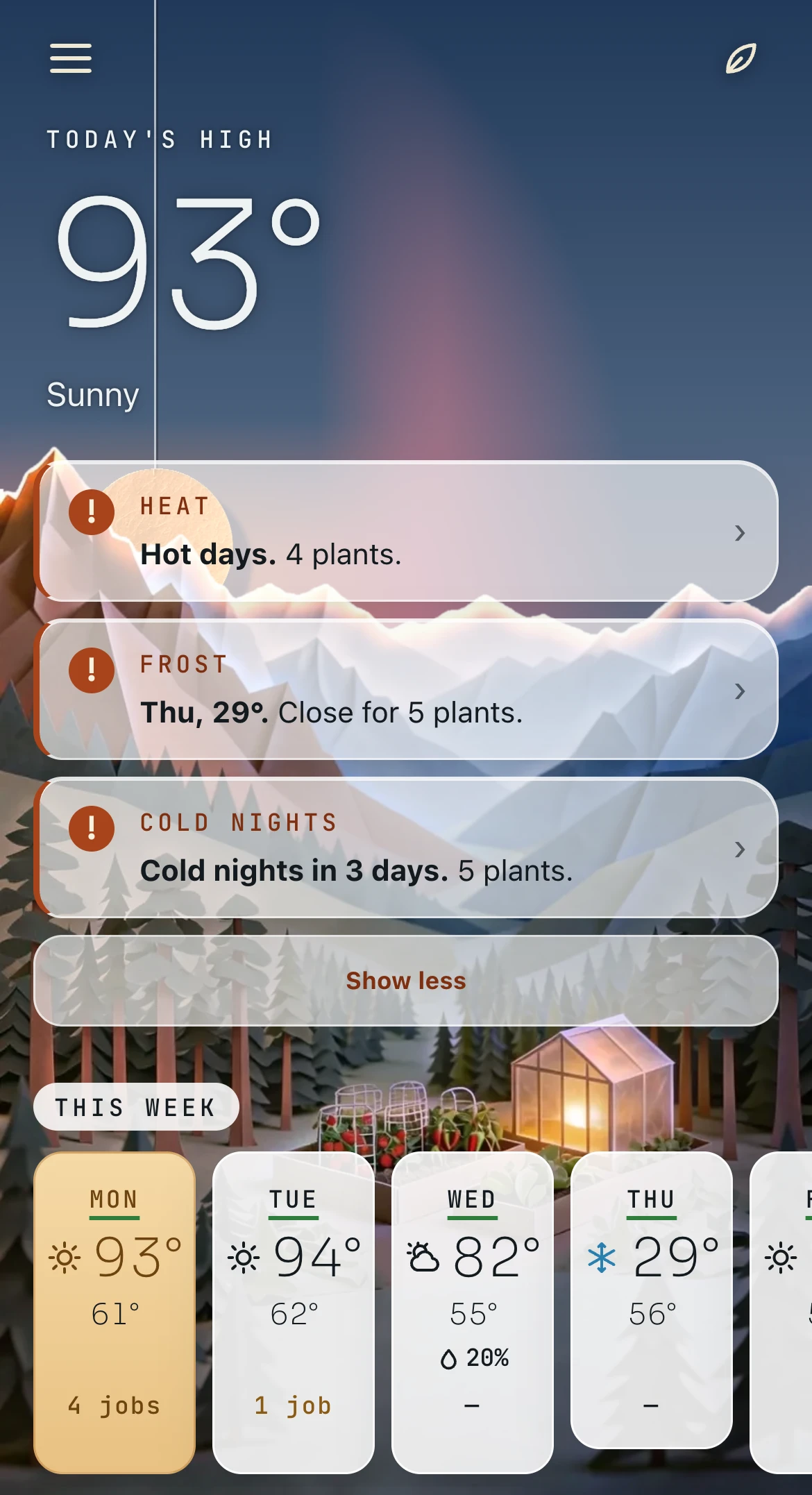
You hear about Thursday’s frost on Monday morning.
The forecast says it’ll drop to 29°F on Thursday night, so Today warns you three days ahead and counts how many of your plants it’ll reach.
Denver’s first frost usually comes around October 10. This year the forecast showed one on September 17, three weeks early, and that’s why the warnings go by your actual forecast instead of the average. Hardy crops like kale and garlic stay off the count unless it gets cold enough to hurt them. Kale doesn’t mind a little frost anyway.
September · Monday, 7:05 AM
If you’ve got a lemon in a pot, GardenTrack tells you when to bring it inside.
Citrus doesn’t like nights below 50°F, so when one’s coming, you get a card that tells you which night.
Tap Brought it in and it goes in your garden’s record. Come spring, once the forecast shows a whole week of nights at 50°F or warmer, another card tells you to ease it back outside. Right now that works for lemons, limes, oranges, grapefruit and mandarins.
Meyer lemon Today
 Bring it inside
Thursday night drops to 29°F. In a pot, it comes inside once nights go below 50°F.
Why this? Brought it inSeptember · Thursday, 6:00 PM
On the night of the frost, it tells you which plants to cover.
At 6 PM you’ll get a notification with tonight’s low and the first few plants by name, and the card in the app tells you what to do about them.
Once you’re done, answer with one tap: Covered them, Picked what was on them, or Leaving them. A plant the frost will only damage gets a gentler note than one it’ll kill, because those are two very different evenings. If you haven’t turned on notifications, the same warning will be waiting for you on Today.
GardenTrack
29°F tonight Frost will end Basil, Sungold and 3 more. Cover them or pick what is on them.Tonight 29°F Now
Tonight ends 5 of your plants
Basil, Sungold, Cherry tomato and 2 more. Cover them, or pick what is on them.
Why this? Covered them Picked what was on them Leaving themQuestions people ask about frost warnings.
- Is there an app that warns me when frost is coming for my garden?
- Yes. GardenTrack watches the forecast for your own garden. When frost shows up in it, Today warns you ahead of time and counts how many of your plants it’ll reach. Turn on notifications and at 6 PM on the night itself you get one with the low and the first few plants to cover, by name.
- How does GardenTrack work out my frost dates?
- Type in your ZIP or your street. It works out when frost usually ends in spring and starts again in fall, right where you are, from 26 years of daily lows for your spot (1995 to 2020). Frost dates are worked out for the lower 48 states.
- Does it warn me about heat too?
- Yes. When your forecast shows a hot spell your outdoor plants can’t take, Today warns you. With notifications on, you get one about three days ahead and another the evening before that says what to do.
- Is it free?
- Free to start. No credit card required. Free covers 10 active plants, with your frost dates and the frost and heat warnings. Just want your frost dates? The lookup is free with no sign-up.
Everything else GardenTrack keeps track of.
- TodayIt shows your weather and today’s jobs, bed by bed, before you head outside.
- Journal and free Season RecapIt keeps a record of your garden from year to year, and the free Season Recap lets you talk through how it went.
- Your gardenIt keeps every plant where it really lives, whether that’s a bed, a pot, a tree or the greenhouse.
- Calendar and What still fitsIt lays out your season week by week and shows what you can still plant this year.
- Garden PlannerYour whole plan for the rest of the year, and the time it takes.
- Photos and garden walksWalk the garden spot by spot and snap as you go. Every photo is kept with its plant.
- TalkAsk a question in your own words, and the answer starts from what you’ve planted and logged.