

Plant Spacing Calculator
Enter your bed size and pick a crop. You'll see how many plants fit, how far apart they go, and a picture of the bed.
Pick a crop to set dense, standard, or roomy spacing from its sourced range.
Square and triangular use the between-plants number both ways. Rows adds the walking gap.
Your plant count shows up here
Set a bed size and a crop, and we'll work out how many fit — with the layout, spacing, and a bed preview.
Save this bed in GardenTrack, and it keeps track of what you plant in it.
How the calculator figures it
No secret here. Take the bed's length, divide by the spacing, round down. That's one row. Do the same with the width to count your rows. Multiply.
A 4×8 bed is 96 by 48 inches. Leaf lettuce wants 6 inches each way. 96 ÷ 6 = 16 per row. 48 ÷ 6 = 8 rows. 16 × 8 = 128 plants. That's a lot of salad.
Round down every time. A 5-foot bed at 18-inch spacing gives you 3 per row, not 3.3. The extra .3 of a cabbage helps nobody.
Pick a crop and you get a density choice — dense, standard, or roomy — pulled straight from that crop's sourced range in the chart below. Standard is the balanced spacing most guides recommend; dense packs more in but invites crowding, and more plants isn't more harvest. Every number is the final spacing after thinning. And your seed packet knows your variety better than any chart — when they argue, the packet wins.
Plant spacing chart for common vegetables
Every preset the calculator uses, plus the full ranges. These come from the university extension guides listed in the sources below. Where the guides disagree, you see the whole range.
| Crop | Between plants (in) | Between rows (in) | Per sq ft* |
|---|---|---|---|
| Beans, bush | 2–4 | 24–36 | 9 |
| Beans, pole (trellised) | 4–6 | 30–48 | 4 |
| Beets | 2–4 | 12–18 | 9 |
| Broccoli | 18–24 | 30–36 | — |
| Brussels sprouts | 18–24 | 30–36 | — |
| Cabbage | 12–24 | 24–36 | — |
| Carrots | 2–3 | 12–18 | 16 |
| Cauliflower | 18–24 | 30–36 | — |
| Chard, Swiss | 6–12 | 18–24 | 1 |
| Collards | 18–24 | 30–36 | — |
| Corn, sweet | 8–12 | 30–36 | 1 |
| Cucumbers | 8–12 | 48–72 | 1 |
| Eggplant | 18–24 | 30–36 | — |
| Garlic | 3–6 | 12–18 | 4 |
| Kale | 12–18 | 18–36 | — |
| Kohlrabi | 4–6 | 12–24 | 4 |
| Lettuce, head | 10–12 | 12–18 | 1 |
| Lettuce, leaf | 4–6 | 12–18 | 4 |
| Melon (muskmelon/cantaloupe) | 24–36 | 60–72 | — |
| Okra | 12–18 | 36–42 | — |
| Onions | 2–4 | 12–18 | 9 |
| Parsnips | 3–4 | 18–24 | 9 |
| Peas | 1–3 | 18–24 | 16 |
| Peppers | 18–24 | 24–36 | — |
| Potatoes | 10–12 | 30–36 | 1 |
| Pumpkins | 36–48 | 72–96 | — |
| Radishes | 1–2 | 6–18 | 16 |
| Spinach | 2–4 | 12–18 | 9 |
| Squash, summer (zucchini) | 24–36 | 36–48 | — |
| Squash, winter | 36–48 | 72–96 | — |
| Sweet potatoes | 12–18 | 36–48 | — |
| Tomatoes (staked or caged) | 18–24 | 36–48 | — |
| Turnips | 2–4 | 12–18 | 9 |
| Watermelon | 36–60 | 72–96 | — |
* Plants per square foot, mapped from the top of each crop's between-plants range (3 in = 16, 4 in = 9, 6 in = 4, 12 in = 1). A dash means the crop wants more than one square. Strict square-foot gardening runs a few crops its own way — see the section below.
Spacing covers how far apart. Which crops to put next to each other is a separate question, and the companion chart handles that one.
Square, rows, or triangular — which layout fits more
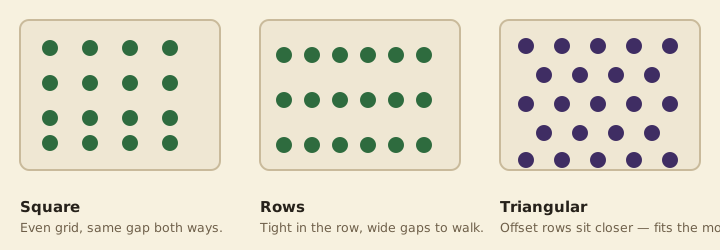
Rows exist so you can walk between them. Corn, potatoes, a big in-ground plot — rows make sense there. In a raised bed you reach in from the side, so those wide walking gaps are wasted dirt. A square grid at plant-to-plant spacing almost always fits more.
Triangular means offsetting every other row. The rows sit about 13% closer without any plant getting nearer its neighbors, which works out to as much as 15% more plants in the same area. That's geometry, not a gardening trick. In a small bed the edges eat some of the gain, and sometimes all of it. The calculator does the honest math instead of promising you the 15%.
Planning what goes where, not just how many? The companion planting chart covers which crops belong side by side.
Square-foot gardening spacing
Square-foot gardening is the same math with the bed pre-chopped into 1-foot squares. Mel Bartholomew's system plants each square by spacing tier: 12-inch crops get 1 per square, 6-inch crops get 4, 4-inch crops get 9, and 3-inch crops get 16.
So a 4×8 bed is 32 squares. One square holds 1 broccoli, or 4 leaf lettuce, or 9 bush beans, or 16 carrots. Mix and match, square by square.
The chart's per-square column follows that tier math. The book runs a few crops its own way — corn goes 4 to a square, and trellised crops like peas and pole beans climb instead of spread. If you're running strict square-foot gardening, his chart wins.
Why your seed packet disagrees with every chart
Because the packet's playing a different game. It tells you how thick to sow, then how far to thin. "Sow 1 inch apart, thin to 3" means you drop a lot of seeds and pull most of the babies. The chart above shows where you end up, not where you start.
The other trap is reading the row number as the plant number. That 36-inch row spacing assumes you'll walk between rows. Plant-to-plant is the number that matters in a bed.
And varieties genuinely differ. A patio tomato and a sprawling heirloom aren't the same animal. When the packet and the chart argue, the packet knows your variety. It wins.
Staring at a packet wondering when to start seeds for your zone? Anchor it to your last frost with the frost date lookup, and count back the weeks on the seed packet.
What actually happens when you crowd plants
Short version: more plants, less food.
Crowded leaves stay wet longer, and wet leaves are where powdery mildew and blight move in. Roots end up fighting over the same water and nitrogen, so everything grows small and the harvest shrinks with it.
We've crowded 'em too. An extra zucchini squeezed into a full bed feels like free food in May. By July it's a mildew farm, and the beans behind it haven't seen sun in weeks.
None of that means you're bad at this. Nobody's born knowing a cauliflower wants two feet. Now you've got the numbers, and that's the whole fix.
FAQ
How do you calculate plant spacing?
Divide the bed's length by the spacing your crop needs to get plants per row. Divide the width by the row spacing to get the number of rows. Multiply the two and round down. In a raised bed you can use the plant-to-plant spacing in both directions.
How many plants fit in a 4×8 raised bed?
Depends on the crop. At final spacing: 8 staked tomatoes, 10 broccoli, 32 head lettuce, 128 leaf lettuce, or around 500 carrots. Run your own numbers in the calculator above.
Can you space plants closer in a raised bed?
Yes. The row spacing in most charts includes room to walk, and you don't walk through a raised bed. Use the plant-to-plant number in both directions instead. Don't go tighter than that, though. The plants still need the light, air, and root room.
What spacing do tomatoes need?
18 to 24 inches between staked or caged plants, with 36 to 48 inches between rows if you're planting in rows. Give big indeterminate varieties the full 24 inches. Sprawling, uncaged tomatoes need more room than that.
Sources
The chart's spacing ranges are drawn from these guides. The calculator presets sit inside them.
- University of Missouri Extension — Vegetable Planting Calendar (G6201)
- Virginia Cooperative Extension — Vegetable Planting Guide and Recommended Planting Dates (426-331)
- Clemson Cooperative Extension, Home & Garden Information Center — Planning a Garden (HGIC 1256)
- Oklahoma State University Extension — Oklahoma Garden Planning Guide (HLA-6004)
- Mel Bartholomew — All New Square Foot Gardening (the 1/4/9/16 per-square system)
For your exact variety, the seed packet or the breeder's page beats all of the above.