
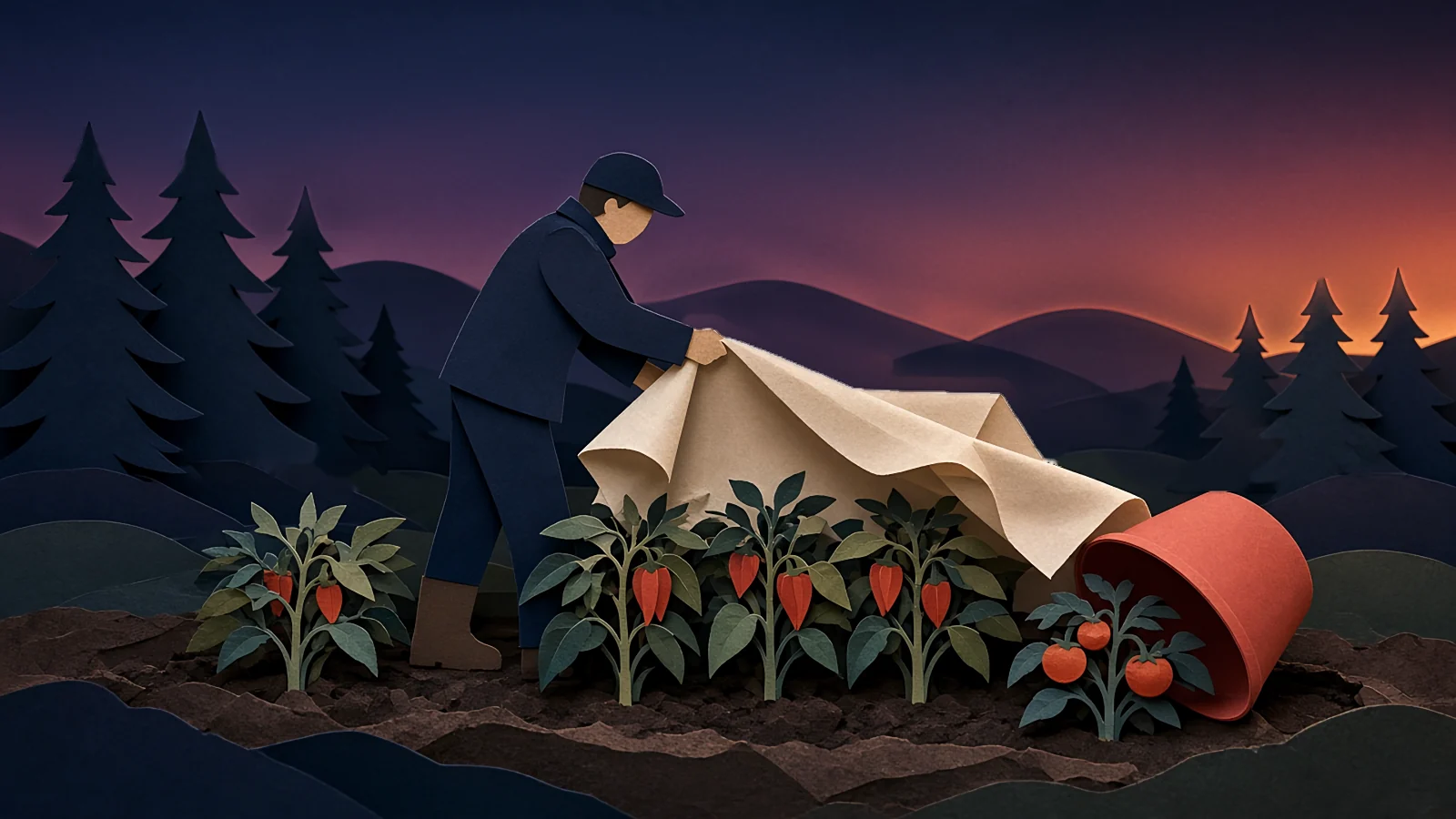
Protect plants from frost by first checking which plants are even at risk tonight, then covering only the tender ones. Tomatoes, peppers, basil, squash, beans and cucumbers die at a light frost (28–32°F); most greens and root crops shrug it off. Cover before dark with sheets or blankets that reach the ground, and take them off in the morning.
First: does your plant even need covering tonight?
Before you drag a sheet outside, work out what is actually at risk. Half the garden probably needs nothing. Only tender, warm-season plants die at a light frost — most greens and root crops take one in stride, and several taste better afterwards.
The list lives on one page, not two. Which vegetables survive frost sorts every crop we hold into four groups with the temperature each one starts taking damage at. That page owns the question, and it is the one to check tonight.
This page is the other half: once you know what needs covering, what a cover is actually doing and how to stop it failing.
Don't know your usual frost timing? The frost date lookup gives the odds for your own address, so you are not guessing in October.
How to cover plants for frost, the right way
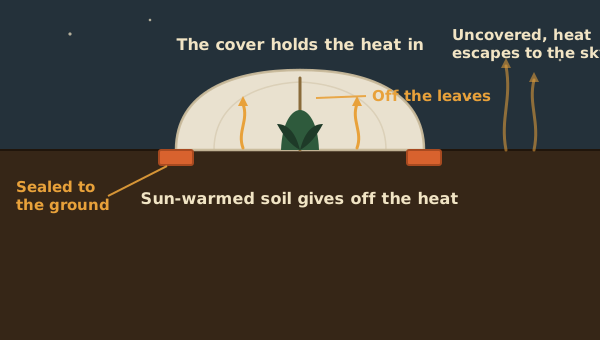
Here's the thing almost every frost guide skips: a cover doesn't hold in the plant's own warmth. It traps the heat the ground gives off. All day the soil soaks up heat from the sun. On a clear, calm night that heat escapes straight up into the open sky — a layer of cloud would trap it, but a clear sky lets it go. A cover is a stand-in for that missing cloud, holding the ground's heat around your plants.
That one fact decides everything about doing this right: the cover has to reach the ground to catch that heat, it goes on before the ground gives it all up, and it comes off in the morning. Colorado State, Michigan State and Iowa State all land on the same picture.
- Water the soil earlier in the day. Give the bed a good drink in the morning or afternoon. Not at night. Moist soil soaks up and holds more of the day's heat than dry soil, then feeds it back out overnight. Michigan State Extension suggests wetting the soil about six inches deep. Water the ground, not the leaves.
- Put covers on before dusk. Get covers on in the late afternoon or early evening, while the ground is still warm from the day. Wait until after dark and most of that heat has already escaped, so all you're doing is tucking cold air in for the night.
- Use a cover that reaches all the way to the ground. Drape sheets, blankets or frost cloth right down to the soil. Every side. Don't gather the cover around the stem. That traps almost nothing. The whole job is holding the ground's heat in, so the cover has to touch down to seal it (UF/IFAS, Colorado State).
- Keep the cover off the leaves. Prop the fabric up on stakes, hoops, tomato cages, or a couple of buckets so it isn't resting on the plant. Wherever a cover touches a leaf, the cold conducts right through and freezes that spot — and plastic laid straight on a plant is the worst for it (Utah State, Michigan State).
- Anchor the edges down. Weigh the hem to the ground with bricks, boards, rocks, or a shovel of soil. An open edge lets the warm air leak out the bottom, and the first breeze will drag the whole cover off (Colorado State, Maryland Extension).
- Take the cover off in the morning. Pull covers once the temperature climbs back above freezing. Left on into a sunny morning, the air under a closed cover can run 20 to 40°F hotter than outside and cook the plant you just saved — Utah State clocked exactly that. Fabric that blocks light also needs to come off so the soil can reload its heat for the next night.
A cover only buys you so much. Below about 28°F it mostly stops working, so at a real hard freeze the smarter move is to pick what you can and let the rest go (Iowa State) — a green tomato ripens fine on the counter (South Dakota State). What to grab, and the mistakes that undo all of it, are right below.
What to cover with (you've probably got it already)
You don't need to buy anything for one cold night. The stuff in your linen closet works. As long as you use it right. If frost is a regular thing where you garden, one upgrade is worth the money — but start with what's on hand.
Do bed sheets protect plants from frost? Yes.
Straight answer: an old bedsheet or blanket works, and works well. Utah State Extension puts the gain at about 3 to 5°F over the open air — plenty to carry tender plants through a light frost. Grandma wasn't wrong.
Four rules make or break it. Keep the fabric dry: a wet sheet cools as the water evaporates and can end up colder than no sheet at all (Colorado State). Keep it off the leaves. Run it all the way to the ground. And take it off in the morning.
Grab whatever's handy — sheets, blankets, towels, a tarp, cardboard boxes, a bucket or laundry basket over a single plant, even straw or a few sheets of newspaper on low stuff. Nebraska Extension's list runs about that long. Plastic works too, but only over a frame that keeps it off the leaves, and it has to come off first thing in the morning.
If you'd rather buy something: frost cloth
Frost cloth, also sold as row cover, is the one upgrade worth it. Unlike a sheet, it breathes and lets light through, so it can stay on for days instead of coming off every morning (Colorado State).
How much it buys depends on the weight. University of Maryland Extension lines it up: the lightest cloth adds about 2°F, mid-weight 4 to 6°F, and heavyweight up to 8°F — though the heavy stuff blocks close to half the light, so it's for a cold snap, not the whole season (Maryland, Minnesota Extension). The best grades stretch to around 10°F of protection (Colorado State), and the heaviest can hold off cold down near 20°F for a short spell (Minnesota).
The mistakes that waste the whole effort
Most of the work people put into covering plants leaks out through the same handful of mistakes. Any one of them undoes the whole night.
The cover doesn't reach the ground. A sheet cinched around the trunk, or draped over the top like a tent, leaves the sides open — and the ground's heat, the only heat you've got, pours right out (Colorado State, Maryland Extension).
The cover rests on the leaves. Cold conducts straight through the fabric wherever it touches, and those leaves freeze anyway. Plastic laid right on a plant is the classic version (Utah State).
It's left on into a sunny morning. A closed cover in the sun turns into a little oven, 20 to 40°F hotter than the air outside, and cooks the plant (Utah State). Pull it once it's above freezing.
The fabric's wet. A soaked sheet cools as the water evaporates and can leave things colder than bare ground (Colorado State). Keep it dry, or reach for plastic over a frame instead.
And one that isn't about the cover at all: waiting too long. Throw it on after dark, once the ground's given up its heat, and you've just sealed cold air in for the night. Before dusk beats after dinner.
Watering, mulch, and plants in pots
Three moves around the cover matter almost as much as the cover — and one of them, people get exactly backwards.
Water beats a dry bed
Watering before a cold night sounds backwards, but it helps. Moist soil holds more of the sun's heat than dry, dusty soil and lets it back out slowly overnight (Michigan State, UF/IFAS). Water the ground earlier in the day, aim for the roots, and leave the leaves dry. One thing to skip: don't dig or hoe the bed right before a freeze — loosening it opens gaps that let cold sink straight down (NC State).
Mulch is a root move, not a leaf move
This one trips people up. Piling on mulch tonight won't shield the leaves — if anything, a fresh, loose layer insulates the soil and cuts how much heat it can send back up to the plant. Michigan State found firm, moist, bare ground can run up to 5°F warmer at plant level than loose or covered soil during a frost. Mulch earns its keep protecting roots and perennials over a whole winter, not shielding tomato leaves from one cold night.
Move the pots
Plants in pots are more exposed than the same plant in the ground — the roots don't have the earth around them for insulation, and Clemson notes that on some hardy plants, root damage can start as warm as 28°F. Easiest fix by far: carry pots into the garage or indoors for the night, then set them back out once it warms (Iowa State, UF/IFAS). If they're too big to move, shove them together and mulch around the pots to slow the heat loss (UF/IFAS).
Your yard can run colder than the forecast
The low on your phone is for a whole region, and your yard isn't the whole region. On the exact clear, calm nights frost shows up, cold air slides downhill and settles in the low, open spots — so a hollow in the yard, or a bed at the bottom of a slope, can run a few degrees colder than the number you were quoted (UF/IFAS). A spot tucked against the house usually runs a little warmer.
You can't change that, but you can plan around it. Look up how likely frost is for your spot and time of year, and see exactly how those odds are built in our frost-date method. Nobody can honestly tell you the exact temperature one bed will hit tonight — but knowing your frost odds, and which corners of your yard run cold, tells you when it's worth heading out with the sheets.
After the frost
Say a frost got ahead of you and some leaves are blackened and mushy the next morning. Don't grab the pruners yet. Even dead-looking foliage insulates the living stems under it from the next cold night, so cutting it off now can make things worse (UF/IFAS).
Wait for spring, or for new growth to tell you what's actually alive. UF/IFAS suggests scraping a little bark with a fingernail — green underneath means it's fine, brown or black means that part's gone, and letting the plant push new shoots shows you exactly where to cut. Watering the bed helps too; it thaws the soil and gets moisture back to roots that couldn't drink while everything was frozen. Hold off on fertilizer until frost danger's fully past, so you're not pushing tender new growth into the next cold snap (UF/IFAS).
The hardy stuff usually needs nothing. Kale, collards, and spinach usually come through a frost just fine — and plenty of hardy crops, Brussels sprouts and root crops especially, actually taste sweeter after one (South Dakota State) — so check which vegetables survive frost before you mourn a plant that's fine. And the tender fruit you didn't get to? Green tomatoes, melons, and pumpkins picked ahead of a hard freeze will keep ripening indoors (South Dakota State). With a little patience, most gardens come out the other side in better shape than they look at 7 a.m. (UF/IFAS).
Frost protection FAQ
Do bed sheets protect plants from frost?
Yes. A dry sheet or light blanket adds roughly 3 to 5°F of protection, per Utah State Extension — plenty for a light frost. The rules that make it work: keep the fabric dry (a wet sheet can actually make things colder), keep it off the leaves, run it all the way to the ground, and take it off in the morning.
What temperature should I cover plants at?
Cover tender, warm-season plants — tomatoes, peppers, basil, squash, cucumbers, beans — when the forecast low nears a light frost, around 32°F and below. They start taking damage between 28 and 32°F. Below about 28°F a cover mostly stops helping, so at a hard freeze it's better to harvest what you can than to cover it (South Dakota State, Iowa State).
When should I cover my plants?
Before dusk, while the ground is still warm from the day. A cover works by trapping the heat the soil gives off overnight, so putting it on late — after dark, once that heat's gone — just seals in cold air. Then take the cover off in the morning as it climbs back above freezing, or a sunny day can cook what's underneath.
Do I need to cover kale, cabbage, or other hardy greens?
Usually not. Hardy cool-season crops — kale, collards, cabbage, broccoli, Brussels sprouts, spinach — take a hard freeze in stride, down into the mid-20s°F and often lower (Purdue, South Dakota State, NC State). Many actually taste sweeter after a frost. Save your sheets for the tender stuff.
Will covering my tomatoes save them no matter how cold it gets?
No, and it's worth being honest about that. A cover only adds a handful of degrees: a few for a sheet, up to about 8 to 10°F for heavy frost cloth (Maryland, Colorado State). Once the low drops below roughly 28°F, covering mostly stops working (Iowa State). At a real hard freeze, pick your green tomatoes and ripen them indoors instead of fighting a losing battle.
Should I water before a frost?
Yes, water the soil earlier in the day. Moist ground holds more of the sun's heat than dry ground and releases it overnight, which buys your plants a little warmth (Michigan State, UF/IFAS). Water the roots, not the leaves, and don't dig or disturb the bed right before — that lets cold sink in deeper.
Sources
Every planting date, depth, and temperature on this page traces to these university extension guides. Where they differ, the ranges above hold the whole spread.
- National Weather Service (NOAA) — Watch, Warning & Advisory Definitions
- National Weather Service (NOAA) — Understanding Cold Weather Alerts
- Michigan State University Extension — Frost and freezing temperatures and ways to protect plants
- Michigan State University Extension — Should I irrigate ahead of the coming freeze?
- Michigan State University Extension — Moist, weed-free soil retains more heat
- Michigan State University Extension — Identifying and preventing freeze damage in fall vegetables
- South Dakota State University Extension — Fall Frost Tolerance of Common Vegetables
- Purdue University Extension — HO-66-W: The Fall Vegetable Garden
- NC State Extension — Frost and Freeze Protection for Vegetable Crops
- Clemson Cooperative Extension — Cold Damage
- Colorado State University Extension — Frost Protection and Extending the Growing Season
- University of Maryland Extension — Row Covers
- University of Minnesota Extension — Extending the growing season: start early, end later
- Utah State University Extension — Five Ways to Protect Plants from Dipping Temperatures
- Utah State University Extension — Extending the Garden Season
- Nebraska Extension in Lancaster County — Frost: Cold Temperatures Bring an End to the Gardening Season
- Iowa State University Extension and Outreach — How to Protect Plants from Frost and Freeze
- University of Florida IFAS Extension — Cold Protection of Landscape Plants
- University of Florida IFAS Extension — Treating Cold-Damaged Plants
- University of Florida IFAS Extension (Okaloosa County) — Cold Protection of Landscape Plants
How to protect plants from frost, start to finish: which plants are actually at risk tonight, what to cover them with, how to do it so it works, and what to do after. Every temperature and degree of protection here traces to the US extension and National Weather Service pages listed above.
Covering plants for one cold night is the easy part. The hard part is the list that lives in your head — which plants are tender, when frost usually hits your spot, what you covered last time and whether it pulled through.
That's the whole idea behind GardenTrack: a garden app that remembers every plant you've got and tells you what to do and when, including a heads-up when frost's in your local forecast. The free app is open now, and the Today screen already warns you when frost is on the way. Want to try it? Start free.