
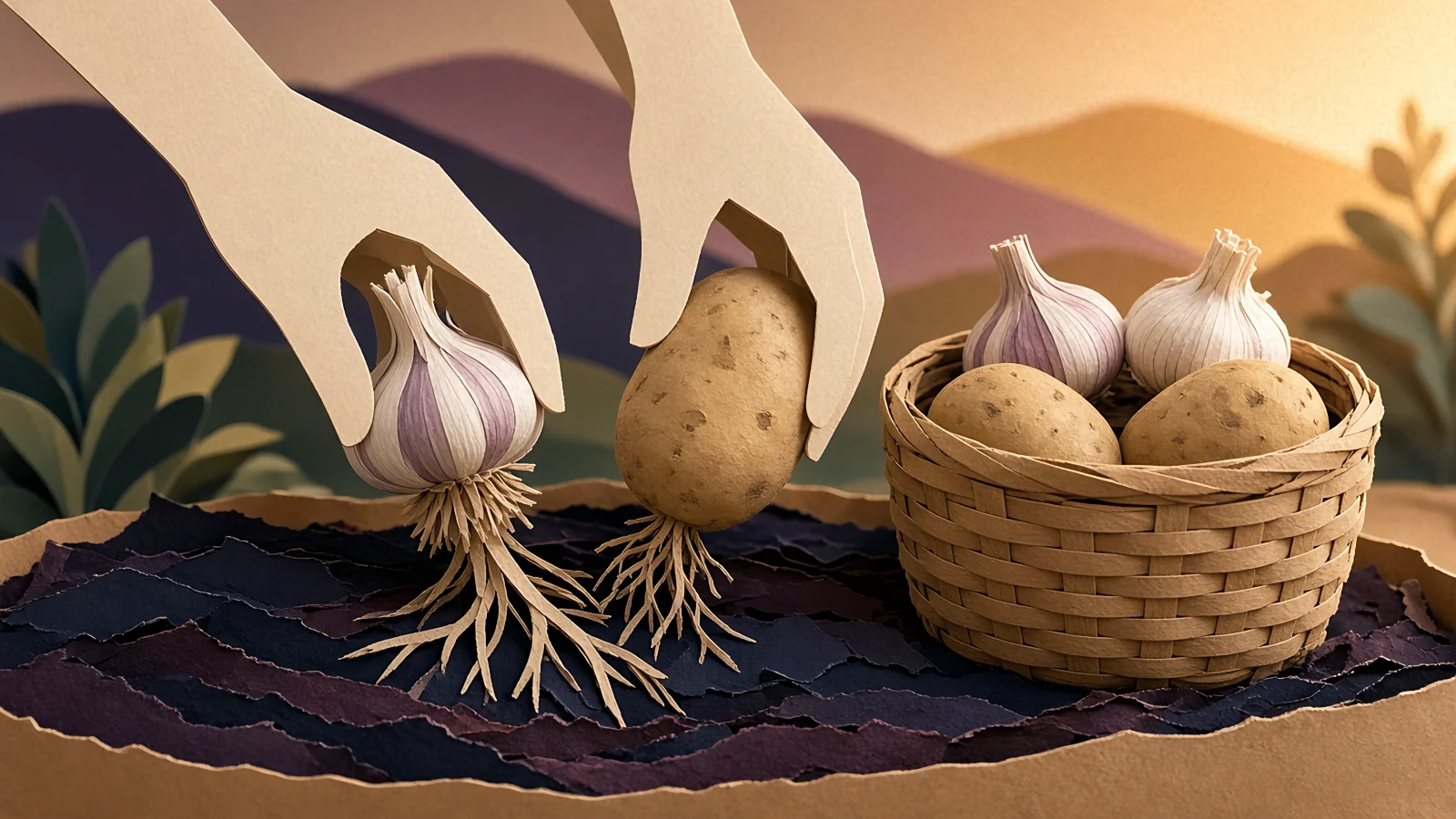
Two signs and one test. When the lower leaves have gone brown but half the upper leaves are still green, you're close. Then pull one bulb and cut it across: if the cloves fill their skins, the whole bed is ready. Waiting for all the leaves to brown costs you the wrappers that keep it.
The leaves are the wrappers
Start here, because it makes every other piece of advice on this page obvious instead of arbitrary.
Ohio State University Extension: "When the lower leaves begin to yellow, the garlic is ready for harvest. The leaves are actually connected to the garlic bulb wrappers below."
Each leaf you can see is a wrapper you cannot. The papery layers around a bulb are not a separate thing that grows over it — they are the bottom ends of the leaves standing above ground. So when you count leaves you are counting wrappers, and the plant is telling you about the bulb directly rather than by proxy.
Which turns the usual warning into arithmetic. Ohio State: "Waiting until leaves turn brown will result in rotted or missing wrappers." Every leaf that goes brown is a wrapper you have lost, and wrappers are what keeps garlic through the winter. Leave it long enough and Ohio State's other consequence arrives too — "as the bulbs mature, they may dry and split, leading to shorter storage life or bulb rot."
The leaf rule, with an actual fraction
Most pages say to harvest when the leaves start to yellow, which is a description rather than an instruction. Minnesota gives a version you can count.
University of Minnesota Extension: "Begin harvesting when the lower leaves turn brown and when half or slightly more than half of the upper leaves remain green."
Go and count them. Brown at the bottom, and about half of what is above still green, is the window — and it is worth actually counting rather than glancing, because half is a different plant from most. Ohio State's simpler version says the same thing from the other side — the lower leaves beginning to yellow — and both are describing the same moment.
Minnesota also gives the calendar, which is context rather than a decision: "Depending on variety and climate zone, harvest garlic between late June and late July." Our own record puts a fall-planted crop at 250 to 270 days from planting, sourced to Maryland — which is the count for an autumn planting, the way most people grow it. Treat both as a heads-up about which couple of weeks to start looking, not as the answer. If you planted in spring, the day count does not apply to you at all.
The test that settles it: cut one open
The leaves get you to the right week. This gets you to the right day, and it costs exactly one bulb.
- Pull one plant from the middle of the bed. Not one from the end, where the soil dries differently and the plant may be a week ahead or behind the rest. Take one that represents the bed.
- Cut the bulb across, through the middle. A clean cut through the widest part, so you are looking at the cloves in cross-section rather than end-on.
- Look at whether the cloves fill their skins. Minnesota's test is exactly this: if the cloves fill the skins, then the bulbs are ready to harvest. Minnesota does not say what the other two answers look like, so this part is ours: gaps around the cloves read as give it another week, and cloves visibly straining at the wrappers read as go now, before they split them.
Minnesota's own wording, so you can check it: "Alternatively, you can pull a few bulbs and cut them in half. If the cloves fill the skins, then the bulbs are ready to harvest."
This is one bulb out of a bed, and it answers the question completely. It is a strange thing that most pages on this subject bury it or leave it out.
What too early and too late each cost you
A harvest window has a price at both ends, and Minnesota names them in one breath: "Harvesting too early will result in small bulbs. Harvesting too late will result in cloves popping out of bulbs."
Those two failures look nothing alike and neither one is recoverable. Early gives you a bulb that was still filling — the size it would have reached is simply gone. Late gives you a bulb that has burst its wrappers from the inside, and a bulb with split wrappers does not store; you are eating it in the next few weeks whether you planned to or not.
So the honest framing is not wait for the signs but: the signs open a window a week or two wide, and you want to be inside it rather than early or late. If you are unsure, the cut bulb above decides it.
Then cure it, and the calendar is not the test
Lifted garlic is not stored garlic. It needs to dry down until the skins go papery, and this is where our sources stop agreeing — which is worth showing rather than hiding.
Two services, two answers, and they do not overlap. Utah State says to dry the plants "for 1-2 weeks". Minnesota says "Put the plants in a warm, dry, airy place for three to four weeks to cure." One finishes before the other starts.
That spread is not a flaw in the advice, it is a clue about the question. Curing time depends on your humidity, your airflow and the size of the bulbs, so nobody can give you a number that is right in every garden. What they can give you is the finish line, and Utah State states it plainly: "When fully cured the garlic skins should be papery and the roots dry."
So hang it somewhere warm, dry and airy out of the sun, start checking at a week, and stop when the skins rustle. Then Utah State's tidy-up: "For stored bulbs, cut off the leaves 1-2 inches above the bulb", and keep it "in cool (32-40°F), dry conditions."
One thing our sources do not say, because it does not occur to them to: you do not have to cure garlic to eat it. Curing is for keeping. A bulb pulled this afternoon is perfectly good in tonight's dinner, skins and all.
Why a yellow leaf means dig here and nothing at all elsewhere
One last thing, because it is the reason this page could be written at all.
Lower leaves going yellow is the single most misread sign in a garden. We hold growth-stage records for 153 crops, and lower leaves going yellow is listed as an expected sign at 33 different crop-and-stage combinations in them. Fourteen of those carry a harvest job. Nineteen carry nothing at all.
The fourteen are crops at a harvest or ripening stage: garlic, potato, sweet potato, sunchoke, horseradish, peanut, lentil, quinoa, amaranth, buckwheat, flax, sesame, oat and cereal rye. The nineteen are mostly perennials going dormant — currant, asparagus, bee balm, chives, catnip, globe artichoke and the rest — where the yellow is a plant putting itself to bed and a gardener who has been told yellow leaves are bad spends the autumn worrying about nothing. - The sign is identical. The stage is what makes it a clock or a shrug. That is not something you can look up in a table of symptoms, which is why yellow-leaf pages tend to answer with a list of diseases rather than a question about timing.
Garlic harvest questions people actually ask
How do I know when garlic is ready to harvest?
Two signs and a test. Lower leaves brown, and about half the upper leaves still green, puts you in the window. Then pull one bulb and cut it across — Minnesota's rule is that if the cloves fill their skins, the bed is ready. That last step settles it in a minute.
What happens if I harvest garlic too late?
You lose the wrappers. Each leaf is connected to a wrapper on the bulb, so browning leaves are rotting wrappers, and Ohio State warns the bulbs may also dry and split. Minnesota's version is cloves popping out of the bulb. Split wrappers means it will not store.
Should I stop watering garlic before harvest?
Maryland's advice is that as harvest approaches, watering should be less frequent to avoid disease problems. That is about the bulb sitting in wet soil while its wrappers are already beginning to break down, which is the exact moment rot has an opening.
How long does garlic need to cure?
Between one and four weeks, depending on who you ask — Utah State says one to two, Minnesota three to four, and those two do not even overlap. The disagreement is the point: it depends on your humidity, your airflow and the size of the bulbs. The finish line is skins papery and roots dry.
Sources
Every planting date, depth, and temperature on this page traces to these university extension guides. Where they differ, the ranges above hold the whole spread.
- Ohio State University Extension — Growing Garlic in the Garden
- University of Minnesota Extension — Growing garlic in home gardens
- Utah State University Extension — Garlic in the Garden
- University of Maryland Extension — Growing Garlic in a Home Garden
We are building GardenTrack to know what stage each plant in your garden is in, so a yellow leaf reads as a clock or a shrug without you having to look it up — and the free app is open now.