

Plant garlic in fall, about one to two weeks after your first killing frost, so cloves root before the ground freezes hard. That's roughly late September into mid-October in zones 3–6, late October into November in zones 7–8, and November in zones 9–10. Cloves root through winter and bulb up next summer. Spring planting works, but bulbs run smaller.
When to plant garlic, by zone
Garlic goes in during fall almost everywhere. The window swings by a month or more depending on how hard your winter bites. Find your zone below, then count back from your own frost date to pin the actual week.
| USDA zone | When to plant | The cue |
|---|---|---|
| Zones 3–4 | Late September to early October | About 1–2 weeks after your first killing frost |
| Zones 5–6 | Early to mid-October | In the ground 4–6 weeks before it freezes hard |
| Zones 7–8 | Late October into November | First leaves up before freezing weather |
| Zones 9–10 | November into early December | Pre-chill seed garlic ~10 weeks in the fridge first |
Find your exact week from your frost date
Start from your first killing frost rather than a month printed for the whole country. Cloves go in a week or two after it. That leaves them time to root before the ground locks up, and North Carolina State Extension puts the establishment window at four to six weeks before the freeze.
Don't know your frost date? Look it up for your exact spot. Frost isn't a date so much as odds, so you get three of them: the early date it has already frosted by in one year out of ten, the middle date it has frosted by in half of years, and the late date it has almost always frosted by. Plant off the middle one and you're planting the way the weather actually behaves. If you want to see how those are worked out, we show the method.
Up north the ground can freeze a couple of weeks after that first frost. Don't dawdle. Mild-winter zones get a long runway — cloves go in right up until the soil locks up. And in frost-free places the cold never arrives at all, which is a fixable problem, further down.
Why garlic goes in the ground in fall
Everything else is coming out of the ground about now. You're pulling spent tomato vines, the beans have gone leathery, and here you are with a trowel putting something in. It feels wrong.
Garlic runs on a different clock.
It needs to be cold for a while. Maryland Extension puts the requirement at 32 to 50°F for roughly two months, and then the lengthening days of spring are what tell the clove to split into a head. Miss that cold and the clove just gets bigger. One round lump, no cloves, after nine months in your bed.
The shape of the year: roots in fall, nothing at all through winter, tops up fast in spring, bulb filled by early summer. Most of that is the doing-nothing part. It sits out there under the snow and it's fine — plant a cold-hardy type, throw some mulch on, and leave it alone.
Hardneck or softneck? Your winters decide
Two families, and most garlic advice online was written by somebody in Vermont. If your winters are mild, that advice will cost you a crop.
Hardneck is the cold pick. Hardier, bigger cloves, fewer of them. It's the only one that throws a scape, which is the curly stalk you cut off in June and cook. Rocambole, Purple Stripe, Porcelain.
Softneck handles heat, stores months longer, and braids. It's what's in the grocery store. Mild winters, plant this. Artichoke, Silverskin.
Zones 9 and 10: your winter can't do this on its own. There isn't enough cold to trigger bulbing, so you supply it. Paper bag, back of the fridge, eight to ten weeks before you plant. Maryland Extension puts the requirement at two months between 32 and 50°F; the Old Farmer's Almanac says ten weeks in the fridge for frost-free areas. Either way it's a bag of garlic behind the milk since August.
How to plant garlic, step by step
Timing sorted, type sorted. The planting is an afternoon. One rule before you start: real seed garlic, not a supermarket bulb.
- Buy seed garlic, not grocery cloves. Garden center or seed catalog. Not the produce aisle. Supermarket bulbs are often treated to stop them sprouting, which is good for the shelf and useless in your bed, and they tend to be a softneck bred for somewhere warmer than where you live.
- Crack the bulbs a day or two before planting. Break the bulbs into cloves right before planting. Leave the papery skins on. Plant the big outer ones — bigger clove, bigger bulb — and cook the small inner ones.
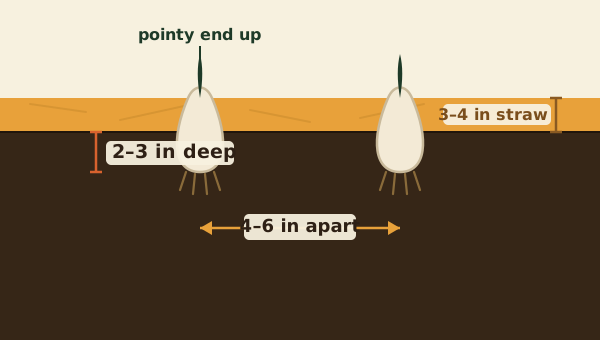
- Plant pointy end up, 2–3 inches deep. Pointy end up, flat root-plate down, two to three inches deep. Upside down or sideways grows a small misshapen bulb. It costs you a second to check.
- Space cloves 4–6 inches apart. Four to six inches apart, about a foot between rows, more if you want to walk between them. Working out how many fit in your bed? The spacing calculator below does the arithmetic.
- Mulch with 3–4 inches of straw. Three to four inches of straw or shredded leaves over the whole bed. It steadies the soil temperature, holds moisture and keeps the weeds down. Use straw. Hay carries weed seed and you will regret it in May.
- Water it in, then leave it. Water it once. Then walk away until spring. Nothing shows up top for months while the cloves are putting down roots underneath, and that blank bed is exactly what success looks like in November.
Garlic earns its keep as a bed-mate too. It's a classic companion for a lot of crops. Check what grows well next to garlic and space the rest of the bed before you fill it in. Want the full growing rundown? See garlic's complete profile.
Missed the fall window? You've still got room
Fall got away from you. That happens to everybody at least once, usually because October is also when everything else needs doing, and you have more room than you think.
The rule is simpler than the calendar makes it look: if the ground isn't frozen, you can still plant. Cloves go in right up until the soil locks up, and in mild-winter zones that can run into February or March. You do pay for the late start, but only a little — the Old Farmer's Almanac says the bulbs come out smaller, not that they fail.
Spring planting works too, and it is a real fallback rather than a consolation prize. The cloves get less cold and less of a head start, so they size up smaller — Utah State and Maryland Extension both found the same thing. If spring is what you have, put them in the moment the soil can be worked and you will still be pulling garlic in summer.
What to expect after you plant
In warmer zones you'll get green shoots within a few weeks. That's fine. Mulch carries them through. The only real mistake is planting so early it puts up a lot of top growth, which a hard winter will burn.
Spring, the tops go fast. Hardneck throws its scape in late spring. Cut it off and eat it — leave it on and your bulb comes out about a third smaller.
Harvest is next summer. May through July depending where you are, and the sign is the lower leaves going yellow while the plant is still mostly green.
Which is the same yellow that means something is badly wrong on a tomato. That's the whole problem with garden advice: the sign means nothing until you know which plant is wearing it, and by then you have either dug the garlic or lost it.
Garlic planting FAQ
Can you plant grocery store garlic?
You can. Don't count on it. Supermarket bulbs are often treated to stop them sprouting, and they are usually a softneck grown for somewhere milder than where you are — Ohio State Extension says outright not to plant it. Seed garlic costs a few dollars and it is a whole season riding on the difference.
Is November too late to plant garlic?
In most of the country, no. Zone 7 and warmer plant into November routinely, and into December in the South. Up north it is pushing it. The rule is a week or two after your first killing frost, with several weeks to root before the ground freezes hard, so check your own date rather than the month.
What if my garlic sprouts before winter?
It is fine. Green shoots in fall are common in milder zones and mulch carries them through. Underground the clove is growing roots either way. The one thing to avoid is planting so early that it puts up a lot of top growth, because a hard winter will burn it.
How deep and how far apart do garlic cloves go?
Pointy end up, two to three inches deep, four to six inches apart, about a foot between rows. Then three to four inches of straw over the top. Give them room and they size up. Crowd them and you shrink the whole harvest.
Can you plant garlic in spring instead of fall?
Yes. Expect smaller bulbs. Garlic wants about two months of cold to size up, so fall gets the best heads. Utah State Extension confirms spring planting still works — put cloves in as soon as the soil can be worked — it just yields smaller than fall does.
Sources
Every planting date, depth, and temperature on this page traces to these university extension guides. Where they differ, the ranges above hold the whole spread.
- University of Minnesota Extension — Growing garlic
- Utah State University Extension — Garlic in the Garden
- NC State Extension — Allium sativum (Garlic)
- Ohio State University Extension — Growing Garlic in the Garden
- Clemson Cooperative Extension — Onion, Leek, Shallot & Garlic
- University of Maryland Extension — Growing Garlic in a Home Garden
- The Old Farmer's Almanac — Garlic: Planting, Growing, and Harvesting Garlic
When to plant garlic, zone by zone: the timing, the fall-planting logic, hardneck vs softneck, a step-by-step, and what to do if you missed the window. Every date and number here is sourced to the university extension guides listed at the foot of the page.
Garlic's the easy part — plant it once and mostly walk away. The hard part is remembering what you put where, and what each bed needs next, season after season.
That's why we're building GardenTrack: a garden app that remembers every plant you've got and tells you what to do and when. The free app is open now. Want to try it? Start free.