

Yellow tomato leaves are a symptom, not a diagnosis, and the yellow alone won't tell you the cause. Look at what else is on the leaf. Spots with dark borders or target-like rings mean disease. Evenly pale bottom leaves, healthy green new growth. That is nitrogen. Yellow wedges narrowing from the leaf edge suggest a wilt.
Stop looking at the yellow
You were probably out there doing something else, watering or tying something up, and you looked down and a couple of leaves near the bottom had gone yellow. So now you're standing there with the hose running, wondering whether this is the start of something. Here's the annoying part.
The yellow can't help you. All five of the common causes turn leaves yellow, so the one thing you can actually see is the one thing that rules nothing out.
What narrows it down is everything around the yellow — whether there are spots in it, what shape the yellowing is, and which end of the plant it started at. Penn State Extension's tomato guide hints at this: for early blight the tissue surrounding the spots may turn yellow, and with Septoria leaf spot the leaves turn yellow before falling off, after spots have already appeared. On those two the spot came first. The yellow followed. On the other three there are no spots at all, and the shape of the yellowing is the whole clue.
So before anything else, pick a yellow leaf, turn it over, and hold it up to the light. One question: is there anything on this leaf besides the yellow? Everything below follows from that answer.
The five common causes, and what tells them apart
Find the row that matches what you are looking at. If two rows seem to fit, the detailed sections underneath will separate them — and if nothing fits, the last section is honest about that too.
| What you see | Most likely cause | The giveaway |
|---|---|---|
| Brown spots with rings inside them, like a target | Early blight | Concentric rings and often a yellow halo around each spot |
| Small spots, pale in the middle, dark around the edge | Septoria leaf spot | About a quarter-inch across, whitish center, dark border |
| No spots. Bottom leaves evenly pale, new growth still green | Nitrogen shortage | Whole leaf fades together. No patches, no spots |
| No spots. Yellow wedges pointing in from the leaf edge | Verticillium wilt | V-shaped yellow areas that narrow as they go in from the margin |
| The NEW leaves at the top are yellow, veins still green | Iron or manganese shortage | The youngest growth. Backwards from everything else here |
Why 'which leaves' is the fastest clue you have
Two of these causes look similar on a single leaf but sit in completely different places on the plant, and that's often quicker to check than squinting at a spot.
Nitrogen and magnesium move around inside a plant. When there's not enough, the plant pulls what it has out of its oldest leaves and sends it to the new growth and the fruit — so a shortage of those shows up at the bottom first. Iron and manganese don't move like that. A shortage of those strands the newest leaves at the top, which is why UC Integrated Pest Management describes iron deficiency as affecting new foliage that's "undersized and yellow to whitish, except for green along the veins."
So: yellow at the bottom of the plant is a different list of suspects than yellow at the top. Check which end first. Before anything else.
Spots with rings: early blight
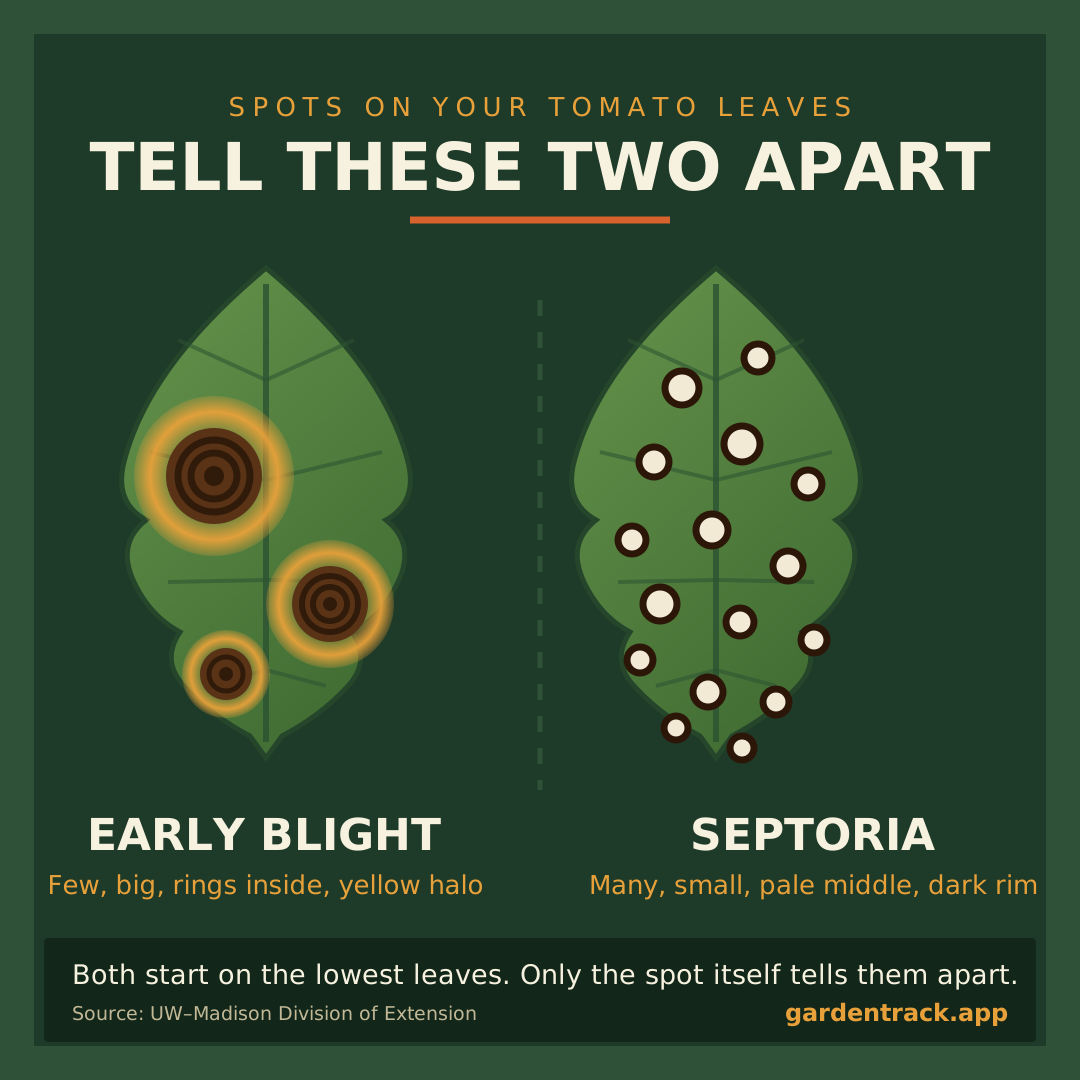
University of Wisconsin Horticulture describes early blight as "roughly circular, brown spots" that develop "concentric rings," giving them a "target-like appearance," often with "a yellow halo" around the spot. If you can see rings inside the spot, stop. You have your answer.
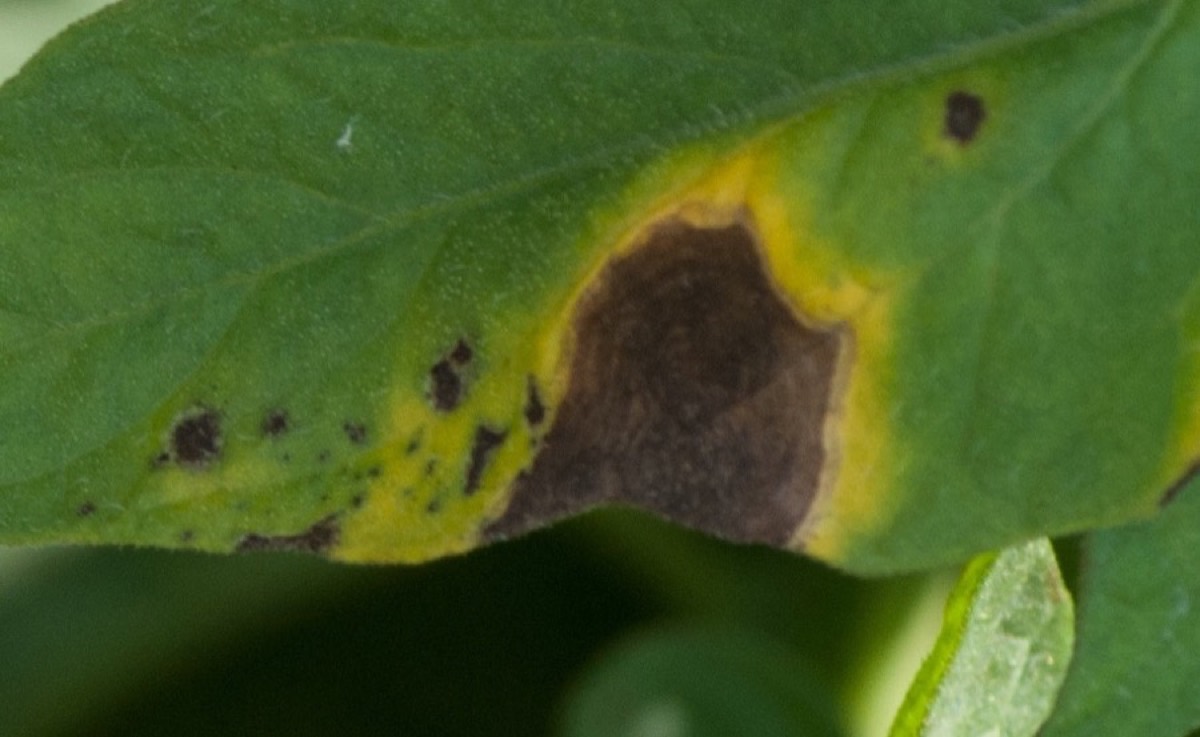
It starts at the bottom. Wisconsin notes symptoms "first appear at the base of affected plants" and that the disease gets going as "plant canopies start to close" — in other words, once the plant is big enough that the lower leaves stop drying out quickly after rain. Left alone it can cause "total defoliation of lower leaves."
What to do. Pick the spotted leaves off and bin them. Not the compost heap — the spores sit there all winter waiting for next year's plants. Then open the thing up so air moves through it: Wisconsin recommends thinning plants or taking branches off, wider spacing, and about an inch of mulch so rain stops splashing soil up onto the lowest leaves. And water at the base. Overhead watering keeps the leaves wet. That is the one condition it needs.
If you want to spray. Wisconsin names two active ingredients labeled for vegetables: copper or chlorothalonil. Read the label on whatever product you buy and follow its rate and its pre-harvest interval — that's the number of days you must wait between spraying and picking, and it's on every label. One honest warning from the same source: "once symptoms of early blight appear, control is difficult." Sprays work best before you see anything, which is cold comfort if you're reading this because you already see something. If it's already through the lower third of the plant, removing leaves and improving airflow is the better use of your afternoon.
Small spots with pale centers: Septoria leaf spot
The other common spotting disease. It is the one most often mistaken for early blight. Wisconsin Horticulture describes "small (approximately ¼ inch diameter) spots" on leaves and stems that "typically have a whitish center and a dark border."
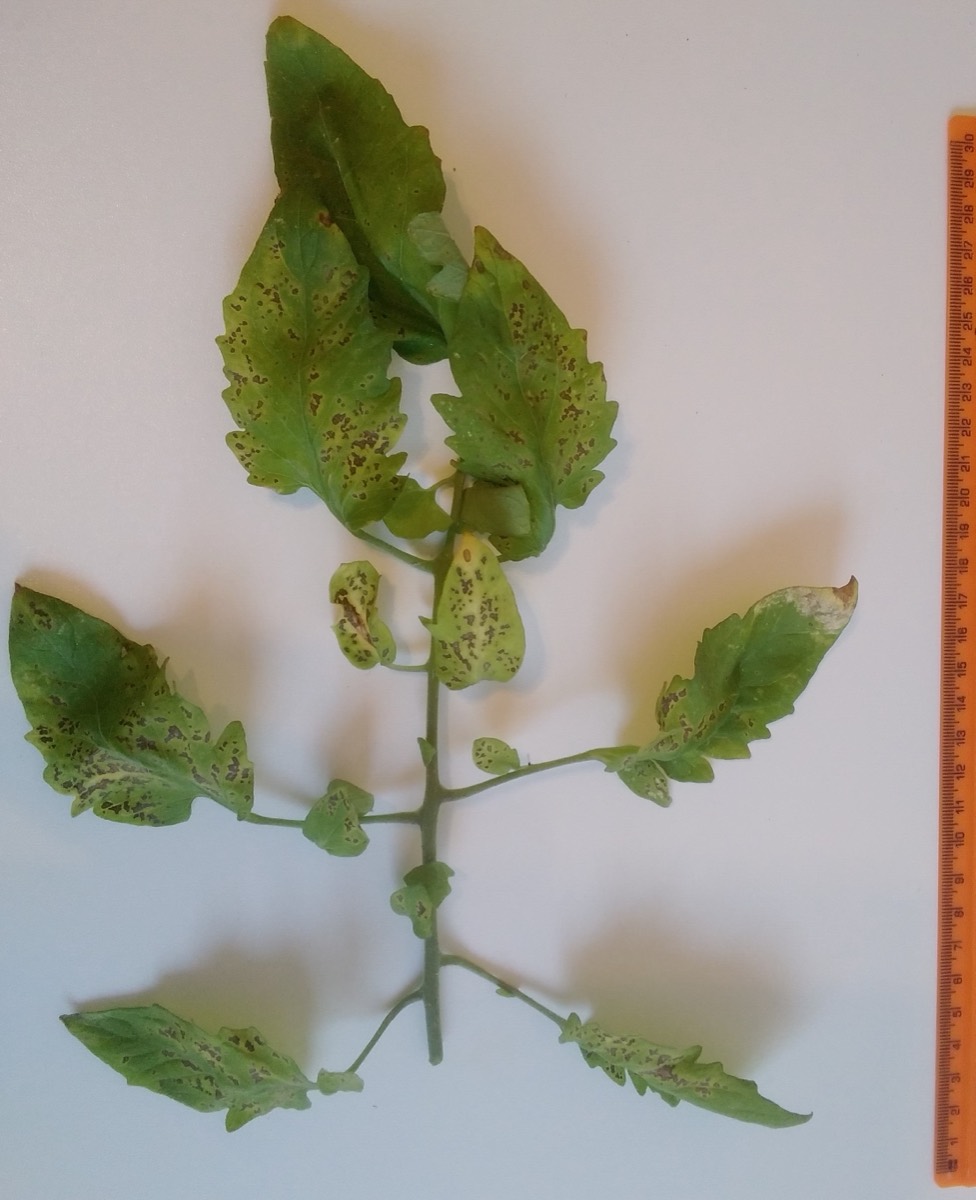
That's the whole distinction, and it's worth getting right because it's easy: early blight spots have rings inside them; Septoria spots have a pale middle and a dark rim, and they're small and numerous. Septoria also starts at the base of the plant and also gets going as the canopy closes, so location won't separate them — only the look of the spot will.
What to do. The same things, which is the good news: strip the affected leaves, improve airflow, mulch, water low, rotate where you plant tomatoes next year, and clear the debris at the end of the season. The same two active ingredients apply — copper or chlorothalonil — with the same caveat that they're preventative by nature.
No spots at all
If you've turned the leaf over, held it to the light, and there's genuinely nothing on it but yellow, you're looking at a feeding, watering or vascular problem rather than a leaf disease.
One thing to separate out before you go further: if the plant has also stopped setting fruit during a hot spell, that part is a heat problem with its own explanation, and it's covered in why tomato flowers fall off. We're not claiming the heat caused the yellow leaves — we couldn't find a source saying that — only that a plant can have two things going on at once, and blossom drop in a heat wave is the more likely reason the fruit stopped. Our tomato plant page has the conditions this crop wants if you want to check the basics first.
Evenly pale at the bottom, green at the top — nitrogen
UC Integrated Pest Management puts it plainly: "older leaves or needles become uniformly pale green to yellowish when nitrogen is deficient," while "new growth is sparse and undersized but is usually green."
Two words in there are doing the work. Uniformly — the whole leaf fades together, rather than going patchy or spotted. And older — it's the bottom of the plant, because the plant is robbing its old leaves to feed the new ones and the fruit.
What to do. Feed it. A balanced vegetable fertilizer at the rate on its label will do; there's no need for anything exotic. One caution worth having, from University of Minnesota Extension: "too much nitrogen fertilization will lead to plants that are bushy, leafy, and slow to bear fruit." If your plant is huge, dark green up top and only slightly pale at the very bottom, it doesn't need feeding — it's doing what a heavily fruiting tomato does.
Yellow wedges from the leaf edge — Verticillium wilt
This one has a shape you can recognize. UC IPM describes it exactly: "older leaves on tomato plants infected with Verticillium appear as yellow, V-shaped areas that narrow from the margin." The wedge is widest at the edge of the leaf and points inward. "The leaf progressively turns from yellow to brown and eventually dies."
There's a second check that settles it. Cut through the main stem low down and look at the cut face: with Verticillium, "a light tan discoloration develops in the vascular tissue, especially near the base of the plant." Healthy tomato stem is uniformly pale green-white inside. A tan or brown ring in there's the disease.
What to do, honestly: there's no spray for this one. It is a soil fungus. It gets in through the roots and blocks the plumbing. Nothing you put on the leaves reaches it. Keep the plant watered and fed and you'll usually still get a crop, just a smaller one. The real decisions are for next season: don't plant tomatoes, peppers, eggplant or potatoes in that spot, and buy varieties whose tag carries a V, which is the standard code for Verticillium resistance.
Both of those controls — rotating the bed and buying resistant varieties — have to be decided a season ahead rather than in the moment, which is the frustrating part of this diagnosis. If you're re-planning where things go next year, the frost date lookup gives you the planting window for your exact spot rather than your region.
New growth at the top, veins still green — iron or manganese
The opposite pattern. Much less common in a vegetable bed. UC IPM: "new broadleaf foliage is undersized and yellow to whitish, except for green along the veins when iron or manganese or both are deficient." The leaf looks like a green skeleton on a yellow background.
This is usually not an empty soil — it's a soil too alkaline for the plant to take the iron up. UC IPM notes it commonly occurs in high-pH conditions. So adding iron to the ground often does nothing. A soil test through your county extension office is the cheap next step. Do that first. You are fixing the pH. A bag of fertilizer will not move it.
Work it out on your own plant, in order
Five minutes, one plant, almost no equipment. Work down the list in order — steps 1 to 6 narrow it to a cause, and step 7 decides whether it's worth doing anything about, which is worth reading whatever you landed on.
- Find which end of the plant is affected. Stand back and look at the whole plant. Is the yellow at the bottom, or is it the new growth at the top? Yellow at the top with green veins is an iron or manganese problem and the rest of this list doesn't apply. Everything else starts at the bottom.
- Pick a yellow leaf and look at it against the light. Take one leaf that's yellow but not yet dead — a fully dead brown leaf has lost the evidence. Hold it up so light comes through. Look at both sides.
- Decide whether there are spots on it, or not. This single question splits the whole problem in two. Spots mean a leaf disease. No spots means feeding, water, or a wilt.
- If there are spots, look inside one. Rings within the spot, like a shooting target, often with a yellow ring around the outside: early blight. Small spots about a quarter-inch across with a pale middle and a dark edge: Septoria leaf spot.
- If there are no spots, look at the shape of the yellow. A wedge of yellow that's widest at the leaf edge and narrows inward points to Verticillium wilt. Yellow spread evenly across the whole leaf. That is nitrogen.
- If you suspect a wilt, cut a low side branch — not the main stem. Take a lower side branch off where it joins the main stem, and look at the cut face. Don't cut through the main stem itself: that kills the plant, and a plant with Verticillium will usually still give you a crop. A healthy tomato stem is pale green-white all the way through. A tan or brown ring inside the cut confirms a vascular wilt, and no spray reaches it — plan for next season instead.
- Check how much of the plant is involved before you act. A few yellow leaves at the very bottom of a plant loaded with fruit isn't an emergency. Yellowing moving steadily up past the lower third is. Match the size of your response to how far it has actually got.
Do this in the morning if you can. Tomato plants often wilt a little in afternoon heat and perk up by evening, and that temporary droop can look alarming when nothing is wrong.
What we couldn't find a source for
A great deal of gardening advice online says the bottom leaves of a tomato yellowing is simply old age, and nothing to worry about. That may well be true — leaves do age, and a plant carrying a heavy crop does pull nutrients out of its oldest foliage to fill the fruit.
But we went looking for a university extension source that says it about tomatoes, and we couldn't find one. We checked three guides written for exactly this question — University of Minnesota Extension's tomato disorders guide, Penn State Extension's tomato diseases and disorders guide, and University of Illinois Extension's tomato problems article. None of the three describes yellowing lower leaves as a normal stage of a tomato's life. What they describe instead are the causes above.
We're telling you that rather than quietly leaving it out, because it cuts against advice you've probably already read. Our reading of it: on tomatoes specifically, the lower leaves are also exactly where early blight and Septoria start, so "it is just age" is a comfortable answer that happens to look identical to the first two diseases Penn State's guide lists. Check the leaf for spots before you accept it. If there are genuinely no spots, no wedges, and the plant is cropping well, then a few pale leaves at the very bottom aren't worth losing an evening over.
If you find an extension source that addresses it directly, we would genuinely like to see it — we will add it and say where it came from.
One reason we can afford to end a page with your plant is probably fine: there's nothing for sale at the bottom of it. We don't sell fungicide, we don't sell fertilizer, and a page that talks you out of buying something costs us nothing. Whether that's true of everything else you read this week is worth keeping in mind, but it's a question about incentives generally and not an accusation about anyone in particular.
Questions about yellow tomato leaves
Why are my tomato plant leaves turning yellow?
There are five common causes and the yellow alone can't tell them apart. Look for what else is on the leaf. Brown spots with rings inside them are early blight. Small spots with a whitish center and dark border are Septoria leaf spot. No spots with even yellowing on the lowest leaves points to a nitrogen shortage. Yellow V-shaped wedges narrowing in from the leaf edge suggest Verticillium wilt. Yellow new growth at the top with green veins is an iron or manganese problem.
Should I remove yellow leaves from my tomato plant?
If they're spotted, yes — take them off and bin them rather than composting them, because both early blight and Septoria overwinter on plant debris. Removing lower leaves also opens the plant up so air moves through it, which is a recommended control for both diseases. If the leaves are yellow with no spots at all, removing them doesn't fix anything; find the cause first.
Is it normal for the bottom leaves of a tomato plant to turn yellow?
It's very commonly said, but we couldn't find a university extension source stating it about tomatoes, and we checked four. What the extension literature describes for yellowing lower tomato leaves is early blight, Septoria leaf spot, nitrogen shortage or a vascular wilt. Since the lowest leaves are exactly where the two common diseases start, check for spots before accepting that it's just age.
What's the difference between early blight and Septoria leaf spot?
Look inside the spot. Early blight makes roughly circular brown spots with concentric rings that give a target-like appearance, often with a yellow halo. Septoria makes smaller spots, around a quarter-inch across, with a whitish center and a dark border. Both start at the base of the plant, both get going as the canopy closes, and both are managed the same way, so telling them apart matters less than catching either one early.
Can I save a tomato plant with Verticillium wilt?
You can usually still get a crop off it, but you can't cure it. Verticillium is a soil fungus that enters through the roots and blocks the plant's water-carrying tissue, so nothing sprayed on the leaves reaches it. Keep the plant watered and fed and harvest what you get. For next year, avoid planting tomatoes, peppers, eggplant or potatoes in that spot and choose varieties whose tag includes a V for Verticillium resistance.
Will yellow leaves turn green again?
Generally no. A leaf that has lost its chlorophyll doesn't usually recover, even once you fix the cause. What tells you a fix is working is the new growth coming in green and the yellowing stopping where it is, rather than the old leaves changing back. Judge it by whether the problem is still climbing the plant. The leaves that already went are gone either way.
Sources
Every planting date, depth, and temperature on this page traces to these university extension guides. Where they differ, the ranges above hold the whole spread.
- University of Wisconsin–Madison Division of Extension — Early Blight
- University of Wisconsin–Madison Division of Extension — Septoria Leaf Spot
- University of California Statewide Integrated Pest Management Program — Common Nutrient Deficiency Symptoms
- University of California Statewide Integrated Pest Management Program — Verticillium Wilt — Tomato
- Penn State Extension — Tomato Diseases and Disorders in the Home Garden
- University of Minnesota Extension — Growing tomatoes in home gardens
GardenTrack keeps a record of every plant in your garden and where it's standing, so when something looks wrong you're not starting from scratch — you can see what this bed did last year, what went in before it, and whether the same thing happened at the same time last season.
That history is the part no guide can give you, because it's about your ground. Have a look at what it does.
.jpg)
.jpg)