

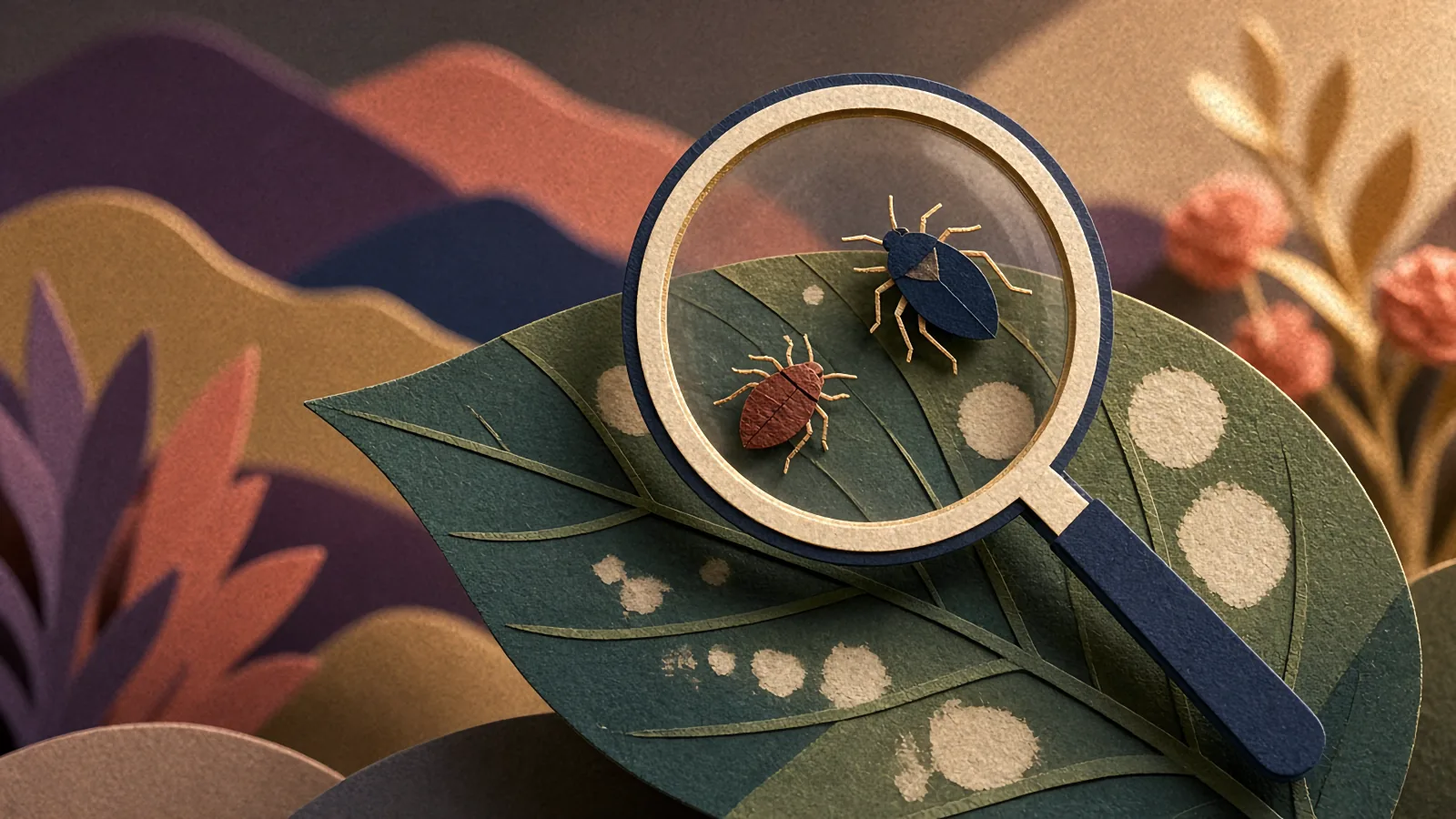
They're too small to see — about one fiftieth of an inch. What you see is the damage: fine pale speckling, like the leaf's been sanded. Confirm it by shaking a leaf over white paper and watching for specks that walk. Then check the color: green streaks are the pest, orange ones are eating it.
You will not see the mite, so read the leaf
This is a page about the garden — the beds, the rows, the fruit. Spider mites are also the great houseplant villain, and if yours is a monstera on a windowsill, Colorado State has a section written for exactly that. What follows is for the forty-six outdoor crops we hold this pest on.
Minnesota puts the twospotted spider mite at about one fiftieth of an inch long, yellow-orange with two dark spots, one on each side of the body. At that size you are not going to spot one while you are watering. You will spot the leaf.
The first sign is fine pale flecking — Minnesota calls it a "stippled or mottled appearance" — as though someone went over the leaf with very fine sandpaper. Let it run and the leaf goes "bronzed or bleached", and then it drops.
Webbing is the late sign, not the first one, and half the internet has this backwards. Minnesota: "Webbing indicates a spider mite infestation." By the time you are looking at webs you have a heavy population, not an early warning — and Colorado State adds that the webbing itself "gives the mites and their eggs some protection from natural enemies", so it is working against you twice.
Two tests, and the second one matters more
The first test tells you something is there. The second tells you whether to leave it alone — and almost nobody publishes it.
- Hold white paper under a suspect leaf and shake it. Pale speckling on a leaf has a dozen causes. This one has a tell: knock the leaf against a sheet of white paper and watch. Dust sits still. Mites walk.
- Streak the specks with your finger. Ohio State gives the test that separates them: wipe the specks across the paper with a fingertip and look at the smear. Green is a plant feeder — the pest. Yellow or orange means you are most likely looking at a predator, and killing it is the worst thing you could do next.
- Count before you act. Ohio State puts a number on it rather than leaving it to nerve: ten or more per sample, commonly, is the point at which control is probably warranted. Fewer than that, on a plant with predators walking around on it, is a situation that may well sort itself out.
The predators are worth knowing by sight, because you are about to spend the rest of this page protecting them — the same crew that does most of the work on aphids. Colorado State's list: "small lady beetles, predatory mites, minute pirate bugs, big-eyed bugs, and predatory thrips."
Why the obvious spray often makes it worse
This is the same shape as the Japanese beetle trap, where the obvious purchase is the mistake. Two extension services say the spray can make it worse, and a third says the ordinary bottle does not work on mites in the first place. Those are different claims and the page keeps them apart.
University of Minnesota, on the long-lasting insecticides: "Long-lasting insecticides, such as bifenthrin and permethrin can be used on twospotted spider infestations." And then the catch, in the same breath — "However, these insecticides also kill natural enemies and could possibly make infestations worse in the long run."
Colorado State, independently and more bluntly: "One reason that spider mites become problems in yards and gardens is the use of insecticides that destroy their natural enemies." Also: "Few insecticides are effective for spider mites and many even aggravate problems."
Ohio State adds the thing nobody mentions on the shelf: "Spider mites are usually not killed by regular insecticides, so be sure to check the pesticide label to see if the designation "miticide" is present." So the ordinary bottle may do nothing to the mites at all — while doing plenty to everything that was eating them.
Colorado State is the only page on this subject we could find that names names, and all three are named as causes. Carbaryl, sold as Sevin, "devastates most spider mite natural enemies and can greatly contribute to spider mite outbreaks." Malathion "can aggravate some spider mite problems, despite being advertised frequently as effective for mite control." And soil applications of imidacloprid, sold as Merit or Marathon, "have also contributed to some spider mite outbreaks."
We are not recommending a product and there is not a rate or a label instruction anywhere on this page. Those three are named because the sources name them as causes. That is a warning, and it is a different act from a recommendation.
Three products, named by the sources as causes
Colorado State is the only page on this subject we could find that names names. All three of these are stated as things that have made spider mite problems worse, not as things to use.
| What it is sold as | What the source actually says | Who says it |
|---|---|---|
| Carbaryl (Sevin) | Named as devastating most of the mites' natural enemies and greatly contributing to outbreaks. | Colorado State |
| Malathion | Named as aggravating some mite problems, despite being widely advertised as a mite control. | Colorado State |
| Imidacloprid (Merit, Marathon) | Soil applications named as having contributed to outbreaks. | Colorado State |
| Bifenthrin, permethrin | Usable against mites, but named as killing natural enemies and possibly worsening things long term. | Minnesota |
| Products sold for mite suppression | Described as usually weak miticides that will not perform well. | Ohio State |
And they get resistant
Colorado State: "strains of spider mites resistant to pesticides frequently develop, making control difficult." Ohio State turns that into a rule you can actually use — if a miticide has been used correctly and the population is not controlled within five to seven days, "do not use the same miticide!" Switch to a different mode of action, because you are probably looking at a resistant population and a second dose of the same thing only removes more of the predators.
What actually works, and it starts with a hose
Water. Genuinely. Ohio State: "Since rainy weather seems to knock off spider mites, using a forceful jet of water from a hose (syringing) can perform the same task. Regular syringing can keep spider mites under control on most ornamental plants in the landscape."
And the reason it is the first thing to try rather than the cheap thing to try: "This technique also helps conserve natural predators." It is the only control on this page that works on both sides of the problem — it takes mites off and leaves the things that eat them in place. Minnesota says the same: "Use a high-pressure water spray to dislodge twospotted spider mites."
Soaps and oils next, and the hedging is the sources' own. Minnesota: "Soaps and horticultural oils are reasonably effective against mites." Colorado State is more precise and less encouraging — used at the summer-oil rate, oils are "perhaps the most effective miticide available for home use", while insecticidal soap is "Marginally effective against twospotted spider mite and where webbing prevents penetration."
Both work on contact only, which is why coverage decides everything. Ohio State: "mites are very tiny and soaps and oils work by contact only. Therefore, thorough coverage of the plant upper and lower leaf surface is necessary for good control." Undersides. That is where they live and that is where the spray misses.
Why hot and dry is when they turn up
Minnesota ties them to "hot, dry summer weather", which everyone repeats. Colorado State explains it, which nobody does.
Dry weather helps the mite twice over. First, directly: "They feed more under dry conditions, as the lower humidity allows them to evaporate excess water they excrete." Second, and this is the half that matters — "At the same time, most of their natural enemies require more humid conditions and are stressed by arid conditions."
So a hot dry spell speeds the pest up and slows its predators down at the same moment, which is why an outbreak seems to arrive from nowhere in the third week of a heatwave. Colorado State adds a third strand: "plants stressed by drought can produce changes in their chemistry" that feed into it too.
The practical read: a dry stretch of two weeks is the time to go looking, not the time to wait for webs. And keeping the plants watered is doing more than keeping them alive — Colorado State puts it as "Adequate watering of plants during dry conditions can limit the importance of drought stress on spider mite outbreaks."
Spider mite questions people actually ask
What kills spider mites instantly on plants?
Nothing you should reach for. A forceful jet of water knocks them off immediately and, unlike a spray, leaves their predators alive. Ohio State recommends it outright. The instant-kill products are the ones three extension services name as making outbreaks worse, which is a slow problem bought with a fast fix.
Can a plant recover from spider mites?
Often, yes. Minnesota describes the progression as stippling first, then bronzed or bleached leaves, then leaf drop — so the earlier you are in that sequence the better. Leaves already speckled will stay speckled; what recovers is the plant, through new growth, once the population is down.
Does Dawn dish soap kill spider mites?
Insecticidal soap is a real control, and Colorado State rates it honestly: marginally effective against twospotted spider mite, and worse where webbing blocks it. Dish detergent is a different product, and our sources say nothing about it either way. If you want the soap route, buy the one sold and labeled for the job.
How to get rid of spider mites permanently?
You do not. They arrive on the weather and on new plants, and resistant strains develop, which Colorado State says happens frequently. What you can do is keep the predators alive and check during hot dry spells — that turns a recurring disaster into a recurring inconvenience.
Sources
Every planting date, depth, and temperature on this page traces to these university extension guides. Where they differ, the ranges above hold the whole spread.
- University of Minnesota Extension — Twospotted spider mites in home gardens
- Colorado State University Extension — Spider Mites
- Ohio State University Extension — Spider Mites and Their Control
We are building GardenTrack to know what is in your garden and to put a leaf check on Today while it grows — and the free app is open now.