

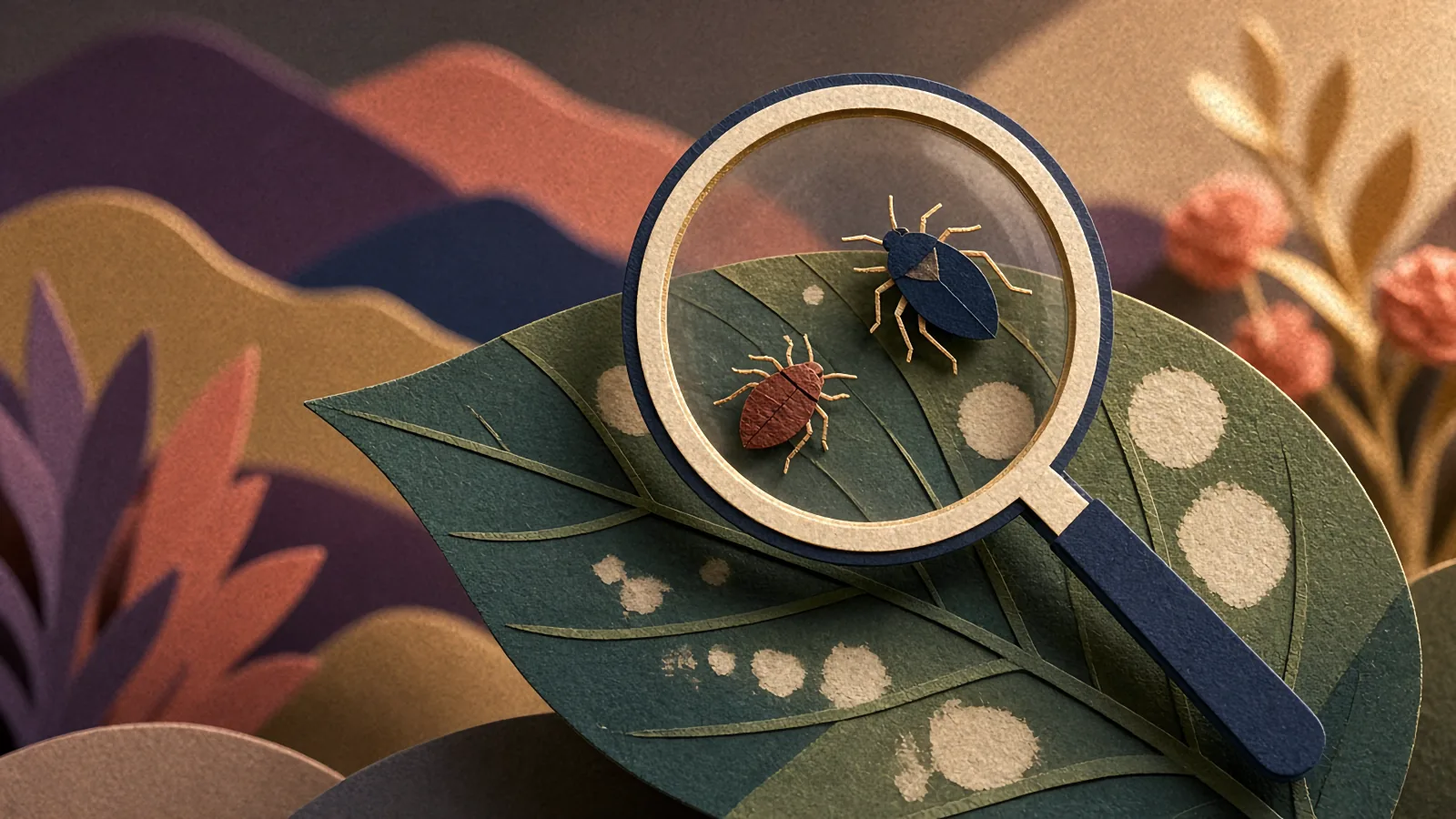
Look at the back end. Every aphid has two tiny tailpipes sticking out of it, and nothing else on your plants does. Then look again before you spray: Minnesota says most aphid populations do little or no damage and can be ignored. If you do act, a hose knocks them off and few ever get back.
Two tailpipes, and that is the identification
"Small green bugs on my plants" describes about fifty insects. Here is the one that only describes this one.
University of Wisconsin: "all aphids are soft-bodied and pear-shaped with a pair of cornicles (tailpipe-like structures) projecting from the rear end of their abdomen." Two little exhaust pipes at the back end. Minnesota uses the same feature and puts it more bluntly still, in a photo caption: "All aphids have tailpipes".
Color will not help you and you should stop trying. The species run green, black, pink, gray and woolly white, and Wisconsin notes that "Adult aphids may or may not be winged", so wings do not settle it either. Size is small and that is all our sources will commit to. The cornicles are the check.
One more thing you will see and probably misread. Minnesota: "Aphids shed their exoskeletons (skins) as they grow. These white cast skins can be found on leaves or stuck in honeydew secretions of the aphid." Little white flecks that look like a second problem are usually the same problem's laundry.
You will usually find the mess before you find the insect
Aphids "excrete a sugary substance (called honeydew) that can attract ants as well as support the growth of a saprophytic fungus", as Wisconsin puts it. Which is why the first sign is often not an insect at all — and why a line of ants marching up a stem is worth following to the top.
Wisconsin: "in some cases, the presence of honeydew or sooty mold is the primary indication of an aphid outbreak." Sticky leaves first, then a black film growing on the stickiness. The sooty mold is a fungus living on the sugar — it is not attacking the plant, it is eating the spill, which is why treating the mold is the wrong end of the problem.
The plant-side symptoms are less specific. Wisconsin lists "reduced plant vigor, stunting, and deformation of plant parts", and Colorado State adds that "Some aphid species can curl the new leaves of some types of plant." Curled new growth with something sticky under it is about as close to a giveaway as the damage gets.
Where to look, and how many to look at
Wisconsin publishes an actual scouting protocol rather than telling you to keep an eye out. It takes about two minutes.
- Go to the growing tips. Aphids feed on the softest tissue, so the newest growth at the end of each shoot is where a population starts and where it is densest. If they are anywhere, they are there.
- Check fifteen plants in a row. Wisconsin's instruction is to examine the terminals of 15 consecutive plants. Consecutive matters — picking the fifteen that look worst tells you about your eye, not about the planting.
- Turn the leaf over. Undersides, every time. It is where they sit, and it is also the surface a spray misses if you ever get that far.
Do this on a schedule you can keep rather than when something looks wrong. By the time a plant looks wrong you are past the point where the easy answers work.
Most of the time, do nothing
This is the part the rest of the internet will not tell you, and it is not our opinion. University of Minnesota Extension: "In most cases, aphids cause little to no damage to plants and can be ignored."
Read the scope, because it is doing work. In most cases. Not all — and the last section of this page is the exception. But the default that a state extension service publishes is the opposite of the default the search results give you.
Why it holds: something is already eating them. It is the same argument as the one about spider mites, where the sprays people reach for take the predators out first. All three of our sources name the same crew. Wisconsin: "predators such as ladybird beetle adults and larvae, green lacewing larvae, syrphid fly larvae, and several parasitic wasps all help reduce aphid numbers." Colorado State: "Natural enemies of aphids include lady beetles, flower fly larvae, lacewing larvae, and parasitic wasps." Minnesota names the same four groups again.
And the weather does a share of it. Minnesota: "Aphids are not strong insects and even a good rainstorm can knock them off. You may notice more aphids in seasons with lighter rain." A dry summer is not bringing aphids in — it is failing to wash them off.
When you do act, start with a hose
If the population is heavy on new growth, or it is a young plant that cannot spare the vigor, there is a first move and it costs nothing.
Colorado State: "On shrubs and garden plants, aphids can sometimes be managed by simply washing them off of plants with a forceful jet of water." And then the sentence that makes it worth doing rather than a token gesture — "Hosing plants may lethally injure aphids and very few surviving aphids that are knocked to the ground can successfully find their way back onto their host plant."
A knocked-off aphid mostly does not come back. That is the whole reason this works, it is the thing no kill-page mentions, and it is also why a hose does not take the predators out of your garden the way a spray does.
If you go further, the sources are consistent and unexcited. Minnesota: "Insecticidal soap, horticultural oil and pyrethrins can be effective at controlling aphids." With the catch, in their words: "These materials will only kill aphids that they come in contact with." So coverage is everything — "Remember to spray the underside of leaves as well as the top" — and "Repeat applications may be needed."
This is also why the beetle trap that seems to work is worth reading about — the same instinct, the same result. We are not printing a recipe, a rate or a homemade mixture. That is the thing this whole results page competes on and it is the thing we are least able to check for where you live.
The damage that outlasts the insect
Here is the honest limit on everything above, and it gets a heading rather than a footnote because it deserves one.
Wisconsin: aphids are "excellent vectors of several virus diseases such as a group of mosaic viruses that infect a wide host range." The aphid leaves. The virus does not. An aphid can pick one up on a neighbor's plant, feed briefly on yours, and be gone before you would ever have found it — and no amount of hosing afterwards undoes that.
Which is why "can be ignored" is a default rather than a rule. On a mature plant carrying a light population with predators working, ignoring them is genuinely the right call. On seedlings, on new growth, and on anything you are growing for a crop rather than for looks, the calculation is different — and it is different because of the virus, not because of the feeding.
We are not going to put a number on that risk. Our source names the mechanism and not a rate, and a rate is exactly the kind of figure that varies by region and by year.
Aphid questions people actually ask
Will Dawn dish soap kill aphids?
Insecticidal soap is a real control and Minnesota lists it as effective. Dish detergent is a different product, and none of our sources say anything about it either way. If you want the soap route, buy the one sold and labeled for the job rather than improvising with something meant for plates.
What is the best homemade aphid spray?
We are not going to give you one. The best-tested thing that costs nothing is a forceful jet of water, which Colorado State recommends and explains: knocked-off aphids rarely find their way back. Beyond that, the products our sources name are ones you buy, and they name no homemade mixture at all.
How do you kill aphids but not plants?
Start with water, which cannot hurt the plant. If you go further, Minnesota's caveat is the one that matters: soaps, oils and pyrethrins only kill what they touch, so cover the undersides, and expect to repeat. The bigger risk is not the plant — it is the predators already eating the aphids for you.
What do aphids hate the most?
Their predators, and rain. Lady beetles, lacewing larvae, syrphid fly larvae and parasitic wasps are named by all three extension services we used, in those words or close to them. Minnesota adds that aphids are weak insects a good rainstorm knocks off — which is why you notice more of them in a dry season.
Sources
Every planting date, depth, and temperature on this page traces to these university extension guides. Where they differ, the ranges above hold the whole spread.
- University of Wisconsin–Madison Division of Extension — Aphids
- University of Minnesota Extension — Aphids in home gardens
- Colorado State University Extension — Aphids
We are building GardenTrack to know what is growing in your garden and which pests usually turn up on it, so its leaf checks know what to look for — and the free app is open now.