


Look at the shape of the yellow. Patches with straight edges that stop dead at the leaf veins mean downy mildew or angular leaf spot — turn a leaf over, because purplish-gray fuzz means downy mildew and there is no home spray for it, while sticky whitish drops mean the bacterial one. If leaves wilt in the afternoon and look fine again by morning, that is bacterial wilt. Pale stippling with fine webbing underneath is spider mites.
Cucumbers give you a shape no other crop does
Most yellowing is a blur — it fades in from an edge or spreads out from a spot. Cucumbers give you something better than a blur: a shape with straight edges, which you can read from six feet away and which cuts a long list of causes down to two.
Downy mildew makes patches with straight edges. University of Minnesota Extension describes the spots as "angular and bounded by leaf veins," and adds that this is "most distinct in cucumbers." The infection can't cross a vein, so instead of a round blotch you get blocky patches that look almost like they were masked off — little yellow tiles between the veins.
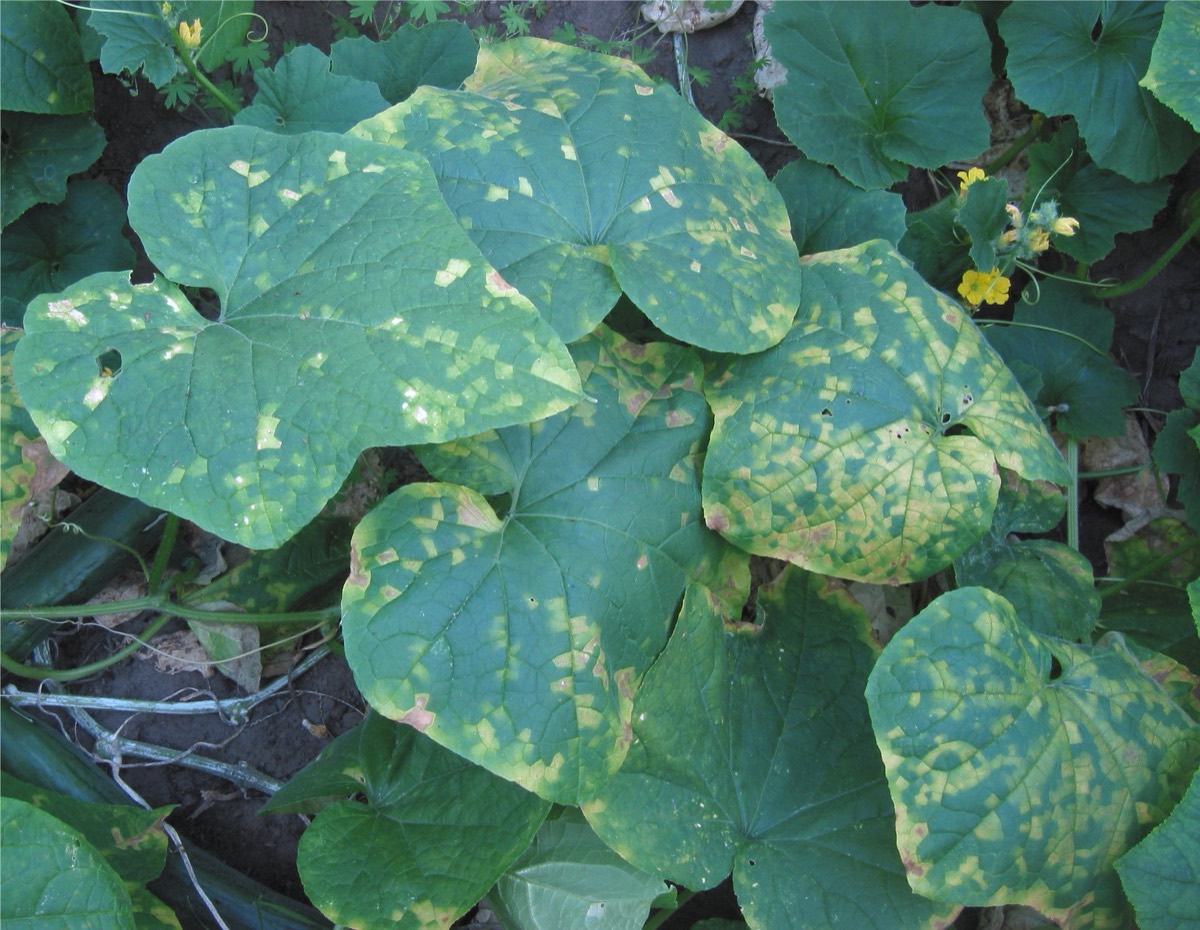
Straight sides narrow it to two, not to one — and this is where most pages stop too early. Angular leaf spot is a bacterial disease named for doing the same thing: Minnesota describes "small, angular, brown or straw-colored spots with a yellow halo," and says the spots are "typically confined within leaf veins." Same tiles, different organism.
Turn the leaf over. That is what decides it, because Minnesota describes a different thing on the underside of each. Downy mildew: "dark purplish-grey fuzz forms on the underside of the leaf." Angular leaf spot: "sticky drops of whitish liquid form on the underside of the leaf when wet, dry to a crust when dry." Fuzz or drops — that is the whole test, and you need no lens for it.
There is a second sign that arrives later. Angular leaf spot's spots "dry and drop out, leaving irregularly shaped holes in the leaves." If your straight-edged patches have started turning into actual holes, that is the bacterial one.
So before anything else: are the yellow areas round and soft-edged, or angular with straight sides? Round and soft-edged sends you to the table below. Straight-sided means you have two candidates and one more thing to check — and on a cucumber specifically, downy mildew is the better first guess, because Minnesota notes angular leaf spot "is less common on cucumber due to the availability of resistant varieties."
The cucumber differential
University of Minnesota's diagnostic tool lists nine causes of discolored cucumber leaves. Read that list. These are the ones you can actually tell apart by looking, with their own descriptions. One row is not from that tool — angular leaf spot, which the cucumber diagnostic does not carry, and which we added because it makes the same straight-edged patches downy mildew does. It is quoted from Minnesota's own page for it.
| What you see | Most likely cause | The tell |
|---|---|---|
| Angular yellow patches with straight edges, purplish-gray fuzz underneath | Downy mildew | Spots "angular and bounded by leaf veins" — the FUZZ underneath separates it from the row below |
| Angular brown or straw-colored spots with a yellow halo, sticky whitish drops underneath when wet, holes later | Angular leaf spot | Spots "typically confined within leaf veins" too — the underside has "sticky drops of whitish liquid" rather than fuzz, and spots later "drop out, leaving irregularly shaped holes" |
| Leaves wilt in the afternoon and look fine again in the morning | Bacterial wilt | "Leaves first appear dull green, wilt during the day, and recover at night" |
| Pale yellow spots starting on the oldest leaves, white dusty coating | Powdery mildew | "Initially pale yellow spots develop on the oldest leaves" |
| Leaves look pale and finely speckled, fine webbing underneath | Spider mites | "Feeding on the underside of leaves causes leaves to appear pale and stippled" |
| Blotchy, wavy mix of yellow and green, leaves often distorted | A virus | "Irregular, blotchy to wavy patterns of yellows and greens" |
| Yellowing and wilting, with insects or their eggs on leaf undersides | Squash bugs or aphids | You can find the insect — the others on this list have no insect to find |
| One vine suddenly yellow and collapsing, hole and sawdust near the base | Squash vine borer | "Feeding by larvae causes yellowing of leaves and wilting" |
| Leaf edges going olive-green to brown after a cold snap | Cold damage | "Leaf edges turn olive green to brown" — and it follows a cold night |
One thing worth noticing about that list
Minnesota's cucumber page doesn't list nutrient deficiency at all. Nine causes, and not one of them is hunger.
We're pointing that out because feed it is the most common piece of advice given for a yellow cucumber, and the extension diagnostic for this exact symptom doesn't include it. That doesn't prove a cucumber is never short of nitrogen. It does mean that reaching for fertilizer before you've ruled out the causes in the table above is working from the wrong list.
Downy mildew, and the honest bad news
This is the one that ends cucumber seasons. Worth being precise about. Minnesota: "Pale green to yellow spots form on the upper surface of leaves, and later turn brown." The spots are angular and stop at the veins. Turn the leaf over and in humid weather you'll find the confirmation — "dark purplish-grey fuzz forms on the underside of the leaf." As it runs, "leaf spots grow together, and entire leaves turn brown."
It likes exactly the conditions a good cucumber summer provides. That is the trouble. It can infect "in a wide range of temperatures (41-86° F) but is most severe from 59-68° F," and critically, "the pathogen needs moisture on the leaf surface in order to germinate and start a new infection." Wet leaves are the whole mechanism.
Now the part most pages won't tell you. Minnesota states it plainly: "There are no effective pesticide products for downy mildew available to home gardeners." Not that they're hard to find or need care — there are none that work for you.
So everything useful here's about keeping leaves dry and air moving: drip irrigation rather than a sprinkler, wide spacing, trellising the vines so air gets through, and pulling badly diseased plants. Choosing a resistant variety next year does more than anything you can do this year. If somebody sells you a fungicide for downy mildew on a home cucumber patch, that's the claim to be skeptical about.
The wilt test you can do without touching the plant
Bacterial wilt has the most convenient symptom in gardening, because the plant tells you on a schedule. Minnesota: "leaves first appear dull green, wilt during the day, and recover at night."
So look in the evening, then look again first thing. A plant that's flat at 4pm and standing up at 8am isn't thirsty and isn't sunburnt — that daily recovery is the signature. As it progresses the recovery stops. The vine stays down.
If you find the insects themselves rather than just the damage, our squash bug guide covers the one that most often turns up on cucumbers and why the adults are the wrong stage to spray.
It's spread by cucumber beetles, which is why it turns up on plants that had beetle damage earlier in the season. There's no cure once a plant has it. What that changes is your priorities: it makes beetle control early in the season the thing that matters, and it means a wilting plant isn't worth spraying a fungicide at.
Don't confuse it with the ordinary midday flop. Big-leaved plants do that in heat. The difference is that a heat-flopped cucumber perks up within an hour or two of shade or evening, every day, all season, and looks completely normal the rest of the time. Bacterial wilt gets worse week on week.
Work it out on your plant
Four minutes, in this order. The first question eliminates the most.
- Look at the edges of the yellow. Straight-sided, blocky patches that stop at the veins mean downy mildew or angular leaf spot — turn a leaf over to tell which, then skip the rest of this list. Soft, round or fading edges mean something else.
- Turn a leaf over. Purplish-gray fuzz confirms downy mildew. Fine webbing with tiny moving specks means spider mites. Clusters of insects or eggs means squash bugs or aphids, and you've found your answer by finding the animal.
- Check the plant twice, evening and morning. If it wilts through the afternoon and stands back up overnight, that is the wilt. This costs you nothing but a second look and it rules in or out the one problem that has no cure.
- Look at the base of the stem. A single vine collapsing while the rest of the plant is fine, with a ragged hole near soil level and what looks like damp sawdust around it, is a squash vine borer inside the stem rather than anything happening on the leaves.
- Ask what the weather did. Olive-green to brown leaf edges that appeared after a cold night are cold damage and need nothing from you. Cucumbers dislike cold far more than most summer crops do.
- Only then think about feeding. Minnesota's diagnostic list for this symptom doesn't include nutrient deficiency. If the causes in the table above are genuinely ruled out and the plant is pale all over rather than patchy, feeding is reasonable — but it's the last item on the list, not the first.
Squash and zucchini leaves turning yellow: the same nine causes, two described differently
If you are looking at a squash or zucchini rather than a cucumber, almost all of this page is for you. Minnesota's diagnostic tool has a separate page for summer squash and zucchini, and it lists the same nine causes — powdery mildew, cold temperature, squash bug, virus, squash vine borer, bacterial wilt, spider mites, downy mildew, aphids. Not one cause appears on the squash list that is missing from the cucumber list, or the other way round.
But the tell at the top of this page does not transfer, and that is the part worth knowing. For cucumbers, Minnesota describes downy mildew as spots "angular and bounded by leaf veins" — the straight-edged patches this whole page is built around. On the squash page, the same disease is described as "Pale green to yellow spots on upper surface of leaves, later turn brown." No mention of angles, no mention of veins.
So the single most useful thing you can do with a yellow cucumber leaf — look at the shape of the edge — is not what Minnesota tells a squash grower to look at. Go by the fuzz on the underside instead, which both pages agree on.
Powdery mildew reads differently too. Cucumbers: "Initially pale yellow spots develop on the oldest leaves." Squash: "White to gray powdery felt in spots, blotches or complete covering of leaves." Same disease, and the squash description is the one most people would actually recognize on sight.
Everything else on this page — the wilt test, the vine borer's hole and sawdust, the cold-damage edges, the absence of nutrient deficiency from the whole list — reads across unchanged. And if you find squash bugs themselves, our squash bug guide is the longer answer.
What this page can't do
Two honest limits, both worth saying.
Several of these causes overlap in real life. A plant with beetle damage can carry bacterial wilt and downy mildew at once, and late in a wet season a struggling cucumber may have three things wrong with it. The differential above is for working out what started it, not for proving there's only one problem.
The tomato version of this question has a different answer list, because the crops fail in different ways — if you're looking at both, yellow tomato leaves runs the same kind of differential for that crop. And since a resistant variety chosen in winter beats anything sprayed in August, the frost date lookup is where next season's timing starts.
And the most useful thing on this page isn't a treatment. It's choosing a downy-mildew-resistant variety next season, because there's no home fungicide for the disease that most often ends a cucumber crop. That's a decision made in January from a seed catalog, which is a deeply unsatisfying answer in August, and it's still the true one.
Questions about yellow cucumber leaves
Why are my cucumber leaves turning yellow?
Look at the shape of the yellowing first. Angular patches with straight edges that stop at the leaf veins mean one of two things — downy mildew, which University of Minnesota Extension notes is most distinct in cucumbers, or angular leaf spot, a bacterial disease that confines its spots the same way. Purplish-gray fuzz on the underside is downy mildew; sticky whitish drops are angular leaf spot. Leaves that wilt in the day and recover at night mean bacterial wilt. Pale, finely stippled leaves with webbing underneath mean spider mites. Pale yellow spots starting on the oldest leaves with a dusty white coating mean powdery mildew. Minnesota's diagnostic list for discolored cucumber leaves has nine causes and nutrient deficiency isn't among them.
What does downy mildew look like on cucumber?
Pale green to yellow spots on the upper surface of the leaves that later turn brown, and the spots are angular and bounded by the leaf veins — so instead of round blotches you get blocky patches with straight sides. In humid weather, dark purplish-gray fuzz forms underneath. As it advances the spots run together. Whole leaves turn brown.
How do I treat downy mildew on cucumbers?
For a home garden, you largely don't, and it's better to know that than to spend money finding out. University of Minnesota Extension states there are no effective pesticide products for downy mildew available to home gardeners. What helps is keeping leaves dry and air moving — water at the base rather than overhead, space plants widely, trellis the vines — and removing badly affected plants. The real fix is next season's seed order.
Should I fertilize my cucumber if the leaves are yellow?
Not as your first move. Minnesota Extension's diagnostic for discolored cucumber leaves lists nine causes and nutrient deficiency isn't one of them, which makes feeding a poor opening guess for this particular symptom on this particular crop. Rule out downy mildew, wilt, mites and insects first. If everything is ruled out and the whole plant is uniformly pale rather than patchy, then feeding is reasonable.
My cucumber wilts every afternoon — is it dying?
It depends entirely on the mornings. Big-leaved plants often flop in midday heat and recover within an hour or two of shade, all season, and that's normal. Bacterial wilt also wilts by day and recovers overnight, but it gets progressively worse week by week until the recovery stops. Check the plant in the evening and again first thing for several days — a clear daily wilt-and-recover pattern that's deepening is the sign to take seriously, and there's no cure for it.
Should I remove yellow cucumber leaves?
If they're diseased, yes — take badly affected leaves off and bin them rather than composting, and pull whole plants that are far gone, since that reduces what's producing spores next to your healthy plants. But removing leaves doesn't treat the cause, and stripping a plant heavily removes the leaf area it needs to ripen fruit. Take off what's clearly finished. Not everything with a mark on it.
Sources
Every planting date, depth, and temperature on this page traces to these university extension guides. Where they differ, the ranges above hold the whole spread.
- University of Minnesota Extension — What's wrong with my plant? — Cucumber, discolored leaves
- University of Minnesota Extension — What's wrong with my plant? — Summer squash and zucchini, discolored leaves
- University of Minnesota Extension — Angular leaf spot
- University of Minnesota Extension — Downy mildew of cucumber, melon and squash
GardenTrack keeps a record of which bed grew cucumbers and when trouble started, which matters here more than most: downy mildew and bacterial wilt are both problems you solve with next season's variety choice and beetle timing rather than with anything you spray in August.

.jpg)