

Squash bugs are flattened brownish-black insects about half an inch long that suck sap and inject a toxin, wilting squash and pumpkin vines. The adults you notice first are the hardest stage to kill. Control works on the eggs — copper-colored clusters on leaf undersides — and on nymphs in the days just after they hatch.
You're looking at the wrong stage
Here's why squash bugs beat people who are doing everything else right. You notice them when there are adults on the plant. Adults are big and dark and, as University of Wisconsin Horticulture puts it, they "often congregate in large numbers." That's the moment most gardeners reach for a spray.
It's the worst moment to do it. Wisconsin is direct about the ranking: nymphs "are more easily controlled by insecticides than adults." University of Minnesota Extension says the same from the other side — "chemical controls are most effective on nymphs." So the stage you can see most easily is the stage that responds least. That is the whole problem.
So this page is arranged the way the insect actually works rather than the way you find it. The fight is won on the eggs, and lost in the week after they hatch.
What you're looking at, and what it means
Three stages, three completely different jobs. Work out which one you have before you decide anything.
| What you see | What it's | What to do |
|---|---|---|
| Tiny copper or reddish-brown beads in a neat cluster, on the underside of a leaf | Eggs — the stage that matters | Crush them, now. This is the cheapest control you'll ever get |
| Small insects with pale green bodies and dark heads and legs | Young nymphs, just hatched | The one window where a spray genuinely works |
| Gray-bodied insects, bigger, moving fast | Older nymphs | Harder. Knock into soapy water; spray is losing its edge |
| Flat brownish-black insects half an inch or more, often in groups | Adults | Hand-pick and trap. Don't expect much from a spray |
The eggs are the whole game, so learn where they sit
Wisconsin describes them precisely: "1/16 inch in diameter and reddish-orange to brown in color," and "often laid in clusters on the undersides of leaves along the center vein."
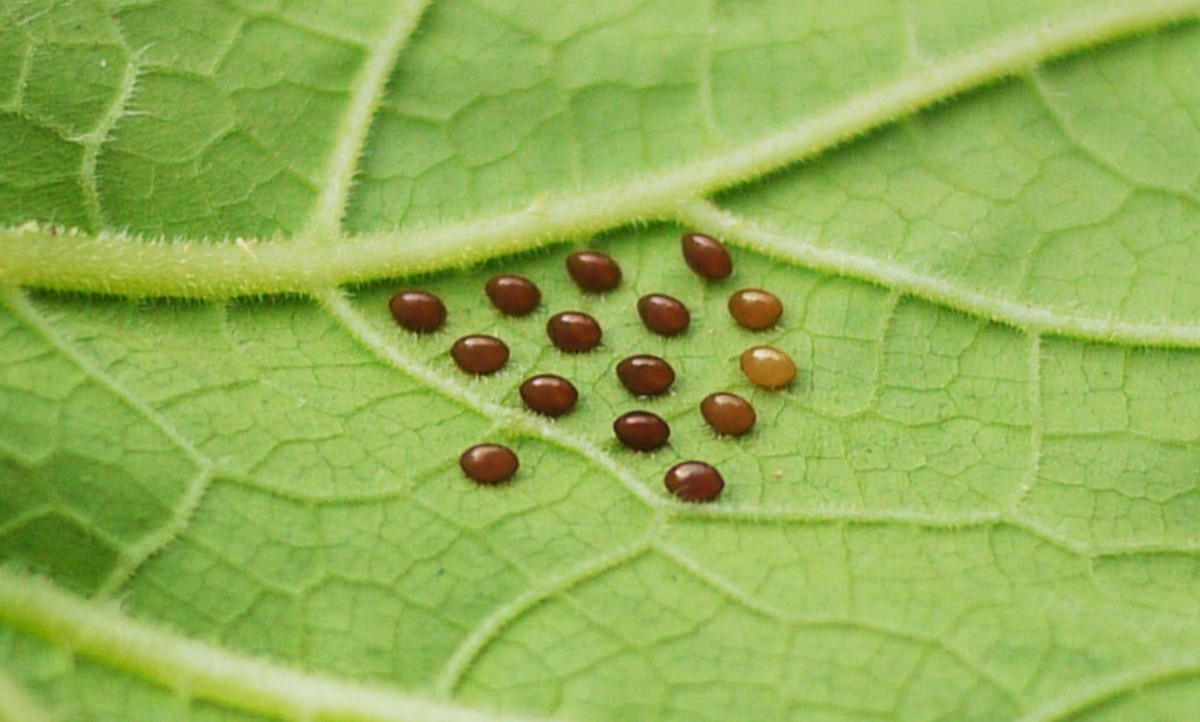
That last part is the useful bit. They're not scattered — they sit in tidy groups, usually in the V where two veins meet on the back of a leaf. Once you've seen one cluster you'll find them fast, because they're always in the same kind of place. Turn leaves over, starting with the biggest and lowest ones.
University of Minnesota's instruction is one sentence long: "crush eggs that are attached to the undersides and stems of leaves." A thumb does it. This is thirty seconds of work that removes an entire generation you would otherwise be chasing around the plant in a couple of weeks.
The clock you're actually running against
Minnesota puts the hatch at "about 10 days" from laying. That number is the most useful thing on this page, because it turns a vague pest problem into a schedule.
Check the undersides once a week and you can't miss a batch. An egg cluster laid the day after you looked is still sitting there, unhatched, when you come back. Check once every two weeks and you'll routinely arrive to find them already hatched and spread out.
If you want one habit from this page, that's it. Weekly, leaf undersides, biggest leaves first. It beats every product mentioned further down.
What the damage looks like, and why it goes fast
Squash bugs don't chew. They drink. Wisconsin: adults and immature bugs "feed on plant juices and release toxins into leaves." That toxin is why the damage runs ahead of the number of insects. A modest population can wilt a plant that looks like it should shrug them off.
The visible sequence is "yellow spotting on the leaves" which then goes "dry and brown or black along the edges," and wilting alongside it. On a young plant that can be fatal. On a big established vine it's usually survivable if you break the cycle.
If the leaves are going yellow without that spotting pattern and you can't find insects underneath, look elsewhere. our guide to yellowing leaves works through the causes that look alike, and the same logic applies to squash.
Because wilting is the headline symptom, squash bugs get blamed for collapses they didn't cause and vice versa. If a vine wilts suddenly with no yellow spotting and no bugs underneath, look for a borer in the stem base instead — different insect, different fix.
The season, in order
Roughly chronological. Nothing here is optional. The early steps are cheap and the late ones are damage control, which is the honest shape of this pest.
- Put a board down beside each plant. Wisconsin's trick, and it costs nothing: place a board, old shingle or similar on the ground near the plants. Squash bugs congregate under it overnight. Lift it each morning and collect what's underneath. This works on the adults that sprays don't touch, and it keeps working all season.
- Turn leaves over once a week and crush the egg clusters. Look on the undersides, especially along the center vein and where veins fork. Copper-colored beads in a tidy group. Squash them with a thumb. Eggs hatch in about ten days, so a weekly check means you can't miss a batch between visits.
- Decide whether you have a real problem. University of Minnesota's threshold is specific and low-drama: consider treatment if you find an average of one egg mass per plant. Below that, keep crushing and keep lifting the board.
- If you spray, spray shortly after a hatch, not when you see adults. This is the whole timing argument in one instruction. Wisconsin advises foliar applications when eggs are hatching, to target the nymphs. Watch a cluster you've found, and if you miss it and it hatches, that following week is your window. Spraying a plant covered in adults is the least effective thing you can do with the same bottle.
- Pick the gentlest thing that reaches the stage you have. Wisconsin lists insecticidal soaps, horticultural oils such as neem oil, and pyrethrins as the organic options, and the pyrethroid group — cypermethrin, permethrin and relatives — plus carbaryl as conventional ones. Soaps and oils only work on contact, so they have to land on the insect. Another reason they suit small nymphs clustered on a leaf rather than adults scattering across a vine. Follow the label rate and the pre-harvest interval, the number of days you must wait between spraying and picking.
- Clear the debris when the plants come out. Adults overwinter under whatever is lying around — old vines, boards, leaf litter at the edge of the bed. The board you used as a trap all season is a five-star hotel in October, so lift it and take it away rather than leaving it there.
One caution on the stronger products: pyrethroids and carbaryl are broad-spectrum and will kill the bees your squash absolutely depends on, since every fruit needs pollinating. If you use them at all, keep them off open flowers and apply in the evening when bees aren't flying.
The honest summary
Squash bugs are one of the few garden pests where the timing matters more than the product, and where the cheap manual controls genuinely outperform the bottle. A board and a weekly look under the leaves will do more than anything you can buy, because they work on the stages the sprays are weakest against.
Timing the next planting matters too. A crop that gets going before the bugs build up often outruns them, and the frost date lookup gives you the real window for your spot, and the when-to-plant guides cover the sowing side.
The flip side, said plainly. If you've found a heavy population of adults on a wilting plant in August, you've probably lost that plant. No product on this page changes that. What you can still do is stop them breeding on it, clear the debris in fall so fewer come back, and start the weekly leaf check earlier next year.
Questions about squash bugs
What kills squash bugs?
Nothing kills adults reliably, which is the part most advice skips. University of Wisconsin Horticulture states that nymphs are more easily controlled by insecticides than adults, and University of Minnesota Extension says chemical controls are most effective on nymphs. So three things actually work. Crush egg clusters on leaf undersides. Trap adults under a board overnight and collect them each morning. And if you spray at all, spray shortly after a hatch, while the nymphs are newly out.
What do squash bug eggs look like and where are they?
About a sixteenth of an inch across, reddish-orange to brown, and laid in neat clusters rather than scattered — usually on the underside of a leaf along the center vein or in the V where two veins meet. They're the single best thing to hunt for, because crushing a cluster removes an entire batch. They hatch in about ten days, so a weekly check of leaf undersides catches every batch.
How do I get rid of squash bugs naturally?
Two methods, both free. Lay a board or old shingle on the soil near each plant — squash bugs gather underneath it overnight, and you lift it and collect them each morning. And turn leaves over weekly to crush egg clusters. Together these hit the adults that sprays struggle with and the eggs before they become the nymphs you would otherwise be chasing.
Why is my squash plant wilting?
Squash bugs are one cause: they feed on plant juices and release toxins into the leaves, which produces yellow spotting that later dries brown or black at the edges, with wilting alongside. But if a vine wilts suddenly with no yellow spotting and no insects on the leaf undersides, look at the base of the stem for a borer instead. Both cause wilting and they need different responses.
When should I spray for squash bugs?
Shortly after the eggs hatch, not when you first notice adults. Wisconsin advises applying when eggs are hatching in order to target nymphs. If you find an egg cluster, that's your calendar — the hatch is roughly ten days out, and the days just after it are the only window where a spray does its best work. Minnesota's threshold for bothering at all is an average of one egg mass per plant.
Do squash bugs kill plants?
They can, particularly young plants, because the toxin they inject does damage out of proportion to their numbers. Established vines often survive an infestation, though yield suffers. A heavy adult population on an already wilting plant in late summer is usually not recoverable, and the useful work at that point is preventing them breeding further and clearing the debris they would overwinter in.
Sources
Every planting date, depth, and temperature on this page traces to these university extension guides. Where they differ, the ranges above hold the whole spread.
- University of Wisconsin–Madison Division of Extension — Squash Bug
- University of Minnesota Extension — Squash bugs
GardenTrack keeps a note of which bed had squash bugs and the day you logged them, so next summer you can look back and start checking before they show up.