

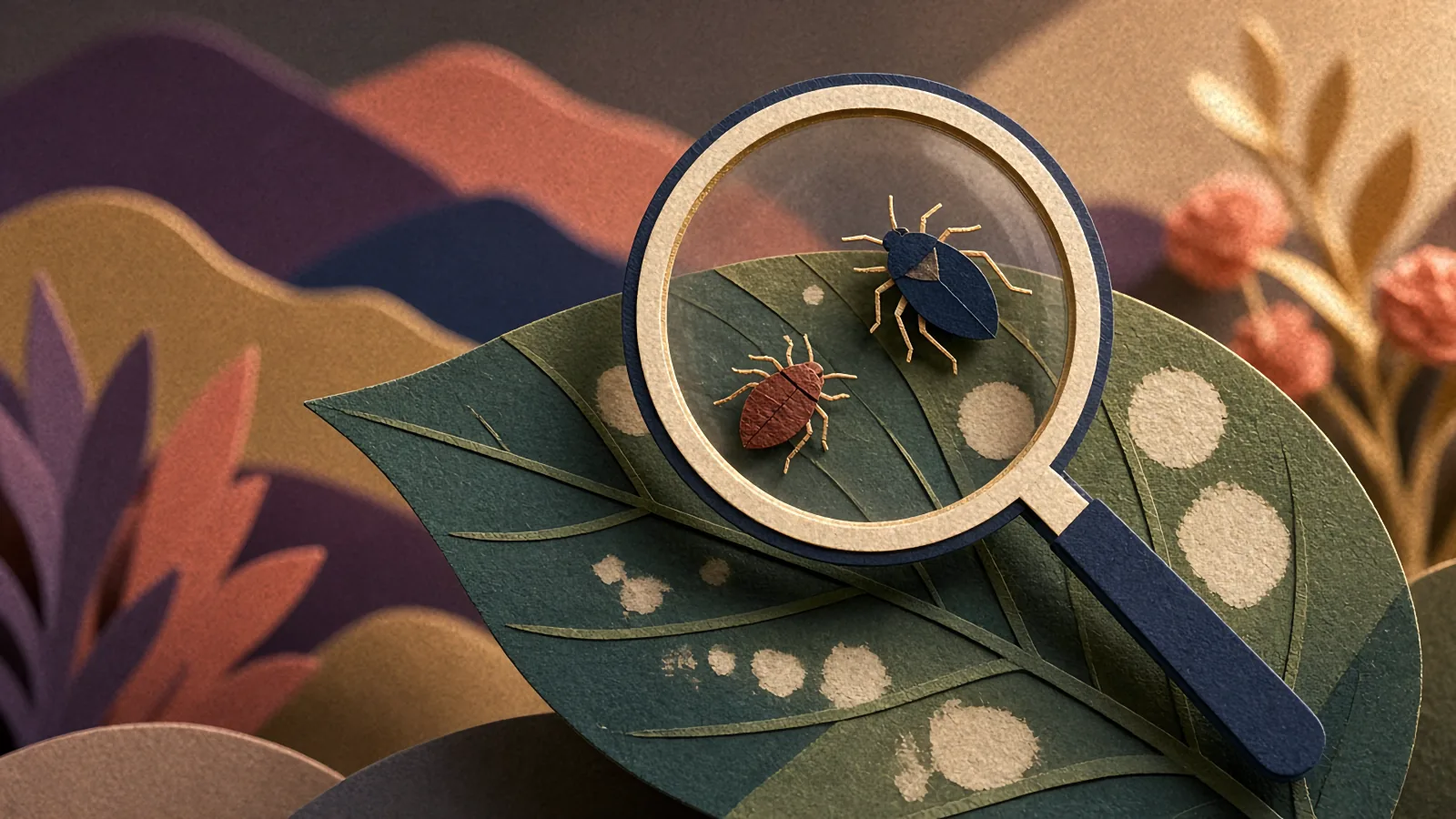
Count the marks. Three black stripes down the back is the striped cucumber beetle, and its grubs feed on cucurbit roots — UC IPM says exclusively — so a wilting plant may be losing them. Twelve black spots is the spotted one, whose grubs are in corn and grasses instead. Both adults chew the same holes.
Two beetles, one name, and the marks are the whole difference
They are the same size and roughly the same color. UC IPM describes the striped cucumber beetle as "yellowish orange and has three black stripes", and the spotted one as "greenish yellow and has twelve black spots on its back" with a black head. Both about a quarter of an inch.
Standing over a squash plant, that reads as a distinction without a difference — two beetles doing the same chewing. Underground it is not.
The striped beetle's larva, UC IPM: "feeds exclusively on cucurbit roots and can damage these crops when infestations are heavy." The spotted beetle's larva feeds on corn, small grains, beans, sweet pea and grasses, and does "not usually cause noticeable damage in gardens."
So the marks on the back tell you where the next generation is. Stripes mean the grubs are in the roots of the plant you are looking at. Spots mean they are somewhere else — in the sweet corn, in the lawn — and whatever is wrong with your cucumber is not their doing.
Which one is on your plant
Everything here from UC IPM's cucumber beetle page. The adult damage row is identical on purpose — that is the point.
| Striped | Spotted | |
|---|---|---|
| How it looks | "Yellowish orange and has three black stripes", about ¼ inch | "Greenish yellow and has twelve black spots on its back", black head, about ¼ inch |
| What the ADULT does | Chews leaves, flowers and fruit | Chews leaves, flowers and fruit — the same damage |
| Where the LARVAE are | "Feeds exclusively on cucurbit roots" — in the plant you are standing over | Corn, small grains, beans, sweet pea and grasses |
| Do the larvae hurt your squash? | Yes — "can damage these crops when infestations are heavy" | No — "do not usually cause noticeable damage in gardens" |
| What a wilting plant means | Possibly grubs at the roots, on top of anything else | Not these grubs. Look elsewhere for the cause |
Why this is the row that catches people
A wilting cucurbit with beetles on it invites one conclusion: the beetles are killing it from below. That is true of one of these two species and false of the other, and they sit on the same leaf looking almost the same. Counting stripes takes a second and changes the diagnosis — which is why an identification that feels pedantic is the useful part here.
What we will not tell you about bacterial wilt
Cucumber beetles are famous for spreading bacterial wilt, and almost every page names a culprit. UC IPM does not.
Their sentence is: cucumber beetles "may also spread cucumber mosaic virus or wilts in cucurbits." That is the whole of it — no species named, and wilts plural rather than bacterial wilt specifically.
So we are not going to tell you the striped one carries it and the spotted one does not, or the reverse. It is a real risk from cucumber beetles generally, and the page we are citing does not divide it between the two. If your plants wilt in the afternoon and recover overnight, that pattern belongs to bacterial wilt itself and is covered on cucumber leaves turning yellow.
What to do
The honest version, which is shorter than most pages make it.
- Count the marks before you conclude anything. Three stripes down the back, or twelve spots and a black head. It takes a second, and it is the difference between a wilting plant that may have grubs under it and one that does not.
- Cover the plants as they come up, not after. UC IPM's home-garden recommendation is to 'place protective cloth over emerging plants and remove it when plants are old enough to tolerate damage'. That is a barrier at the vulnerable stage, and it is the only intervention on their page aimed at a home gardener.
- Take the covers off when the plants can take it. The instruction includes removing the cloth — partly so the plants can be pollinated, and partly because a bigger plant tolerates the chewing. The cover is for the window, not the season.
- Do not expect to eliminate them. UC IPM says plainly that management of cucumber beetles is difficult, and notes that general predators attack them. There is no home-garden spray recommendation on that page, and this page is not going to invent one.
The adults do the same damage whichever species they are, so if all you are seeing is chewed leaves and flowers, the identification does not change what you do about the chewing. It changes what you conclude about the roots.
Squash bugs are a separate insect that also turns up on the same plants and is often confused with these — our squash bug guide covers that one, including why the adults are the wrong stage to spray.
What this page covers
Both beetles are held against five crops each in our database, all cucurbits, and UC IPM's page is written for exactly that setting — cucurbits in a home garden. So the scope matches here, which is worth saying because on several pages in this section it does not.
The one thing genuinely outside it is the spotted beetle's other life. Its larvae are a pest of corn and grasses in their own right, and that is not this page's subject — we mention where they are only so you know they are not in your squash.
Questions about cucumber beetles
How do I tell a striped cucumber beetle from a spotted one?
Count the marks on the back. Three black stripes running lengthwise means striped; twelve black spots plus a black head means spotted. Both are about a quarter of an inch and both are yellowish, so the marks are the only quick tell. It matters because UC IPM says the striped beetle's larvae feed exclusively on cucurbit roots, while the spotted beetle's larvae are in corn, small grains, beans, sweet pea and grasses and do not usually cause noticeable damage in gardens.
Are cucumber beetles killing my plant from the roots?
Only if they are the striped kind. UC IPM says the striped beetle's larva feeds exclusively on cucurbit roots and can damage the crop when infestations are heavy. The spotted beetle's larvae are not in your squash at all — they are in corn and grasses — so a wilting plant covered in spotted beetles is wilting for some other reason, and bacterial wilt is the first thing to rule out.
What should I spray for cucumber beetles?
UC IPM does not recommend a spray for home gardens on the page we cite, and states plainly that management of cucumber beetles is difficult. What they do recommend is physical: place protective cloth over emerging plants, and remove it when the plants are old enough to tolerate the damage. That is a barrier during the vulnerable window rather than a treatment, and it has to go on before the beetles arrive rather than after.
Which cucumber beetle spreads bacterial wilt?
We are not going to say, because our source does not. UC IPM states only that cucumber beetles 'may also spread cucumber mosaic virus or wilts in cucurbits' — no species named and wilts in the plural. Plenty of pages assign it confidently to one beetle; that confidence is not in the publication we are citing. Treat disease spread as a risk from cucumber beetles generally, and use the afternoon-wilt-and-overnight-recovery pattern to identify bacterial wilt itself.
Sources
Every planting date, depth, and temperature on this page traces to these university extension guides. Where they differ, the ranges above hold the whole spread.
- University of California Statewide IPM Program (UC IPM) — Cucumber Beetles — Home and Landscape
The short version: stripes mean the grubs are in your roots, spots mean they are in the corn. Both adults chew the same holes.
And the recommended defense is a cloth over the seedlings, not a bottle — because the source says management is difficult rather than pretending otherwise.