

From the record · 151 crops swept
Nobody publishes the temperature your vegetables die at
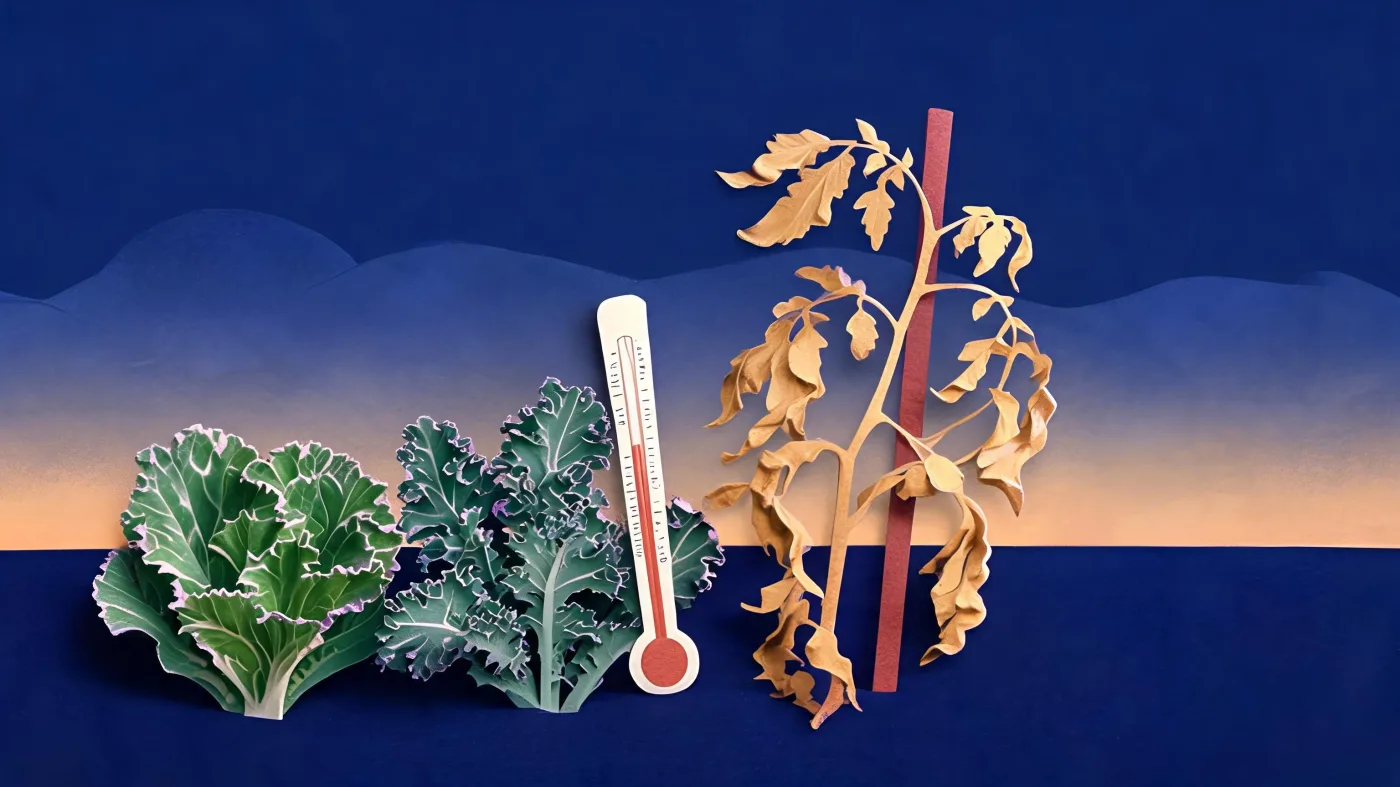
We looked for a published frost-kill temperature on all 151 crops in our database. 27 have one. Of those, 19 are a real death point — and every one is fruit at bloom, a perennial overwintering, a field crop, or a tropical. Not one is an annual vegetable on a frost night, which is the only question anybody actually asks.
What we went looking for
Every gardener asks the same question on the same kind of night. The forecast says 30°F. Is that the end of the beans?
Our plant database has a field for it — the temperature at which a crop is killed — and last month we set out to fill that column for all 151 crops. This piece is what happened instead.
The method was dull on purpose. For each crop, read the extension publications for that species in full and record what they state. Not a search-result summary, not an abstract — the page itself. Where a crop turned up nothing, write down that we looked: which crop, which sources, which date.
136 crops now carry that record. 242 written notes, each naming what was swept. Across them: Utah State appears 207 times, Minnesota 139, Clemson 137, the University of Georgia 136, Missouri Botanical Garden 135, NC State 105, plus Oregon State, Iowa State, Michigan State, Cornell, Penn State and Maryland.
The count
27 of 151 crops have a published frost-kill temperature. 124 do not, and we checked every one. Both figures together account for all 151 — there is no third pile of crops we never got to.
The damage temperature — the point where a plant is hurt but not killed — runs the same way: 41 have one, 110 were searched and came up empty.
Then we looked at what the 27 actually are, and that is where it stopped being a gap and started being a finding.
Eight of the 27 are not death temperatures at all
Eight say the opposite of what the field name suggests. Utah State on cabbage: it is "not seriously damaged by temperatures down to 25°F." South Dakota State on sweet alyssum: it "can tolerate temperatures as low as 28 degrees."
Those are survival floors — the source saying the plant is still fine at that number, not that it dies there. It is a hardiness statement wearing a temperature. Useful, and not the thing we were looking for.
That leaves 19 genuine death points across 151 crops.
And all 19 belong to somebody with a crop to lose
Sorted by what stage of the plant the number is about, the 19 fall into four groups and nothing else:
- Seven are fruit trees and bushes in blossom — apple 25°F, apricot 22°F, blueberry 28°F, cherry 25°F, peach 24°F, pear 24°F, plum 23°F. These come from critical-spring-temperature tables, the kind an orchard checks in April when a frost would cost the season.
- Five are perennials getting through winter — lemon, lime, persimmon, pomegranate, strawberry. The number is about whether the plant is alive in spring, not about tonight.
- Four are field and cover crops standing out — oats 22°F, buckwheat 32°F, quinoa 28°F, hairy vetch 5°F. Written for someone with acres.
- Two are tropicals hurt without a frost — chayote at 54°F, and sesame just above freezing. Chayote is the surprise: damage more than twenty degrees before a frost is anywhere near. Sesame is the opposite kind of gap — Texas A&M says its leaves are killed by temperatures “slightly above the freezing point” and never prints a figure, so the number in our own record is our reading of that phrase rather than theirs.
The last one is asparagus at 28°F, and it proves the pattern rather than breaking it: Iowa State's number is about spears in spring being "severely damaged or destroyed" — a harvest you are about to lose, not a plant that dies.
Not one of the 19 is an annual vegetable on a frost night. No tomato, no pepper, no lettuce, no bean, no squash, no cucumber.
The orchard thermometer
Here is the shape of it, and we think it deserves a name.
The published temperature literature is an orchard instrument, not a garden one. Somebody built those tables for a grower deciding whether to run frost fans over a blooming peach block at two in the morning. That reader has a specific plant, at a specific stage, and a specific amount of money on the line. The tables answer them precisely.
For ordinary garden plants, the same institutions publish something different: a hardiness zone, or a class like hardy or tender. One of our own sourcing notes puts it plainly, after a sweep of twelve extension URL families turned up nothing for a herb:
"Extension publishes a hardiness class or zone for ordinary garden plants and reserves per-crop temperatures for critical-temperature tables — tree fruit at bloom, berries at bloom, citrus in winter, a few chilling-sensitive tropicals."
That is not a failing. A zone is the right answer to what can I grow here, which is the question extension services are mostly asked. It is simply the wrong answer to does this die tonight, and it is the only answer on offer.
What we are not claiming
We are not saying the numbers do not exist anywhere. Somebody has surely frozen lettuce in a chamber and written it up. We are saying that across the extension publications we read, for the crops we hold, the per-crop kill temperature is published for 27 and absent for 124 — and that the 27 map almost exactly onto commercial fruit, perennials and field agriculture.
One number we will not stretch. A single sweep on 5 August read more than 150 verified pages and produced two usable figures. That is one day's work across that batch of crops, not the whole program, and we are stating it that way because a good number with the wrong denominator is exactly the failure this piece is about.
The sweep also had to defend itself: one university's content system served its own "Page Not Found" with an HTTP 200, so every page was checked to be about the right plant before it was read. A page that loads is not a page that exists.
What we do instead
We keep the class rather than invent the number. Every crop carries a frost-sensitivity rating from its sources — tender, half-hardy, hardy, very hardy — and the frost warnings in our app run on that, not on a temperature we made up.
Where a real number exists, we hold it and say which of the 19 stages it belongs to, because "apple dies at 25°F" is wrong in a way that matters — the tree is fine at 25°F, the open blossom is not. And where there is no number, the record says we looked, on what date, in which sources.
A blank that says we checked and it is not published is a different claim from a blank that says nothing. It is the more useful one, and it is the one this whole exercise produced.
We publish every crop free, with its full care data, and every value says whether it carries a citation or is our own estimate. The 124 crops with no kill temperature say that too, rather than showing a blank. The variety list in the download is the 500 most-searched of the 3,174 we hold — ask us if you need the rest.
If you want the frost tolerance we do hold — which crops shrug off a light frost and which do not — frost-tolerant vegetables is the list, and protecting plants from frost covers the night itself.