
Your zone won't tell you. A hardiness zone describes your coldest winter night, not when spring freezes stop, and two gardens in the same zone can have last frosts weeks apart. Start tomato seeds 6 to 8 weeks before your own last frost date, and put the plants outside after that date has passed and the soil has warmed.
The zone is answering a different question
You looked up your zone, you got a number, and the number didn't come with a date. That's not you missing something. A hardiness zone was never built to tell you when to plant.
A zone is one measurement: the average coldest night of your winter. The USDA works it out in 10°F bands, and it exists to answer one question — will this perennial survive here? That's a real question and the zone answers it well. Your rosemary lives or dies on it.
Planting a tomato is a different question. Tomatoes are annuals. They don't have to survive your winter, because they'll be dead by Christmas regardless. What they have to survive is the last freeze of spring, and a zone doesn't measure that at all.
So two gardens can share a zone and be a month apart on the day it's safe to plant out. One has mild winters and a late spring. The other has hard winters and an early one. Same band, same number, different season.
What actually sets the date
One date runs the whole season, and it's your last spring frost — the day the freezing nights are finished with you.
Everything about a tomato hangs off it, and the extension services word it as a condition rather than a countdown. Clemson: sow seed indoors six to eight weeks before the last frost date in your area. Minnesota, on the other end: transplant outdoors after all danger of frost has passed and the soil has warmed.
Notice what neither of them gives you. There's no "plant on May 3" in there, because they can't know where you are. Both instructions are written to be finished by a number you bring.
So if your last frost is April 15, the seeds go in somewhere between February 18 and March 4, and the plants go out on or after April 15 — later if the soil is still cold. Go out before that and you have signed up for a job: Utah State says to use row covers or hot caps to protect the plants when transplanting before the frost-free period, and that protection is not optional.
The hard part was never the arithmetic. It's that nobody hands you the date to subtract from.
Your state can't tell you either, and here's by how much
We measured it. Every US weather station with a full record gets a median last-freeze date from NOAA's 1991–2020 normals; we grouped 6,704 of them by state and looked at how far apart the stations inside one state actually are.
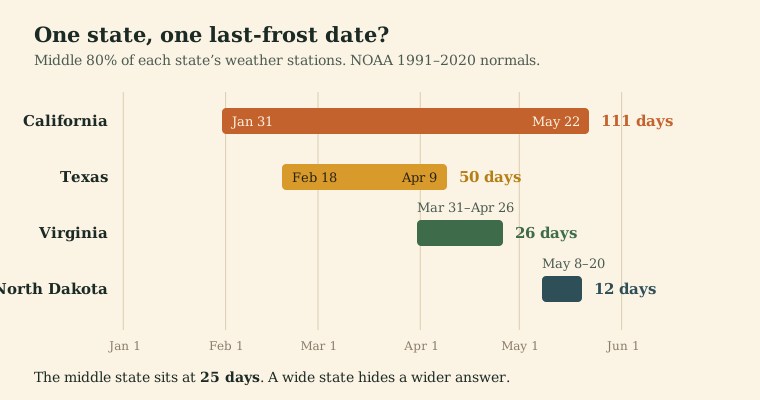
The dates below are the 10th and 90th percentile station in each state, so freak mountain tops and cold hollows are already excluded. This is the spread an ordinary gardener in that state is choosing between. In the middle state it is 25 days.
| State | Last frost runs from | Which is |
|---|---|---|
| Alabama | March 8 to April 5 | 28 days apart |
| Alaska | April 25 to June 2 | 38 days apart |
| Arizona | February 4 to May 24 | 109 days apart |
| Arkansas | March 15 to April 8 | 24 days apart |
| California | January 31 to May 22 | 111 days apart |
| Colorado | April 30 to June 9 | 40 days apart |
| Connecticut | April 14 to May 3 | 19 days apart |
| Florida | February 8 to March 13 | 33 days apart |
| Georgia | March 5 to April 4 | 30 days apart |
| Idaho | April 24 to June 10 | 47 days apart |
| Illinois | April 7 to April 27 | 20 days apart |
| Indiana | April 9 to April 28 | 19 days apart |
| Iowa | April 19 to May 3 | 14 days apart |
| Kansas | April 9 to April 30 | 21 days apart |
| Kentucky | April 4 to April 24 | 20 days apart |
| Louisiana | February 9 to March 15 | 34 days apart |
| Maine | April 28 to May 23 | 25 days apart |
| Maryland | March 29 to April 25 | 27 days apart |
| Massachusetts | April 13 to May 6 | 23 days apart |
| Michigan | April 28 to May 25 | 27 days apart |
| Minnesota | April 27 to May 24 | 27 days apart |
| Mississippi | March 5 to April 1 | 27 days apart |
| Missouri | April 4 to April 20 | 16 days apart |
| Montana | May 10 to June 4 | 25 days apart |
| Nebraska | April 22 to May 13 | 21 days apart |
| Nevada | March 10 to June 7 | 89 days apart |
| New Hampshire | April 30 to May 21 | 21 days apart |
| New Jersey | April 2 to April 26 | 24 days apart |
| New Mexico | April 2 to May 30 | 58 days apart |
| New York | April 12 to May 17 | 35 days apart |
| North Carolina | March 21 to April 22 | 32 days apart |
| North Dakota | May 8 to May 20 | 12 days apart |
| Ohio | April 17 to April 30 | 13 days apart |
| Oklahoma | March 28 to April 15 | 18 days apart |
| Oregon | March 16 to June 5 | 81 days apart |
| Pennsylvania | April 14 to May 14 | 30 days apart |
| South Carolina | March 13 to April 5 | 23 days apart |
| South Dakota | May 1 to May 17 | 16 days apart |
| Tennessee | March 31 to April 20 | 20 days apart |
| Texas | February 18 to April 9 | 50 days apart |
| Utah | April 17 to June 4 | 48 days apart |
| Vermont | May 2 to May 23 | 21 days apart |
| Virginia | March 31 to April 26 | 26 days apart |
| Washington | March 24 to May 14 | 51 days apart |
| West Virginia | April 15 to May 7 | 22 days apart |
| Wisconsin | April 27 to May 22 | 25 days apart |
| Wyoming | May 9 to June 2 | 24 days apart |
What we did, and what we deliberately did not do
Every station here freezes in at least 90% of years. That filter matters more than it sounds: a station that only freezes two winters in three still gets printed with a "median last freeze" date, and that date is an artefact rather than a season. It dropped 244 stations, most of them in south Florida and coastal California.
We did not do this by hardiness zone, and we could have faked it. Zone is a function of the average coldest winter night, and this dataset holds freeze dates rather than winter minimums — so there is no zone column in it. Working a zone out from latitude and elevation would have meant inventing the exact number this page is about. State is a field that's really there.
Arizona and California run past 100 days because they contain both desert floor and alpine. North Dakota comes in at 12 because it is flat and uniformly cold. Neither is a flaw in the data. It is the thing the page is telling you: the wider your state, the less its name is worth as a planting date.
Ten miles apart, two weeks apart
State lines are the easy case. The uncomfortable one is your own neighborhood.
We compared every pair of neighboring weather stations in the country — 6,191 pairs with full records — and asked how much two nearby stations disagree about the last frost. Half of all pairs disagree by 5 days or more. One pair in seven disagrees by two weeks or more.
And distance barely rescues it. Among pairs sitting within ten miles of each other, 13.1% still disagree by two weeks. The widest pair in the country is 114 days apart — the Grand Canyon rim against the canyon floor, which are close enough to see each other.
That's the whole reason a lookup beats a label. Cold air runs downhill and pools at the bottom, so a valley floor gets frost when the bench above it doesn't. The full study, with the method and the stations, is at how wrong your nearest weather station is.
Getting your actual date
The frost date lookup computes it for your address rather than the nearest airport. It's free and there's no signup.
It gives you three dates instead of one, and the three are the point. The middle one is the average — frost is done by then in half of years. The early one is the date it's done by in 1 year out of 10, and the late one is the date it's done by in 9 years out of 10. Plant on the middle date and you're accepting a one-in-two chance of a later freeze. Wait for the late one and you've bought near-certainty, and given up two or three weeks of season.
That's a choice, and it's yours. A cheap tray of lettuce can go out on the early date. The tomatoes you started in February probably shouldn't.
Counting back for the seeds
Once you have the date, the seed timing falls out of it: 6 to 8 weeks back for tomatoes, and different for everything else.
We've done that arithmetic for 20 crops and 28 cities on when to start seeds indoors, including the crops that go outside before the last frost rather than after. Broccoli and cabbage are happy in a light freeze. Tomatoes are not.
The night that still gets you
A last frost date is an average, not a promise. It's the date the freeze is finished by in half of years, which means that in the other half of years it isn't finished, and something goes out too early.
No date on this page knows whether next Tuesday drops to 30°F. Nothing built on thirty-year averages can, and a page that implied otherwise would be lying to you comfortably.
So the last step isn't on the calendar. Check the forecast the week you plant out, and be willing to go back out at ten at night with an old sheet. That's the step that costs people a whole flat of seedlings, and no chart can do it for you.
Questions people actually ask
What zone are tomatoes best in?
Tomatoes grow in every zone in the country, so the question doesn't have a useful answer. They're annuals — they never have to survive a winter, which is the only thing a zone measures. What changes by region is how long your warm season is, and that decides which varieties finish in time. A short season wants an early variety; it doesn't want a different zone.
Can I plant tomatoes before the last frost?
Not without covering them. Tomatoes are a tender crop — a light frost of 28 to 32°F kills them outright, and they start sulking below 50°F well before any frost arrives. Utah State's guidance is to use row covers or hot caps when transplanting before the frost-free period, and people do exactly that to steal two or three weeks. It works. It is a job you have committed to rather than a date you have moved.
What is the difference between a hardiness zone and a frost date?
A hardiness zone is your average coldest winter night, in 10°F bands, and it tells you which perennials survive. A frost date is the day spring freezes stop, and it tells you when to plant annuals. Mixing them up is the single commonest way people lose seedlings, because two gardens in one zone can be weeks apart on the frost date.
When do I plant tomatoes in Florida?
Backwards from everybody else. Across Florida's stations the last freeze runs from about February 8 to March 13, and south Florida barely freezes at all — 244 stations nationally were dropped from our figures for freezing in under 90% of years, most of them there and in coastal California. If that's you, heat is your limit rather than cold: plant early enough that the fruit sets before high summer, because tomatoes stop setting fruit in real heat.
When do I plant tomatoes in Texas?
It depends which Texas. The state's stations run from about February 18 in the south to April 9 in the Panhandle — 50 days apart at the 10th and 90th percentile, and 88 days between the two extremes. Bruni in the south brush country is done with frost by January 30. Dalhart, up at about 3,900 feet, waits until late April.
Is it too late to plant tomatoes?
Count forward instead of back. Find your first FALL frost, subtract the days-to-maturity on the packet, and add two weeks because a plant in cooling weather runs slower than the packet says. If the answer is still in the future you have time, and if it's close, buy a transplant rather than starting seed.
Sources
Every planting date, depth, and temperature on this page traces to these university extension guides. Where they differ, the ranges above hold the whole spread.
- USDA Agricultural Research Service — USDA Plant Hardiness Zone Map
- NOAA National Centers for Environmental Information — U.S. Climate Normals 1991–2020, freeze/frost probabilities
- Clemson Cooperative Extension — Tomato
- University of Minnesota Extension — Growing tomatoes
- Utah State University Extension — Tomatoes in the Garden
The date is the anchor for everything else this season. Once you have it, when to start seeds indoors counts back for 20 crops, and the spacing calculator works out how many plants the bed will actually hold.
If you want the evidence behind the argument on this page rather than the summary, how wrong your nearest weather station is has the whole study: 6,191 station pairs, the method, and the worst disagreements in the country.