

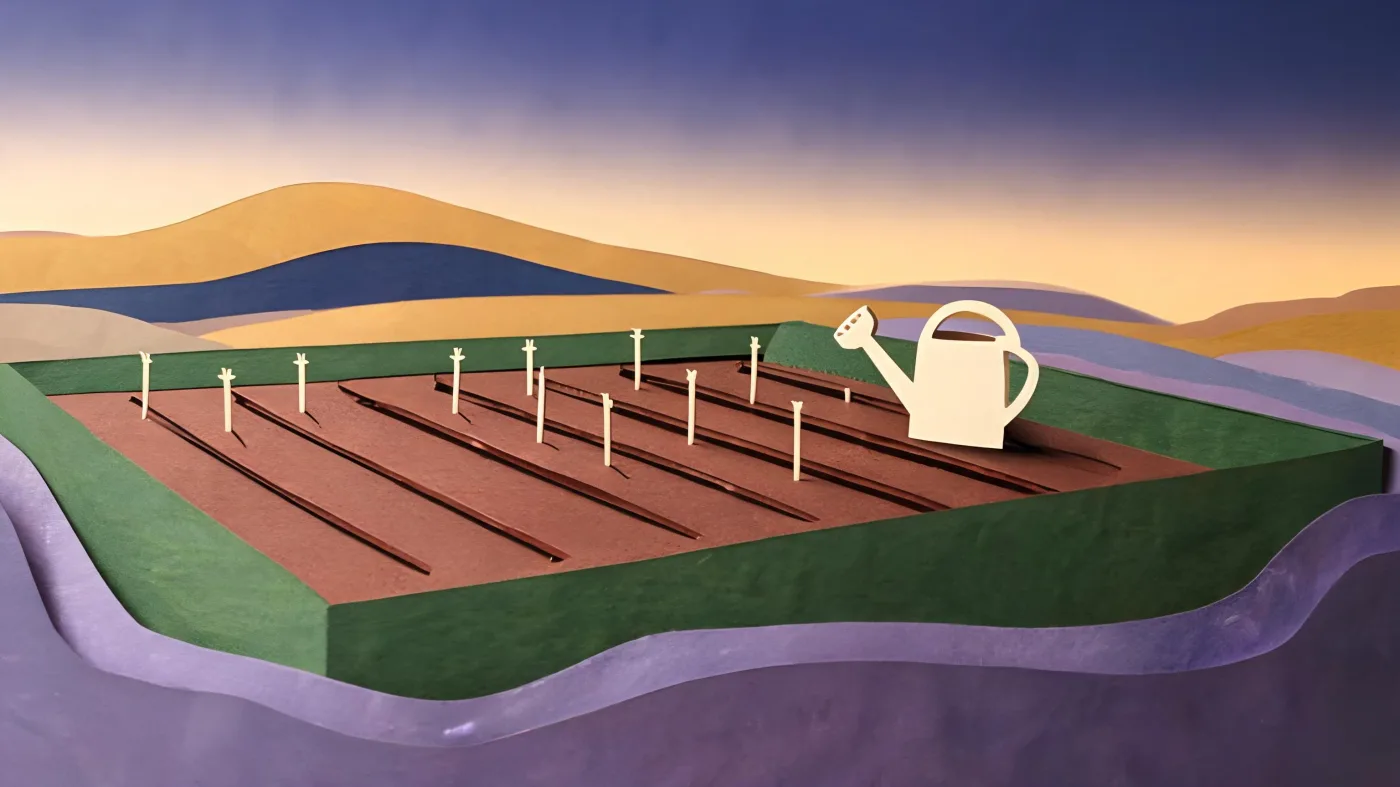
The gap is not an oversight. It is where the seed actually dies.
You sow the seed and the calendar says nothing for a week
Growth stages start when something is visible, and for most crops nothing is visible for about a week after sowing. Of the 115 crops we hold that can be sown, 92 have that gap — a median of seven days and up to fourteen. It lines up exactly with the window where a drying seedbed kills the seed, and almost nothing puts a job in it.
The week where you cannot tell if it worked
You sowed a row of carrots on Saturday. It is now Wednesday. There is nothing there.
Is that normal? Did they wash out? Was the soil too cold? Should you water it again, or is that how you rot them? You have no information at all, and the only thing you can do is wait and keep the surface damp — which happens to be the single most important thing anyone will ever do for that row, and nobody is telling you to do it.
Why the calendar is empty, and it is not laziness
Gardening calendars are built out of growth stages — germination, seedling, leafy growth, flowering, fruit set. It is a good structure and we use it too.
But a growth stage starts when something is observable, and for the first stretch after sowing there is nothing to observe. The seed is doing a great deal underground and none of it shows. So the first stage does not open on the day you sowed. It opens when the seedling breaks the surface.
Which leaves a hole between the two, and the hole is where the jobs would go.
We measured our own database, and it is 92 of 115
Every crop we hold records how it is propagated. 115 of our 151 crops can be sown — the other 36 are grafted, divided or grown from cuttings, and an apple tree having no sowing stage is correct rather than missing.
Of those 115:
- 92 have a silent gap after sowing. The first stage anchored to the day you sowed opens later than that day.
- The gap runs 3 to 14 days, with a median of 7. Fifty crops sit in the 6–10 day band; 31 are quicker; 11 take eleven days or more.
- 17 have no sowing-anchored stage at all — the calendar for those never starts from sowing, it starts from something else.
A week does not sound like much. It is the whole of the period in which the outcome is decided, and then the plant either exists or it does not.
It is the same week as the last piece, and that is the point
We wrote recently that the standard finger test measures an inch down while most seed goes in at half an inch or less — so a seedbed reads "still moist" while the seed sits in dry soil.
That failure and this one are the same seven days. The surface dries fastest, the seed is in the surface, and the only correct job is a light watering possibly more than once a day. It is the one week in a plant's life when watering little and often is right.
And it is the week the calendar has nothing in it. The advice is wrong for that window and the schedule is empty for that window, which is a good explanation for why a row of seed quietly failing to appear is such a common way to lose a crop.
The two that have nothing at all, and they are cover crops
Of the 17 crops with no sowing-anchored stage, exactly two list direct sowing as their only propagation method: cereal rye and hairy vetch. Both are cover crops. Both are sown by scattering seed on bare ground, and that is the only way anybody grows them.
So for those two, the gap is not a week. There is no sowing-anchored calendar at all, for a crop whose entire interaction with a gardener is sowing it.
The other fifteen are softer and we are not going to pretend otherwise — they are things like rosemary, mint, blueberry and plum, where seed is technically listed among several methods but almost nobody raises them that way for a crop. The two cover crops are the honest examples. The other fifteen are a maybe.
What we are doing about it, and what we have not done
The gap is real in our data and we have not filled it yet. Our stages open where the plant becomes observable, which is defensible and which produces the same quiet week as everybody else's.
What belongs in it is not more stages. Inventing a "germination" stage that starts on day zero would be making up an observation nobody can make. What belongs there is a job — check the surface, water lightly, and an expected date by which you should see something, so that silence stops being ambiguous.
That is not built. We are saying what the data shows and not describing a feature that does not exist yet.
What to do in the meantime, without any app
Write the expected date on the label, not the sowing date. Every packet gives a germination range. Sowing date plus the top of that range is the day you are allowed to start worrying — and before it, silence means nothing is wrong.
Treat the week as a daily job even though nothing is asking you to. Scrape a little soil beside the row and look at the color half an inch down. Dry means water now, lightly.
And if the date passes with nothing showing, re-sow rather than wait. A row that has missed its window by a week is a row you still have time to replace; a row you give three more weeks of hope to usually is not.
Where these numbers are soft
The 92 counts crops, not sowings. A crop with a gap of three days and one with a gap of fourteen both count once, which is why the median matters more than the headline.
"Can be sown" comes from our own propagation field, and it is generous — it counts a crop where seed is one of four listed methods. That is what puts rosemary and plum in the 115, and it is why we separated the two cover crops out rather than presenting all 17 as equivalent.
And we corrected ourselves twice getting here. Our own backlog said 101 of 151, and the first re-measurement said 103 of 151 — both of which quietly counted apple, cherry and asparagus as having a missing sowing stage. They do not have one because you do not sow them. Scoping it to crops that can actually be sown moved the answer to 92 of 115, and the smaller number is the true one.
Sowing depths and stages for every crop we hold, free: the plant database.
When to sow in the first place: the frost date tool.
The free app is open now. Start free if you want in.