

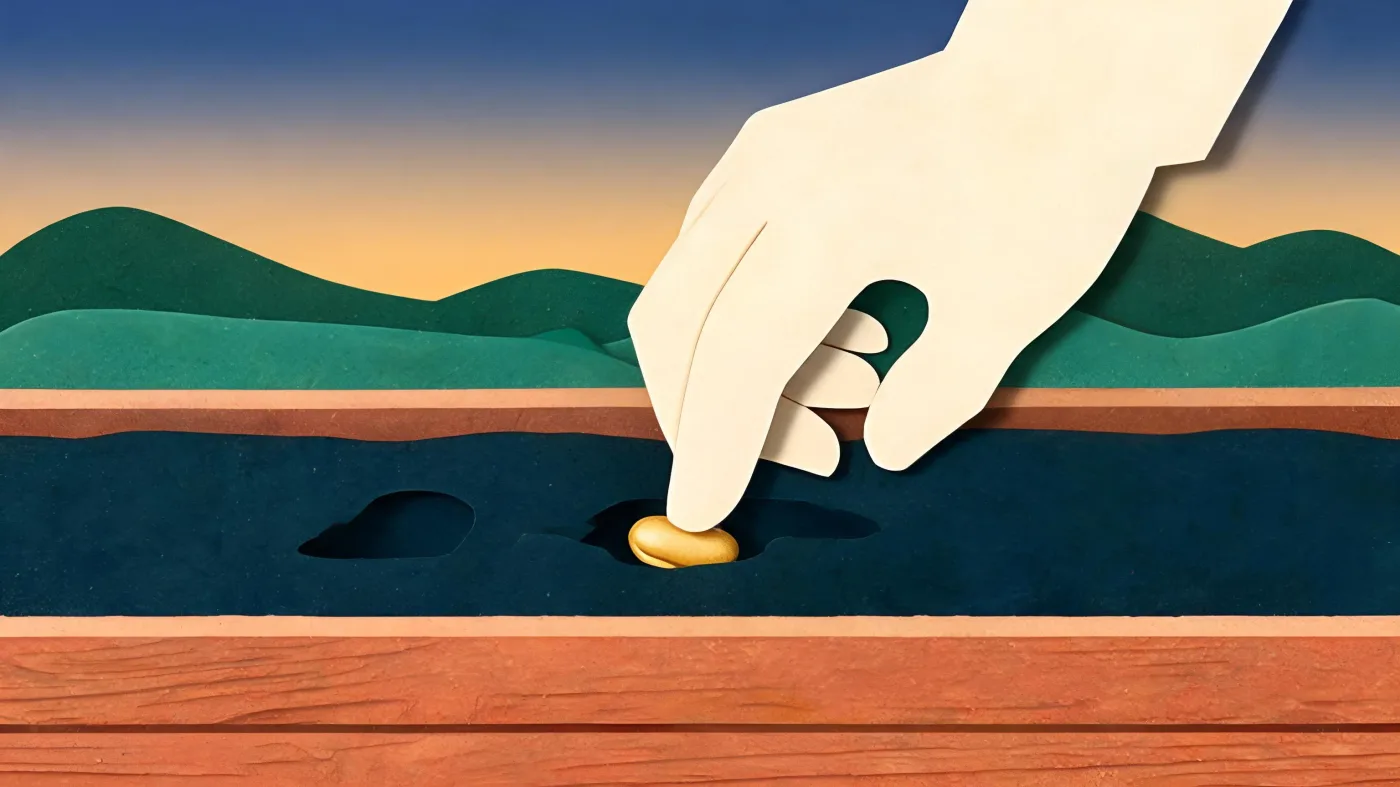
The advice is not wrong. It is the right test for the wrong week.
A knuckle is an inch down. Your seed is half an inch down.
The finger test measures moisture about an inch down, which is where an established plant's roots are. Of the 127 crops where we hold a sowing depth, 90 are planted at an inch or less, and most of those are far shallower. Soil can be moist at an inch and dry at a quarter of an inch — so on a seedbed the test reports on soil the seed is not in.
The most repeated piece of advice in gardening
Push a finger into the soil up to the first knuckle. If it is dry at your fingertip, water. If it is damp, leave it.
It is genuinely good advice. It stops the two commonest mistakes at once — watering on a schedule instead of on need, and watering a little every day so the roots never go looking. We would give the same advice.
And it is the wrong test for the bed you sowed on Sunday, for a reason that is pure geometry rather than horticulture.
Your finger stops below the seed
A first knuckle is about an inch down. That is the point of the test: an inch is roughly where an established plant's working roots begin, so it tells you something real about the water those roots can reach.
We hold a sowing depth for 127 crops, and 90 of them go in at an inch or less. Carrot, lettuce, most brassicas and nearly every herb are shallower still — a quarter to a half inch, some barely covered at all.
And the top of a seedbed is not a scaled-down version of the soil beneath it. It is the part that dries first, dries fastest, and dries hardest, because it is the part in the sun and the wind. So the ordinary state of a seedbed on a bright day is damp at an inch and dry at a quarter inch.
Which means the test can return "still moist" while the seed sits in dust. The finger is not lying. It is reporting on soil the seed is not in.
The sources have this right, and the repetition lost it
This is not a case of extension services being wrong. It is a case of one sentence surviving the journey and the other one not.
Penn State, on sowing annual seeds: "Maintain a constant moisture in the seedbed until seeds have germinated." Not deep moisture. Constant. And on frequency: water daily, "except on bright sunny days when the seedbed may need light waterings two or three times."
Utah State, on germination: keep it "evenly moist but not waterlogged," "do not allow dry spots to form before seeds germinate," and the memorable one — "a similar moisture level to that of a wrung-out sponge."
Then Penn State names the switch explicitly: "As seeds germinate, give young seedlings more generous waterings less frequently."
That is the whole thing in one sentence. There are two regimes, and germination is the line between them.
Two opposite jobs, and only one of them has a catchphrase
Before emergence: shallow and often. You are keeping half an inch of soil from drying out. A fine spray, once a day, twice or three times when it is bright and windy. The volume is small; the frequency is what does the work. This is the only time in a plant's life when watering little and often is correct.
After emergence: deep and seldom. More water, further apart, so the root follows the moisture down instead of loitering at the surface. This is where the knuckle test belongs, and it is excellent there.
The reason the first regime has no catchphrase is that it only lasts a couple of weeks. The second one lasts all season, so it is the one that got repeated until it became the whole of the advice.
What to do instead, and it is not complicated
Test at the depth you sowed, not at the depth of your knuckle. Scrape a little soil aside next to the row — not on it — and look at the color half an inch down. Dry pale soil at seed depth means water now, whatever an inch down is doing.
Check in the afternoon, not the morning. A seedbed that was damp at eight can be dry by two, and it is the afternoon state that decides whether a germinating seed makes it.
Stop when they are up. The moment there is a row of seedlings, the shallow-and-often regime becomes actively bad for them — it is what keeps roots at the surface where the next hot week kills them. Switch, and start using your knuckle.
What we cannot tell you, and where our own number is soft
We do not hold a "how deep to check" figure for any crop, because no source we read publishes one. The half-inch above is reasoning from sowing depth, which is a good proxy and is not the same thing as a measured recommendation. If you see that number stated as a fact somewhere with our name on it, that is us over-reaching.
And our sowing-depth field is broader than seeds. It records how deep any propagule is set, so it also covers a bare-root apple whose crown sits at soil level and an artichoke going in at ten inches. The 127 figure is every crop that carries a depth, not 127 packets of seed — and 24 more crops carry no usable depth at all.
The claim that survives all of that is the one the piece rests on: the great majority of what a gardener sows goes in above where the standard moisture test measures. That is true whichever way the edges are counted.
Sowing depths for every crop we hold, free and sourced: the plant database.
When to sow in the first place: the frost date tool.
The free app is open now. Start free if you want in.