By Nik Crawley, founder of GardenTrack · Updated July 23, 2026
✓ In your garden
Rossa Lunga di Tropea is the long red spindle onion from the Calabrian coast — deep maroon, tapered at both ends, and unmistakable next to any round red onion. It's prized for being sweet and mild enough to eat raw with almost no eye-burn, the star of Calabria's agrodolce. Two honest things to know: despite its Mediterranean fame it's an intermediate-to-long-day onion that wants central-to-northern latitudes (not the Deep South), and like all sweet onions it's a poor keeper you grow to enjoy fresh.
it's yours — saved right here, no account
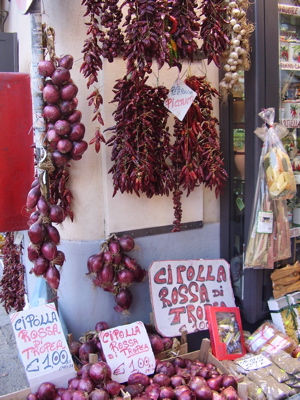
an Italian market stall with baskets of Rossa di Tropea onions — elongated deep red-purple bulbs — under a hand-lettered 'Cipolla Rossa di Tropea' sign · Photo: kajikawa
(CC BY 3.0, via Wikimedia Commons)
· source
Elongated red torpedoIntermediate–long-daySweet — poor keeper
“The unmistakable long red spindle from Calabria — sweet and mild enough to eat raw, but a poor keeper you grow to enjoy fresh, and it wants central-to-northern (not Deep-South) day length despite its Mediterranean roots.”
Days to maturity90–120 daysfrom transplant; longer from seed
Shapeelongated spindle / torpedo3–6 in long, tapered both ends
Day lengthintermediate-to-longbest ~35–48°N (central-to-northern US)
Storagepoor (~3 months)a fresh-eating onion, not a keeper
Raw eatingOne of the best 5/5
Mild, sweet, and delicate with low pungency and little eye-burn (low pyruvic acid), crisp and juicy — one of the finest raw-eating onions, and the whole reason to grow it. Young bulbs are milder still.
DistinctivenessUnmistakable 5/5
An elongated red spindle that tapers at both ends — no round red onion looks like it, so it's the easiest onion to ID by shape alone, with glossy deep-maroon skin and light rose-tinged rings inside.
StorageEat it fresh 2/5
The classic sweet-onion tradeoff: high water and low pungency mean it stores only about 3 months in ideal conditions, often less. It's a fresh-eating and bunching onion, not a winter-keeper — plan to use it, not stockpile it.
Day-length fitNot for the Deep South 2/5
It's an intermediate-to-long-day onion (best ~35–48°N). Don't trust catalogs that call it 'short-day' — grown in the Deep South (below ~35–36°N) it bulbs too early and stays small. Match it to your latitude or you won't get a real onion.
The best-looking, best raw-eating onion — you just grow it at the right latitude and eat it fresh.
SweetMildLow eye-burnCrisp
✓ Gorgeous + a superb raw onion~ Match your latitude (intermediate–long-day)✗ Not a keeper — eat it fresh
Numbers from university growing guides. Ratings are our take, judged against all onions. Tap a meter to see why.
Growing basics — shared by every onion
Rossa Lunga di Tropea grows like any other onion. The full picture — how deep to plant, spacing, feeding, pests, harvest — lives on the Onion page so it's maintained in one place.
Greenhouse or cover on: your start slides ~4 weeks earlier and your harvest stretches ~3 weeks later (shown striped).
Planting seeds straight in the ground only works where the season's long and warm — most gardeners start seeds indoors or buy young plants, or you'd pick your first tomato right as frost hits.
Comfortable — first ripe fruit lands around mid Jun, well before your typical frost (~late Oct).
Start seeds indoors
mid Feb – mid Feb
Toughen up outside
mid Mar – mid Mar
Move plants outside
mid Mar – mid Mar
Plant seeds outside
mid Mar – early Apr
Growing
mid Mar – mid Jun
Picking
mid Jun – early Aug
Typical dates for zone 6b — set your zone or ZIP above for yours.
What to plant near Rossa Lunga di Tropea — and what to keep away
✓ Good neighbors
CarrotsTrialed
Interplanted onions confused carrot rust fly in some trials and did nothing in others. Worth a try, not a bet.
BeetsTraditional
Chart canon, both directions.
Cabbage familyTraditional
Old chart pairing; both hold cool-season beds.
LettuceTraditional
On the classic charts — lettuce's own row lists onions.
TomatoTraditional
Chart canon says onions and garlic make good tomato neighbors. No trials to point at, no conflict either.
✗ Keep apart
The badge is the honesty.Trialed = a published field trial · Practical = a real mechanism · Traditional = companion-chart lore. These pairings hold for every onion.
Pairings compiled from University of Minnesota Extension, West Virginia University Extension.
Growing Rossa Lunga di Tropea — the things that trip people up
Get the day length right first — it decides whether you get a real onion. This is an intermediate-to-long-day type, best adapted to roughly 35–48°N (central-to-northern US). Ignore any 'short-day' label; grown too far south it bulbs early and stays small.
Grow it to eat fresh, not to store. Like all sweet onions it keeps only ~3 months at best, so treat it as a raw / bunching onion — it's one of the best raw-eating onions there is, and it's often pulled young as bright magenta salad scallions.
Start seed 8–10 weeks before your last frost and transplant at pencil thickness; keep it rigorously weed-free (onions have sparse, shallow roots). Note the honest caveat below about the famous Tropea sweetness. Set your zone on the [onion page](/plants/onion/) for your dates.
From university growing guides (see Sources).
Where Rossa di Tropea comes from
This is a southern-Italian heirloom from the Tyrrhenian coast of Calabria, around the town of Tropea. 'Rossa Lunga di Tropea' means 'Red Long of Tropea' — the elongated strain of the local red-onion landrace, and it's the seed-grown ancestor of the EU-protected Cipolla Rossa di Tropea Calabria (a PGI product since 2008), the famous 'Red Gold of Calabria.'
One honest caveat worth knowing: the legendary PGI onion is a place-of-origin product tied to that specific sandy coastal terroir. Seed you grow in your own garden is the same variety line, but it won't be the certified PGI item, and a good part of the legendary sweetness owes to Calabria's soil, sea humidity, and day length — not the genes alone.
The unmistakable torpedo shape
You can spot this onion across a market: an elongated spindle, roughly 3 to 6 inches long, tapering at both ends, with glossy thin skin in a deep maroon to red-purple. No round red onion looks like it, which makes it the easiest onion to identify by shape alone. Cut across, it slices into clean bands of light rose-tinged rings.
It pulls double duty, too. Many growers harvest it young — before the bulb elongates — as bright magenta bunching or salad onions, sweet and tender. The intense purplish-red color comes from anthocyanin, the same pigment family behind so many red vegetables.
Rossa di Tropea onions braided into traditional Calabrian strings (treccia) at a market, hung beside strings of red chillies · Photo: Bristakya
(Public domain, via Wikimedia Commons)
· source
Day length: the fact that decides everything
Onions bulb in response to day length, not plant age — and that's the single most important thing to get right, because the wrong type for your latitude gives you leaves and no bulb. Rossa di Tropea is an intermediate-to-long-day onion: it's best adapted to roughly 35 to 48°N, the central-to-northern US. Onion specialists like Dixondale place it in intermediate and long-day areas, and Johnny's lists a 35–48° latitude adaptation.
So here's the trap: do not trust the catalogs that label it 'short-day.' A few do, and it's misleading. Grown in the Deep South (below about 35–36°N), it tends to bulb too early and stay small — southern growers should pick a true short-day red instead. Get the day-length match right and it's easy; get it wrong and you've spent a season for marbles.
Sweet means it won't keep
The mildness that makes Tropea so good raw is the same thing that makes it a poor keeper — that's the universal sweet-onion tradeoff. High water content and low pungency mean it stores only about three months in ideal conditions, often less, so it's a fresh-eating and bunching onion rather than a winter-storage one like a sharp yellow keeper.
One honest nuance on the 'sweetness': it's really low pungency (low pyruvic acid, so less eye-burn and bite) more than unusually high sugar — and the flavor sharpens noticeably as the bulb fully matures. Young and mid-season bulbs are the mildest. Plan to eat it within a few months, and enjoy it at its sweet, fresh best.
Growing Rossa di Tropea
Give it full sun and rich, loose, well-drained soil — sandy loam is ideal, matching its coastal origin — with steady moisture and early nitrogen. Start seed 8–10 weeks before your last frost and transplant out at pencil thickness as soon as the soil is workable; space plants about 3–6 inches apart (grow them tighter and pull alternate plants young as salad onions).
Keep it rigorously weed-free — onions have sparse, shallow roots and lose to weeds fast. Watch out that transplants or sets exposed to prolonged cold can bolt (flower) instead of bulbing. Harvest when about half the tops flop over, push the rest down, and lift within a week; field-cure about ten days until the necks are dry. Then eat it within a few months rather than storing for winter.
In the kitchen
This is a raw onion first: sliced thin on salads, sandwiches, and burgers where its mildness and low eye-burn shine. Its signature cooked use is agrodolce — the classic Calabrian sweet-and-sour braise — and it caramelizes beautifully, cooking down sweet.
Beyond that, it grills or roasts whole or halved, makes a superb red onion jam (marmellata di cipolle), stuffs well (cipolle ripiene), and pickles nicely. And pulled young, it's a sweet magenta bunching onion for the salad bowl. Whatever you do, use it fresh — this isn't the onion you hang in the pantry for winter.
Rossa Lunga di Tropea onion at a glance
Rossa Lunga di Tropea Onion — at a glance
Type
Long Day
Days to ripe
110 days after you plant it outside
Color
Red
Extra fields from seed-catalog listings and university growing guides. Days to ripe and disease resistance shift with your climate and seed source — double-check with your local extension office before you buy.
Watch: growing Rossa Lunga di Tropea
Sowing Tropea Onions · Jonny's Kitchen GardenFrom Seedling to Soil: Transplanting My Tropea Italian Onions · Ebenezer Cottage Garden
Embedded from their creators on YouTube — full credit and views go to the channel.
Add Rossa Lunga di Tropea to your garden
Save it and the plant lights up — kept right here in your browser, no account needed. It's the first thing GardenTrack starts remembering for you.
Plants you add here are saved in this browser. When you’re ready, you can take them into GardenTrack’s free app, and it tells you what to do and when.
Common questions about Rossa Lunga di Tropea
Can I grow Rossa di Tropea in the South?
Usually not well. Despite its Mediterranean fame, it's an intermediate-to-long-day onion best suited to about 35–48°N (central-to-northern US). Grown in the Deep South (below ~35–36°N) it bulbs too early and stays small. Ignore any 'short-day' label on it — southern growers should choose a true short-day red onion instead.
Does Rossa di Tropea onion store well?
No — it's a poor keeper, only about three months in ideal conditions and often less. The high water content and low pungency that make it so sweet and mild raw are exactly what shorten its storage. Treat it as a fresh-eating and bunching onion, not a winter-storage onion.
Why is Rossa di Tropea so sweet?
Mostly because it's low in pungency (low pyruvic acid), so it has little of the sharp bite and eye-burn of a storage onion — more than because it's exceptionally high in sugar. That mildness fades as the bulb fully matures, so young and mid-season bulbs taste the sweetest. Much of the legendary Calabrian sweetness also owes to that region's specific soil and climate.
Is garden-grown Tropea the same as the famous PGI onion?
It's the same variety line, but not the certified product. The famous Cipolla Rossa di Tropea Calabria is an EU place-of-origin (PGI) product tied to Calabria's specific sandy coastal terroir. Grow the seed anywhere and you get a genuine Rossa di Tropea onion, but the legendary sweetness partly comes from that place, not the genes alone.