

Annual Cover Crop · 8 varieties
Cereal Rye
Secale cereale
Poaceae — the same plant family as sweet corn, sorghum, oat, lemongrass and 1 more here. Relatives share pests and diseases, which is why rotation plans group by family.
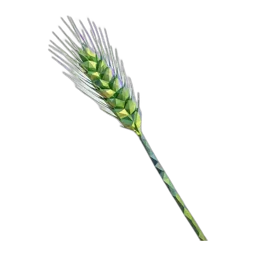
Cereal Rye (Secale cereale) is an annual cover crop. It wants full sun and pH 5.6–8 soil, with about 1 in of water weekly. It matures in about 255–300 days from sowing. Watch for armyworms and ergot. Below: its full sourced profile from 5 extension sources, plus a planting calendar timed to your frost dates.
Typical dates for zone 6b — set your zone or ZIP for yours. Timing is a guide from the crop's sourced growth stages; confirm with your local frost dates and extension before you sow.
What we will not put a number on
We do not give a feeding rate for this crop, and that is deliberate rather than a gap. The figures published by extension services are pounds of nitrogen per acre for a production field — they do not convert safely to a raised bed or a pot without knowing your soil test and your fertilizer's analysis, and guessing errs toward burning roots. It is also why every chart you find online disagrees with the next one.
We give watering as a depth per week rather than gallons per plant, because that is how it is actually measured and how the published figures are written. A gallons-per-plant number depends on your spacing, your soil and whether the plant is in a pot — so it would look more precise than it is.
Site & soil
- Sun
- Full sun
- Soil pH
- 5.6–8
- Soil texture
- Loam, Sandy, Clay, High organic matter
- Frost tolerance
- Very hardy
No published figure for the temperature frost starts to hurt it, the temperature that would kill it and a heat limit. We looked — where a number is missing here it is missing from the research, not skipped. The crop’s frost and heat tolerance above still applies.
The plant
- Mature height
- 2–6 ft
- Mature spread
- 6–12 in
- Growth rate
- Fastest
- Spacing in row
- 1–2 in
- Between rows
- 6–7 in
- Planting depth
- 0.75–1.5 in
- Container size
- 1–3 gal — low end is the minimum, high end is betterest
- Support
- Self-supporting
- Grown from
- Direct sow
Water & feeding
- Water needs
- Low
- Water per week
- 1 in/wkest
- Critical water
- Germination, Establishmentest
- Feeding
- Low
Timing & fruiting
- Days to maturity
- 255–300 days from seedest
- Harvest cues
- First flowers, Lower leaf yellowing
There is no line here for whether the seed needs light or dark to come up, because we have no figure to put there. We went looking and wrote down what we read — it is missing on purpose, not because nobody checked.
Planted again for autumn
- Sow by
- early Feb typical · zone 6b
255 days to maturity from sowing, counted back from the first frost above. Not published for anywhere in particular: it is your own frost date and this crop's own figure, which is why it works wherever you are. A days-to-maturity figure is a catalog number for a good season rather than a promise, and a cold month moves it.
Edible parts per source: seed.
Compiled from the extensions cited below. Which ones actually show up depends on your region — your extension's local list is the last word.
Different parts differ — the edible part is the seed; the notes below flag other parts or preparations.
PeopleErgot alkaloids, Ergotism
Recorded exactly as the source states it — not medical or veterinary advice. If a person or animal may have eaten a toxic part, call Poison Control (1-800-222-1222) or your vet / the ASPCA line (888-426-4435).
| Variety | Type | Days | What it is known for |
|---|---|---|---|
| Aroostook | Dual Purpose | 255–300 | |
| Common/VNS Winter Rye | Common | 255–300 | SARE (Sustainable Agriculture Research and Education) — Managing Cover Crops Profitably records this astakes the cold |
| Danko | Dual Purpose | 255–300 | Practical Farmers of Iowa records this asgives a heavy crop |
| Elbon | Dual Purpose | 255–300 | |
| Guardian | Dual Purpose | 255–300 | Best Forage (La Crosse Seed / DLF dealer) describes this astakes the cold |
| Hazlet | Dual Purpose | 255–300 | Practical Farmers of Iowa records this astakes the cold · gives a heavy crop |
| Rymin | Dual Purpose | 255–300 | |
| Wheeler | Dual Purpose | 255–300 |
- Alternative Field Crops Manual — Rye (Oelke, Oplinger, Bahri, Durgan, Doll & Kelling, 1990; Univ. of Wisconsin-Extension & Univ. of Minnesota; hosted at Purdue newcrop)
- NC State Extension Gardener Plant Toolbox
- Ohio State University Extension (Ohioline)
- SARE (Sustainable Agriculture Research and Education) — Managing Cover Crops Profitably
- USDA NRCS (Natural Resources Conservation Service)
We compile bare facts from these university-extension and horticultural sources, never copied prose. 14 of the 19 values on this page carry a citation. The rest are marked est; hover one and it says why — either nobody publishes a figure we could point at, or a person set it and attached no source. Figures vary with climate and seed source; confirm with your local extension before you buy.
Growing more than cereal rye? Browse all crops, or grab the spacing calculator and frost date lookup. The free GardenTrack app remembers what you planted and where, then tells you what to do and when. Start free →