

Seven to fourteen days, and the sources disagree: Michigan State says begin seven to ten days before your frost-free date, Minnesota and Utah State both say about two weeks. Err long — a day too many costs nothing. The temperature the plant sits in matters more than the count.
The short answer, and why it has a range
Seven to fourteen days. If you want one number, use ten and stop worrying about it.
That range isn't vagueness on our part. It's what the sources say, and they say different things. Michigan State Extension tells you to begin hardening off seven to 10 days before your area's frost-free date. University of Minnesota Extension says two weeks before planting outdoors, move seedlings outside. Utah State says the process should minimally begin about two weeks before transplanting into your garden.
Nobody's wrong. They're describing a process that finishes when it finishes, then rounding it to a number a person can act on. The disagreement is the signal: if three extension services land in three places, the real answer is a range. Anyone handing you one number has picked one and dropped the rest.
Err long
The costs aren't symmetric. An extra day costs you one day of growing season and nothing else. A day too few costs you the tray.
So when the sources spread, take the long end. We shipped seven days in our own app and had to go back and fix it, because seven is the floor of Michigan State's range and we'd been printing it as the range.
The ramp, which every source describes the same way
This is the part nobody argues about. Michigan State, Minnesota and Utah State all describe the same shape, and not one of them varies it by crop.
Spread them over ten days rather than one a day for a week. Repeat any step if the plant looks unhappy. It's not a schedule you owe anybody.
- One to two hours, full shade, out of the wind. Somewhere sheltered — against a north wall, under a table. Wind does more damage than cold at this stage and almost nobody says so. An indoor-grown stem has never once had to hold itself up against moving air.
- Two to four hours, still full shade. Longer, same conditions. Boring on purpose. The waxy layer on the leaf is thickening, and that takes days rather than drama.
- Four to five hours, out of the lee. Still no direct sun, but meeting moving air properly now. Leaves grown under a window have no defense against direct light yet — that comes later.
- Five to seven hours, morning sun then shade. Morning sun is the gentle half of the day and this is the first real exposure. Watch the newest growth — it scorches before anything else does.
- Seven to nine hours, half a day of sun and up. Past noon for the first time. This is the step people skip. It's also the one that prevents the white bleached patches.
- The whole day, where it is actually going to live. Last daytime step. It should look no different at dusk than it did at dawn. Afternoon droop that recovers by evening is normal. Leaves that stay limp are not.
- One night outside. Only if no frost is forecast. Nights are the last thing to get used to, and this is the only step you don't undo at dusk. After it, the plant can go in the ground.
Bring them in every night until the last one. Forgetting is the commonest way this goes wrong, and that's a memory problem rather than a gardening one.
A gap of three days or more undoes most of what you built, because the leaf conditioning reverses. Repeat a step rather than picking up where you left off.
The number that matters more than the number of days
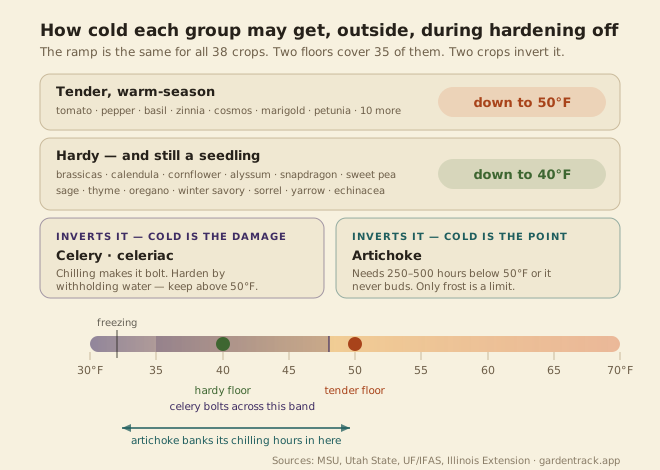
We went looking for a different-length week per crop family and there isn't one. The ramp above is the same for a cabbage and a pepper. What does change is how cold the plant may get while it's out there, and that's the figure worth knowing.
Two of them aren't a matter of degree at all, and they point opposite ways. Celery and celeriac are damaged by the cold exposure itself. Artichoke needs it and won't form a bud without it.
One trap to name before the table: a hardiness zone is not a seedling floor. Yarrow and echinacea overwinter to USDA zone 3, which is about −35°F, and people reasonably conclude their seedlings are bulletproof. That number describes an established crown that has spent a season building roots. The thing in your tray in March is a different plant. The only figure we found stated about seedlings is Utah State's: excessively exposing your hardy and semi-hardy seedlings to temperatures below 40 F can result in premature flowering.
Note the word excessively. The source is describing repeated exposure, not one chilly night, and we're reading it more cautiously than it's written — one forecast below the floor is enough for us to say pause. That's our choice. The cost of being wrong is a lost day.
| Crop group | Do not sit out below | What happens if it does |
|---|---|---|
| Tender warm-season — tomato, pepper, eggplant, tomatillo, ground cherry, basil, squash, melon | 50°F, happiest above 60°F at night | Near-freezing checks them hard; below 50°F stunts some of them outright |
| Hardy brassicas — broccoli, cabbage, cauliflower, Brussels sprouts, collards | 40°F | Below 40°F, hardy and semi-hardy seedlings can flower prematurely |
| Cold-hardy annuals — calendula, cornflower, sweet alyssum, snapdragon, sweet pea | 40°F | They survive colder than this — calendula down to 25°F — but a seedling below 40°F can flower early |
| Perennial herbs and flowers — sage, thyme, oregano, winter savory, lovage, sorrel, yarrow, echinacea | 40°F | The grown plant takes far worse. The first-year seedling is not the plant the hardiness zone describes |
| Celery and celeriac | Above 48°F — and do not use cold to harden them at all | Celery runs to seed after one to nine weeks at 35–48°F; celeriac after two to five at 41–46°F |
| Artichoke | Above freezing — the cold is the point | Grown as an annual it needs 250–500 hours below 50°F or it never forms a bud |
Celery is the exception that should be on the packet
Every other crop on this page is hardened off by gradual exposure, and cold is part of that exposure. Celery and celeriac are the exception.
Both vernalize — they read a stretch of cold as winter having happened, and respond by bolting to seed in their first year instead of making the thing you planted them for. Michigan State puts numbers on it: celery at temperatures between 35 and 48 F for 1 to 9 weeks, celeriac at 41 and 46 F for 2 to 5 weeks. A cool two weeks on a patio in April sits squarely inside both bands.
So you condition them by easing back on water rather than by dropping the temperature, and you keep them clear of that band while you do it — above 48°F is what the cited range implies, and we use 50°F to leave a margin. This isn't a rough approximation of the usual advice. It's the opposite of it, and the usual advice ruins the crop.
And one crop where the cold is the whole point
Artichoke is celery's mirror image, and it's the most useful thing we learned sourcing this page.
Grown as an annual — which is how anyone north of the Gulf coast grows it — an artichoke will not make a bud until it has been cold enough for long enough. UF/IFAS put a number on it: bud development requires sufficient chilling exposure or “vernalization,” which is generally 250 to 500 hours of temperatures below 50°F. Without it the plant does exactly what it's built to do, which is grow leaves, forever, and give you nothing to eat.
One thing you should know about that number, because we would want to know it. UF/IFAS has since withdrawn that publication — as of August 2026 the link returns “gone” rather than a page. We read it while it was up and the sentence above is what it said, but you can no longer go and check us, which is the whole point of a citation. We went looking for the figure elsewhere and it is not there: Utah State says only that artichoke “requires cool spring temperatures to initiate the flower stalk”, and UC IPM gives no number at all. So treat 250–500 hours as the best figure anyone published rather than a settled one — the direction is well supported everywhere, the precise number rests on a document that is no longer available.
So the chilly two weeks that would set a pepper back is, for this one plant, the thing that makes the crop. Ten days of hardening off with nights in the low 40s banks somewhere around 100 hours of it.
The limit is frost, not cold. Utah State notes artichoke plants are frost and freeze sensitive, so the line sits just above freezing. Where exactly, nobody publishes. We use 35°F, and that number is ours rather than anyone's research.
How to tell it is done, which is not the same as counting
Count all you like. The plant is what tells you.
A seedling that's been through the ramp should look no different at the end of a full day outside than it did at the start of it. Stems should be visibly sturdier and slightly shorter than the ones you started with — hardening off doesn't only toughen a plant, it stops it stretching. The leaves often go a shade darker and feel less like tissue paper.
If it still looks soft, or pale, or wilts by mid-afternoon and doesn't fully recover, give it more days. Nothing bad happens. The ten-day count exists so you've got somewhere to start, not so you can plant on day eleven regardless.
What damage looks like
Bleached white or papery patches on the oldest leaves are sunscald, and they mean you went too fast on the light. The plant usually survives. The scorched leaves don't recover, and it costs a week or two of growth it didn't have to spend.
Purpling on tomato or pepper stems and undersides usually means cold rather than disease. It's a phosphorus-uptake problem caused by roots too chilly to work properly, and it sorts itself out once nights warm up.
A tray forgotten outside through a genuinely cold night can look fine in the morning and be dead by afternoon. Water it, put it somewhere sheltered, and wait a day before you decide anything.
What people actually ask
How long does hardening off take?
Seven to fourteen days, and the sources disagree within that range. Michigan State Extension says begin seven to ten days before your frost-free date; Minnesota and Utah State both say about two weeks. Ten days is a reasonable single number if you want one. Err long — a day too many costs one day of growing season, and a day too few can cost the whole tray.
Can I harden off faster than a week?
You can compress it, and people do, but you are trading against a real biological process — the leaf cuticle thickens over days and cannot be rushed by wanting it to. If you must go fast, protect the light rather than the days: keep everything in shade and add hours, then do two or three days of sun at the end. Sunscald is the failure mode of a rushed schedule, not cold.
Do different vegetables need different hardening-off schedules?
Not the ramp itself — Michigan State, Minnesota and Utah State all describe the same progression for every crop and none of them varies it by plant. What differs is the minimum temperature. Tomatoes, peppers and basil should not sit out below 50°F; broccoli and cabbage take 40°F comfortably. Celery and celeriac are a genuine exception and should not be hardened by cold at all.
What temperature is too cold to put seedlings outside?
Two numbers cover almost everything. For warm-season crops — tomato, pepper, eggplant, squash, melon, basil, and the tender flowers like zinnia, cosmos and marigold — 50°F is the working floor. Utah State says not to expose them below 45 to 50°F, and UF/IFAS explains why: below 50°F they suffer chilling injury, which is damage on a night that never came near freezing. They are happiest above 60°F. For everything hardy — brassicas, the cool-season flowers, the perennial herbs — it is 40°F, from Utah State's line that excessively exposing hardy and semi-hardy seedlings below 40°F can result in premature flowering. One night at 38°F is not a disaster; two weeks of them is what the source is warning about.
My herbs are perennials that survive winter here. Do they still need a floor?
Yes, and this catches people out. Thyme, sage and oregano overwinter outdoors to USDA zone 4 or 5; yarrow and echinacea to zone 3, which is around −35°F. None of that describes the seedling. A hardiness zone is a statement about an established plant with a season of roots behind it, and a first-year seedling raised under a light has neither the roots nor the conditioning. Treat it like any other hardy seedling — 40°F — and it will be a zone-3 plant by next winter.
Which flowers can I harden off earliest?
The cold-hardy annuals: calendula, cornflower, sweet alyssum, snapdragon and sweet pea. Illinois Extension labels snapdragon and sweet alyssum "Hardy Annual" outright, and the numbers back the group up — Utah State says calendula "will survive temperature down to 25°F" and South Dakota State says alyssum "can tolerate temperatures as low as 28 degrees Fahrenheit." All of them still get the 40°F seedling floor, because surviving a cold night and being unbothered by one are different things. Zinnia, cosmos, celosia, marigold, nasturtium, petunia and salvia are the other end and want the warm-season treatment.
Why does artichoke need cold when everything else needs protecting from it?
Because for artichoke the cold is what triggers the crop. Grown as an annual it needs roughly 250 to 500 hours below 50°F before it will initiate a flower bud — that bud being the artichoke — and without that chilling it just makes leaves all season. UF/IFAS growers in Florida have to fake it with a hormone spray because their winters are too warm. The only limit is frost, which still damages the plant.
Why does my celery bolt after I harden it off?
Because the hardening off is what caused it. Celery vernalizes at temperatures between 35 and 48°F held for one to nine weeks, and celeriac at 41 to 46°F for two to five — a cool two weeks outdoors in spring sits inside both windows. The plant reads it as a winter that has passed and runs to seed in its first year. Harden celery by easing back on water instead, and keep it clear of that band — above 48°F, and we use 50°F to leave a margin.
Do I have to bring them in every night?
Every night except the last one or two. The night is the part that is hardest to get used to and the part that does the damage when it goes wrong, so it comes last deliberately. The commonest way a tray is lost is not skipping the process — it is doing it correctly for six days and then forgetting them out on the seventh.
I missed several days. Do I carry on where I left off?
No — back up. Three days indoors and the plant has lost a meaningful amount of what it gained, because the cuticle thickening and stem stiffening both reverse. Repeat the last step rather than advancing. After two or three weeks indoors, treat it as starting again; a plant that has been inside a month is closer to unconditioned than to wherever it left off.
Can I skip hardening off if I bought the plants from a nursery?
Ask where they were kept. Plants that have been sitting outside on an open forecourt are already hardened and can go straight in. Plants brought out of a greenhouse that morning, or stacked inside a shop, have not been — and a greenhouse-grown plant is exactly as soft as one you raised on a windowsill. If you cannot tell, give it three or four days; it costs almost nothing.
Does wind matter or is it just about sun and cold?
Wind matters more than most guides admit, and it does most of its damage early. An indoor-raised stem has never had to hold itself up against moving air, and the first genuinely breezy afternoon can snap or lodge seedlings that would have handled the sun fine. That is why the first steps say sheltered as well as shaded — a north wall or under a table, not just out of the light.
Sources
Every planting date, depth, and temperature on this page traces to these university extension guides. Where they differ, the ranges above hold the whole spread.
- Michigan State University Extension — Hardening off vegetable transplants is easy!
- University of Minnesota Extension — Starting seeds indoors
- Utah State University Extension — Starting Vegetable Seeds Indoors: IV. Seedling Culture and Transplanting
- Michigan State University Extension — Bolting in spring vegetables
- University of Florida IFAS Extension — ENH1/MG025: Cold Protection of Landscape Plants
- University of Florida IFAS Extension — ENH1168/EP429: Cold Protection of Foliage Plants in Shadehouses and Greenhouses
- University of Florida IFAS Extension — HS1289: Production Guidelines for Globe Artichoke in Florida
- Utah State University Extension — How to Grow Artichoke in Your Garden
- University of Illinois Extension — Annuals
- Utah State University Extension — Calendula in the Garden
- South Dakota State University Extension — Cool-Season Flowering Annuals for the Garden
GardenTrack is a gardening app you can start using for free, and its hardening-off flow is built on exactly the numbers above — including refusing to tell you to put tomatoes out on a 44°F evening. How that works.
The frost date lookup is free and needs no account, if you are working out when to start.