

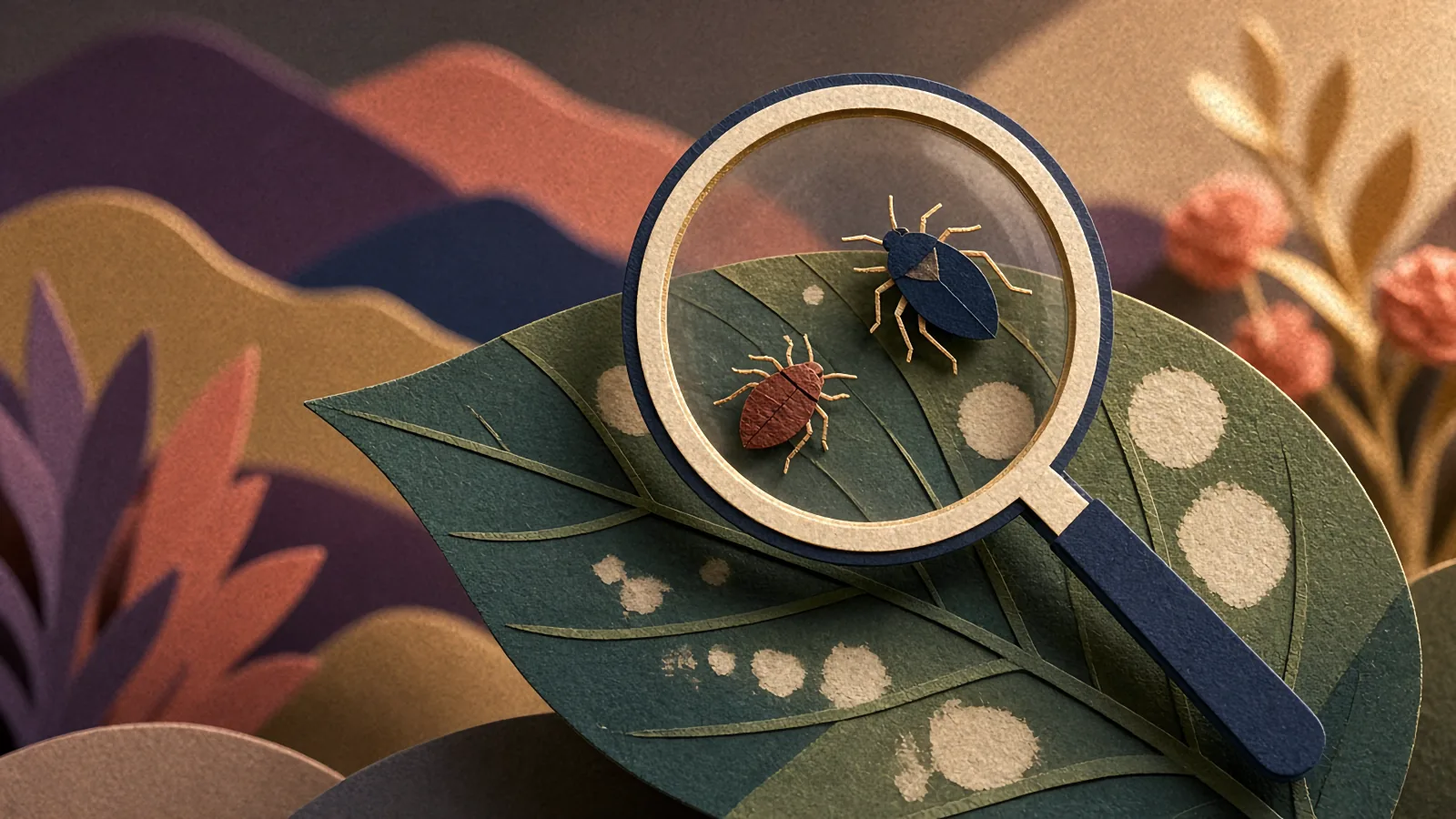
Small round "shot-hole" holes chewed through leaves, and tiny beetles that jump like fleas when you lean in. On a seedling this is urgent — flea beetles can kill young plants outright. On an established plant the same holes are usually cosmetic. Cover seedlings; leave big plants alone.
Is it flea beetles?
Two things together, and you need both. The leaves look like someone fired a shotgun at them. Dozens of tiny round holes, some punched clean through and some stopping at the far skin of the leaf. And when you lean in, something jumps.
That jump is the identification. University of Wisconsin Horticulture puts the beetle at a sixteenth to a quarter of an inch long, with enlarged back legs it jumps on. You will often see the damage first and the insect never, because it leaves before you get close.
If nothing jumps, look again at the holes. Slugs leave ragged edges and slime. Caterpillars eat from the leaf edge inward and leave droppings. Shot-holes plus a jump is flea beetles and almost nothing else.
One thing worth knowing before you go looking for a single insect: flea beetles are a group, not one species. Wisconsin names them by what they eat. The crucifer flea beetle works cabbage and its relatives, the eggplant flea beetle works eggplant. The damage looks identical whichever one you have, which is why the description travels even though the insect doesn't.
Why the same holes mean two different things
This is the part almost nobody says, and it decides whether you do anything at all. University of Wisconsin Horticulture puts it in one line: "Recently emerged plants are most vulnerable to feeding damage and can even be killed by a heavy flea beetle infestation. Older plants are often able to withstand flea beetle damage."
Same beetle, same holes, two completely different situations. A seedling has three or four leaves and no reserves. Take half its leaf area and it has nothing left to run on. A grown plant has dozens of leaves and loses a fraction of its working surface to the identical damage.
| What stage the plant is at | What the holes mean | What to do |
|---|---|---|
| Just up, first true leaves, still counted in days from sowing | Urgent. This is the stage the beetles can actually kill. | Cover it now, before you look for the insect. |
| Established — real leaf area, growing steadily | Cosmetic. Ugly, and the plant carries on. | Do nothing. Watch it, and let it be. |
| Anything you're growing FOR the leaves, at any stage | Cosmetic damage is still damage to the crop you're selling yourself. | Cover it if you mind. This one's a preference, not a rescue. |
How long that dangerous window actually is
It's shorter than people fear and it's countable. Of the 37 crops in our database that carry flea beetles, 27 have a seedling stage we can put day numbers on, measured from the day you sowed.
Arugula and radish are seedlings from day 7 to day 21. Fourteen days, and then they're through it. The median across all 27 is eighteen days. At the other end, cabbage runs day 8 to day 49 and cauliflower day 14 to day 49, which is a six-week stretch of the plant being genuinely vulnerable rather than merely nibbled.
So the practical version is: count days from sowing, not from when you noticed the holes. If you're inside your crop's seedling window, act. If you're past it, you're looking at cosmetic damage on a plant that will outgrow it.
Which of your plants they actually go for
Wisconsin names the hosts by species: crucifers, spinach, beets, beans, potato, eggplant, tomato and pepper. In our own crop data, 37 plants carry flea beetles as a recorded pest — and 15 of those 37 are brassicas: arugula, radish, kohlrabi, mizuna, mustard, tatsoi, turnip, bok choy, collard, kale, rutabaga, broccoli, brussels sprout, cabbage and cauliflower.
That concentration is the useful part. If you grow a lot of brassicas you will meet flea beetles every year, and the ones you sow direct in warm soil (arugula, radish, mustard) are the ones that go from sown to shredded fastest, because they're seedlings during exactly the stretch when the beetles are most active.
Eggplant is the other name worth knowing. It has its own flea beetle, it's a slow starter, and our records give it a seedling stage running well past two months from germination. That's a long time to be the most vulnerable thing in the bed.
What to do about them
Cover the seedlings, and the timing is specific. Wisconsin says floating row covers "can prevent adults from feeding on leaves and laying eggs around plants" — and to "set them up just before the crop emerges or immediately after transplanting to prevent flea beetles from getting in." Not the day you sow, and not when you notice holes: just before the seedlings break the surface. Edges buried or weighted, and off again when the plants are through their seedling window or when they need pollinating.
The timing is the whole trick. Cover goes on at sowing, not when you see holes. By the time you've seen holes on a seedling you have already lost some of the leaf area that seedling was running on.
On established plants, do nothing. That's not laziness, it's the reading. If the plant is past its seedling window and growing steadily, the holes are a look, not a threat, and treating them spends your time and money on a problem that is already over.
One thing we won't do here: name a spray or a rate. Flea beetles are a group of species with different hosts and different regional guidance, and a specific product recommendation from us would be a number we hadn't checked against your state's extension service. If you want that route, your local extension office publishes it for your species and your crop.
What about natural predators?
People ask this a lot, and here is the honest state of it: we have not sourced a predator list for flea beetles, so we are not going to give you one. The extension page this guide is built on covers what the insect looks like, what the damage means and which plants it goes for. It does not cover what eats it, and we would be making the rest up.
What we can tell you is that nothing in that category helps inside the window that matters. A seedling's dangerous stretch is a couple of weeks long. Building up beneficial insect populations is a season-scale project and a good one, and it will not save the arugula you sowed twelve days ago. Row cover will.
If you want the predator answer properly, your state extension service publishes it for the flea beetle species in your area — which is the same reason we do not name a spray here. There are many flea beetles, and the specifics are local.
Flea beetle questions people actually ask
How do you get rid of flea beetles?
On seedlings, floating row cover, set up just before the crop emerges or right after transplanting — Wisconsin is specific about that timing, because a cover put on after the beetles are in keeps them in. On established plants the honest answer is that you don't need to. Cover comes off when the plant is through its seedling window or when it needs pollinating.
Are flea beetles harmful?
To a seedling, yes — University of Wisconsin Horticulture says young plants can be killed outright. To an established plant, no. The identical shot-hole damage that threatens a two-week-old arugula is cosmetic on a grown one. The stage of the plant decides it, not the number of holes.
What are flea beetles attracted to?
Their hosts, and mostly their own. Flea beetles are a group of species rather than one insect, and each kind sticks largely to its own plants: the crucifer flea beetle works cabbage and its relatives, the eggplant flea beetle works eggplant. Brassicas are the group most gardeners meet them on.
What are the natural predators of flea beetles?
We have not sourced a predator list, so we are not going to invent one. What we can say is that no predator arrives fast enough to save a seedling inside its two-week danger window — that is what row cover is for. Your state extension service publishes the local answer for the species you have.
Sources
Every planting date, depth, and temperature on this page traces to these university extension guides. Where they differ, the ranges above hold the whole spread.
- University of Wisconsin–Madison Division of Extension — Flea Beetle
We're building GardenTrack to know which stage your plants are at and what each one needs today — and the free app is open now.