
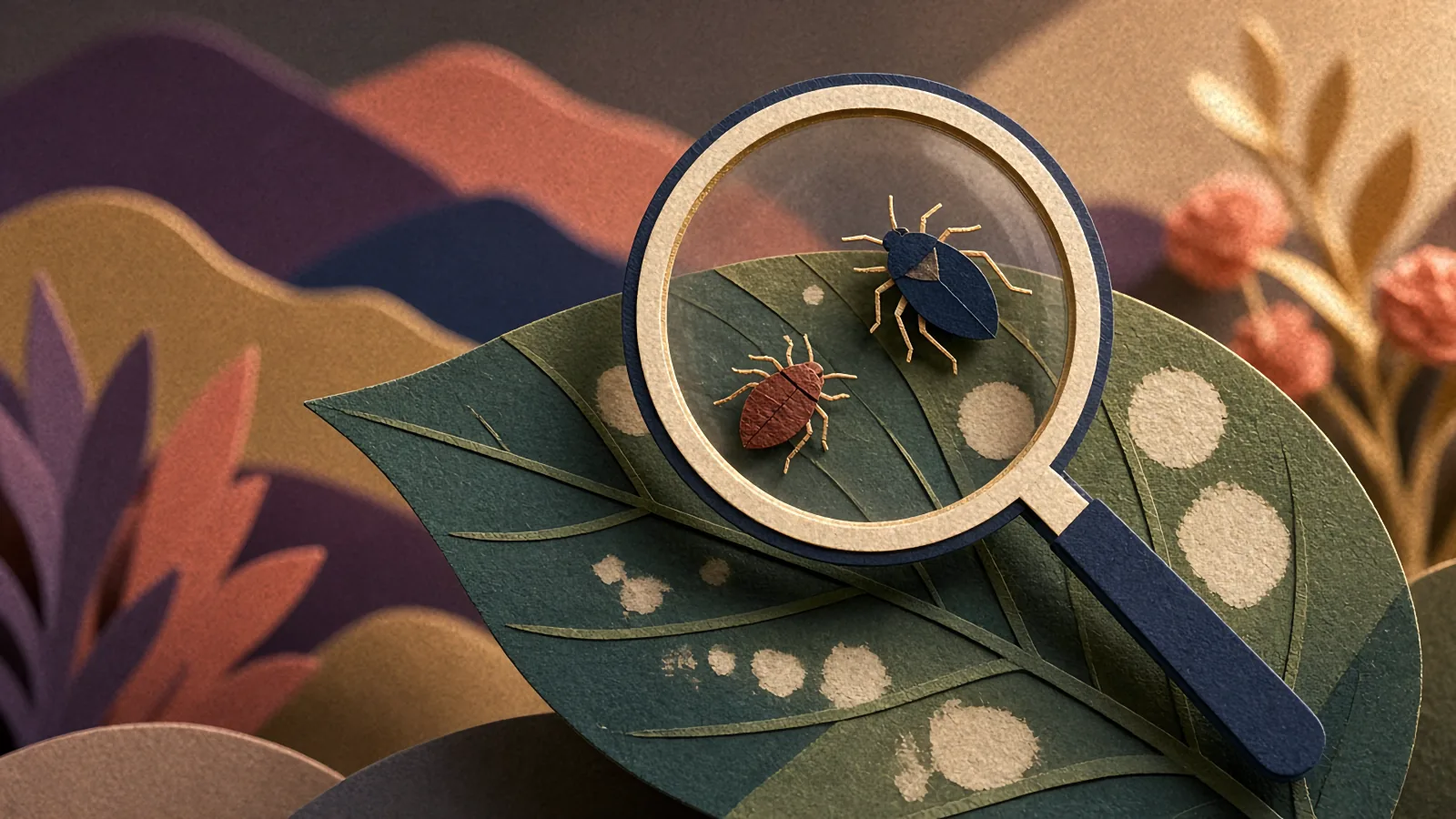
Turn the leaf over. Downy mildew's confirmation is fuzzy growth on the underside — purple-gray on cucumbers, near-black on basil. The angular patches with straight edges that everyone describes are a cucumber thing, and NC State says they are less reliable on watermelon and cantaloupe. On cucurbits it does not survive winter; it blows in each year.
Turn the leaf over — that is the whole diagnosis
Whatever the crop, the confirmation is on the underside. Fuzzy growth, directly beneath the discolored patch you can see from above.
On cucurbits it is the purple-gray fuzz our own records describe. On basil, NC State calls it "profuse, dark sporulation…covering the surface of infected leaves" — dark enough to see without a lens, and they make the point that correct diagnosis requires inspecting the underside, because from above basil downy mildew looks like a plant that wants feeding.
That last part matters more than it sounds. The commonest wrong answer for a yellowing basil is nitrogen, and the fertilizer does nothing because the problem is on the other side of the leaf.
The angular patches are cucumber's tell, not downy mildew's
Almost every page about this disease teaches the same shortcut: look for patches with straight edges that stop dead at the leaf veins. On a cucumber that is exactly right — NC State describes "angular, yellow to brown lesions on top of the leaves that are restricted by leaf veins."
Then they apply it to everything, and NC State says plainly that it does not hold:
"identification of downy mildew can be more difficult in watermelon and cantaloupe than in cucumber since lesions do not always have the characteristic angular shape."
So the single most useful shortcut in cucurbit diagnosis is crop-specific, and going by it on a watermelon will talk you out of a correct diagnosis. Go by the underside instead, which holds everywhere.
There is a reason the descriptions differ, and it is that the organisms differ. Cucurbit downy mildew is Pseudoperonospora cubensis. Basil downy mildew is Peronospora belbahrii — a different genus, not a variant. They share a common name and very little else.
It splits further inside the cucurbits. NC State: "Isolates belonging to clade 1 tend to more frequently infect watermelon, pumpkin, and squash while isolates belonging to clade 2 more frequently infect cucumber and cantaloupe." Even the strain in your garden has preferences.
What it looks like, by crop
The underside fuzz is the constant. Everything above the leaf changes with what you are growing, which is the point of this table.
| Crop group | What the top of the leaf shows | The confirmation underneath |
|---|---|---|
| Cucumber | The classic angular patches — "restricted by leaf veins", so they look tiled | Purple-gray fuzz. This is the one crop where the top-side pattern alone is nearly diagnostic |
| Watermelon and cantaloupe | Yellow to brown patches that often are NOT angular | Purple-gray fuzz — and here it is the only reliable sign, because the shape rule fails |
| Squash and pumpkin | Pale green to yellow spots that later turn brown | Purple-gray fuzz. The strains that hit these crops tend to be a different clade from the ones that hit cucumber |
| Basil | Yellowing or browning that reads exactly like hunger | Profuse DARK sporulation, near-black. Different pathogen entirely — Peronospora belbahrii |
| Brassicas, spinach, alliums and the rest | Yellowing above the affected area | Fuzz underneath. We hold this problem against 33 crops in ten-plus plant families and do not have a per-crop published description for most of them |
Where our own data is thinner than this page
Our database carries ONE symptom line for downy mildew across all 33 crops. That is fine as a pointer and wrong as a description, for the reasons above — so treat the cucumber, melon, squash and basil rows here as sourced, and the last row as an honest gap rather than a summary.
How to identify it
In this order, because the first step is the one that works on every crop.
- Turn a leaf over and look underneath the discolored patch. Fuzzy growth directly beneath the mark is the confirmation. Purple-gray on cucurbits, dark to near-black on basil. Nothing else on this page is as reliable as this, on any crop.
- Only then read the top-side pattern, and read it for YOUR crop. Angular, vein-bounded patches confirm it on cucumber. On watermelon and cantaloupe the same disease often will not make that shape, so an unangular patch rules nothing out.
- Rule out the two things it is mistaken for. Powdery mildew sits ON the leaf as a white dusty coating you can disturb with a finger, usually on the upper side. A nutrient problem yellows from the older leaves and has nothing underneath at all. If the underside is clean, it is not this.
- Decide what is actually worth doing, which is mostly about air and water. The spores need moisture on the leaf to start an infection, so watering at the base rather than over the top, spacing plants apart and trellising vines all take away what it needs. For cucumbers specifically, a resistant variety next season does more than anything available to you this season.
On cucurbits there is a genuinely useful piece of news: NC State says the pathogen "can only overwinter on plants in sites with warm weather such as the Southern United States and greenhouses". In a cold-winter garden it is not waiting in your soil — it arrives on the wind each year, which is why it often turns up late in the season and at roughly the same time across a region.
That is the opposite of a soil disease like fusarium wilt, which stays in the ground for years. Same garden, two diseases, two completely different answers to "is it still in there next spring?" — see fusarium wilt.
What this page cannot tell you
Whether basil's downy mildew can infect your cucumbers. They are differently-named pathogens in different genera, which is a fact. Whether Peronospora belbahrii is strictly host-specific is not something NC State's basil page states, so we are not going to claim it. The practical reading is that they are separate problems; the strict version needs a source we have not found.
A per-crop description for most of the 33 crops we hold this against. We have sourced descriptions for cucumber, watermelon and cantaloupe, squash and pumpkin, and basil. For brassicas, spinach, alliums, grape and the ornamentals we have the general pattern and no published per-crop line, and saying so is more useful than writing five sentences that all say "yellowing with fuzz underneath".
Questions about downy mildew
How do I know it is downy mildew and not powdery mildew?
Which side of the leaf, and whether it rubs off. Powdery mildew is a white dusty coating that sits ON the surface, usually the upper side, and you can disturb it with a finger. Downy mildew's growth is on the UNDERSIDE, beneath a discolored patch you see from above, and you cannot wipe it away because the fungus is growing out of the leaf. On cucumbers the top-side patches are also angular with straight edges where powdery mildew's are soft-edged.
My basil is turning yellow — is this downy mildew or does it need feeding?
Turn a leaf over, which is the only way to tell. Basil downy mildew makes what NC State calls 'profuse, dark sporulation' covering the underside, dark enough to see without a lens. From above it looks like hunger, which is why feeding is the usual first response and why it does nothing. If the underside is clean, a nitrogen shortage is a reasonable next thought.
If my cucumbers got downy mildew, will it be back in that bed next year?
On cucurbits in a cold-winter region, not from your soil. NC State says the pathogen 'can only overwinter on plants in sites with warm weather such as the Southern United States and greenhouses' — so it does not survive the winter in northern gardens and arrives on air currents from the south each season. That is genuinely different from a soil disease like fusarium wilt, which stays in the ground for years. It does mean you cannot prevent it by resting the bed.
Is downy mildew on my squash the same disease as on my basil?
No. Cucurbit downy mildew is caused by Pseudoperonospora cubensis and basil downy mildew by Peronospora belbahrii — different genera that share a common name. Even inside the cucurbits the strains differ: NC State notes that clade 1 isolates more frequently infect watermelon, pumpkin and squash while clade 2 more frequently infect cucumber and cantaloupe. Treating 'downy mildew' as one disease is the mistake this page exists to correct.
Sources
Every planting date, depth, and temperature on this page traces to these university extension guides. Where they differ, the ranges above hold the whole spread.
- NC State Extension — Cucurbit Downy Mildew
- NC State Extension — Basil Downy Mildew
- University of Wisconsin–Madison Division of Extension — Vegetable Disease Quick Reference
The one habit worth keeping: turn the leaf over. It is the only sign that works on every crop, and the famous straight-edged patches only really belong to cucumbers.
And on cucurbits in a cold winter, it is not in your soil waiting — it comes back on the wind.