

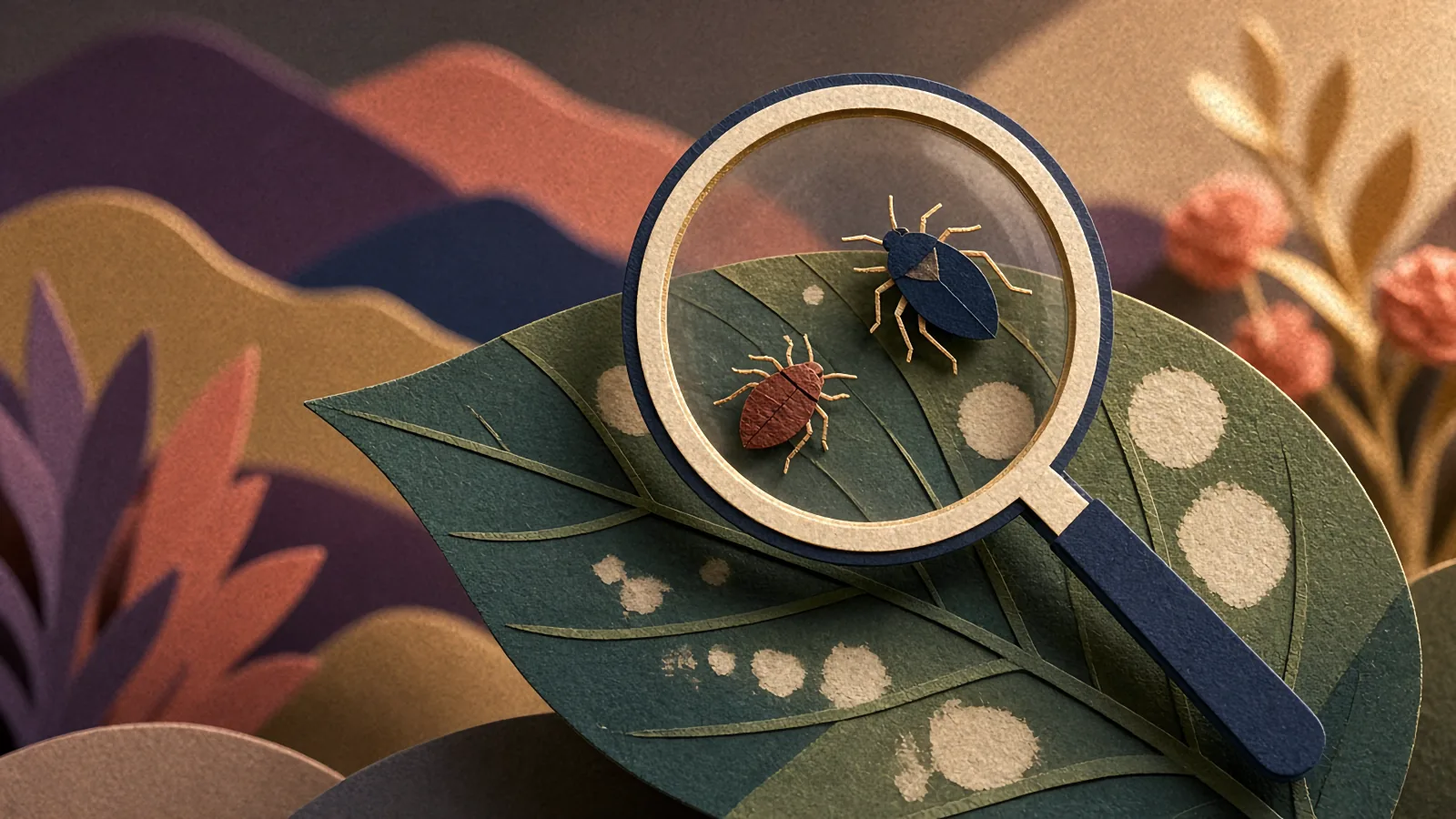
Three different caterpillars share the name, and all three are green, so color tells you nothing. Touch it and watch. A looper humps its back and inches along. An imported cabbageworm barely reacts. A diamondback larva wriggles hard and is tiny. Which one it is changes whether a Bt spray will work.
Three insects, one name, all of them green
"Cabbage worms" is not a species. University of Minnesota's page on caterpillars in cole crops covers three, and a gardener will meet all of them on the same cabbage in the same summer:
The imported cabbageworm — "velvety green with faint yellow stripes running lengthwise", up to an inch. The cabbage looper — "pale green with narrow white lines running down each side", up to an inch and a half. The diamondback moth larva — "light green, tapered at both ends," and only up to a third of an inch.
Read those three descriptions again and notice the problem. Velvety green, pale green, light green. Every published identification guide leads with appearance, and appearance is the one thing these three share.
Which is why the practical test is not looking. It is touching.
The poke test
Put a finger on the caterpillar and watch what it does. Minnesota's own descriptions separate the three by movement, and movement is instant and unambiguous where color is neither — an imported cabbageworm will "move sluggishly when prodded", while diamondback larvae "wiggle vigorously when touched".
| What it does when you touch it | Which one it is | The confirming detail |
|---|---|---|
| Humps its back into a loop and inches along | Cabbage looper | It has no legs in the middle of its body, so looping is the only way it can walk. Up to 1½ in, pale green, narrow white lines down each side |
| Barely reacts — moves off slowly, as if it cannot be bothered | Imported cabbageworm | Minnesota: they "move sluggishly when prodded". Velvety green, a faint yellow stripe lengthwise, up to 1 in, and it crawls normally |
| Wriggles hard, sometimes drops off the leaf on a thread | Diamondback moth larva | Minnesota: they "wiggle vigorously when touched". Tiny — up to ⅓ in — and noticeably tapered at both ends |
If you cannot find the caterpillar, the damage names it
Windowpanes — patches where one surface of the leaf is eaten away and the other is left as a translucent film — are the diamondback. Minnesota: it "starts feeding inside the leaves and then moves to the outside", giving that "windowpane look". Nothing else here does it.
Large ragged holes with the big veins left standing are the imported cabbageworm or the looper, and at that stage the two do the same damage. Small holes are any of them, young.
And the reason to care about a caterpillar you cannot find: droppings in the heart of a cabbage mean something is living in there, whether or not you can see it today.
Why the name actually matters
If the three did the same damage and answered to the same treatment, lumping them would be harmless shorthand. They do not.
Minnesota's advice on Bacillus thuringiensis — the Bt sprays sold for caterpillars — is specific in a way that gets flattened everywhere else: "When diamondback moths are the dominant caterpillar found, or when other caterpillars are found while they are still young, consider using a Bt product. This product is highly effective on small caterpillars."
Read the shape of that. Bt is recommended when the diamondback is dominant — the smallest of the three — or when the others are still young. The common factor is size, and the sentence that follows says so: highly effective on small caterpillars.
So a gardener who finds an inch-and-a-half looper in August and reaches for Bt is using the right product at the wrong moment, and will conclude it does not work. The same product on the same plant three weeks earlier is Minnesota's own recommendation. Naming the caterpillar and judging its size is the difference between those two outcomes, and "cabbage worms" as a single name is what stops people doing it.
What to do
Four steps, and the first two take under a minute between them.
- Look at the damage before you look for the animal. Translucent windowpane patches point at the diamondback. Large ragged holes with the veins left behind point at the looper or the imported cabbageworm. Small holes could be any of the three, young — which is the stage that matters most for what comes next.
- Find one, touch it, and watch. Loops along = cabbage looper. Barely reacts = imported cabbageworm. Wriggles hard and is tiny = diamondback. This is faster and far more reliable than comparing shades of green, which is what most guides ask you to do.
- Judge the size honestly. Under about a third of an inch, or clearly small for its kind, is the window where Bt is at its most effective by Minnesota's own account. An inch and a half of looper is not that window.
- Pick off what you find, and use Bt while they are small. Handpicking works on the two larger species precisely because they are big enough to see and slow enough to catch — the sluggishness that identifies the imported cabbageworm is also what makes it easy to remove. For a diamondback outbreak or a young population of any of them, Bt is the recommendation.
One thing this page will not do is tell you a threshold — how many caterpillars are too many for a home garden. We have not found one published for home growers, and a number we made up would look more useful and be less true.
A fine-mesh row cover put over the bed before the moths and butterflies arrive prevents all three, because none of them can lay eggs through it. That is the only measure on this page that works on all three at every stage.
What this page covers, and what it does not
Minnesota's page is about cole crops — it names "cabbage, cauliflower, broccoli, kale, rutabaga, radish, turnip and collard" — and everything above is sourced to it. That is the right scope for the imported cabbageworm and the diamondback, both of which stay in that family.
The cabbage looper does not. Our own records attach it to lettuce, celery, spinach, mache and radicchio as well as the brassicas, and Minnesota's cole-crop page does not cover those. So if you are looking at a looping caterpillar on lettuce, the identification here holds and the crop-specific advice on that page was not written for you.
Questions about cabbage worms
How do I tell a cabbage looper from an imported cabbageworm?
Touch it. A looper has no legs in the middle of its body, so it humps its back and inches along — it is the only one of the three that moves that way, and it is unmistakable once you have seen it. An imported cabbageworm crawls normally and, in Minnesota's words, moves 'sluggishly when prodded'. Size helps as a backup: loopers reach about an inch and a half, imported cabbageworms about an inch. Color will not help you, because both are green.
What are the little windowpane patches on my cabbage leaves?
That is the diamondback moth larva. It starts feeding inside the leaf and moves to the outside, so it eats one surface and leaves the other as a translucent film. None of the other cabbage caterpillars do that, which makes it the one damage pattern on this page that identifies a species on its own. The larva itself is easy to miss — up to a third of an inch, light green, tapered at both ends, and it wriggles hard when touched.
Why did Bt not work on my cabbage worms?
Most likely because the caterpillars were too big. Minnesota recommends Bt when diamondback moths are dominant, or when other caterpillars are found while they are still young, and states it is 'highly effective on small caterpillars'. A full-grown inch-and-a-half looper is outside that. It is the commonest reason the product gets written off as useless, and it is really a timing problem — the same spray on the same plants a few weeks earlier is the recommended treatment.
Are cabbage worms the same thing as cabbage loopers?
No, and that is the whole point of this page. 'Cabbage worms' is a catch-all covering at least three insects — the imported cabbageworm, the cabbage looper and the diamondback moth larva. All three are green, all three eat brassicas, and they differ in size, in how they move, in the damage they leave and in when a Bt spray will actually work on them. The name is convenient shorthand that costs people a treatment every season.
Sources
Every planting date, depth, and temperature on this page traces to these university extension guides. Where they differ, the ranges above hold the whole spread.
- University of Minnesota Extension — Caterpillars on cole crops
The short version: they are all green, so stop looking at the color. Poke it — a looper loops, a cabbageworm barely moves, a diamondback wriggles hard and is tiny.
And if you are going to use Bt, use it while they are small, which is Minnesota's own condition rather than a detail we added.