


Put your tallest crops on the north side so they don't shade everything else. Give each plant its real spacing — crowding kills more beds than pests do. Keep daily-pick crops like tomatoes and herbs closest to the door. Sketch it before you plant: sun first, then height, then spacing, then paths wide enough to work in.
The four rules that decide every layout
Everything below is these four applied to a shape. Get them right and a plain rectangle out-produces a clever design.
1. Sun first, and measure it rather than guess. Stand in the spot and look at it three times in one day — nine in the morning, one in the afternoon, five in the evening. Where does six to eight hours actually land? A brilliant plan in a four-hour spot loses to a dull one in full sun, every year, without exception.
2. Tall things go on the north side. Our sourced records put staked tomatoes at 2 to 6 feet and pole beans at 6 to 8. Anything that tall on the south edge puts the rest of the bed in shade by July. On the north edge it shades nothing but the fence.
3. Real spacing, not hopeful spacing. This is the one that costs people a season, and it has its own section below, because the number that matters is not the one on the seed packet's front.
4. Paths you can actually kneel in. Eighteen to twenty-four inches. A bed whose middle you cannot reach is a bed you stop weeding in July, and an unweeded bed is a smaller harvest than a smaller bed would have given you.
The number that ruins layouts, and it is not the one you think
Seed packets and layout guides talk about spacing in the row — put your lettuce four inches apart. That number is fine, and it is not the one that decides whether your plan fits.
The row-to-row figure is a different number, and a much bigger one. Across the thirteen crops we checked it runs from about one and a half times the in-row spacing up to ten times it — and the pattern is the opposite of what you would guess. The smaller the plant, the bigger the gap. Bush beans sit 2 to 4 inches apart in the row and want 24 to 36 inches between rows, because you can pack the plants and still need somewhere to put your feet.
Here is what our own sourced records hold for the crops people put in a first bed:
Cucumbers: 8 to 12 inches in the row, and 48 to 72 inches between rows. Summer squash: 24 to 36 in the row, 36 to 48 between. Staked tomatoes: 18 to 36 in the row, 36 to 60 between. Bush beans: 2 to 4 in the row, 24 to 36 between.
A 4×8 raised bed is 48 inches wide. Read those two facts together and the arithmetic does something uncomfortable: one row of cucumbers, at its published row spacing, is the whole bed. Not a corner of it. All of it.
That is why so many first beds disappoint. The plan looked reasonable, every plant went in at its packet spacing, and by July the bed is a thicket where three crops are competing for one crop's worth of light and water. Nothing was done wrong. The arithmetic was never run.
Now run the same check on the plan we recommend below, because it fails too, and that is the point.
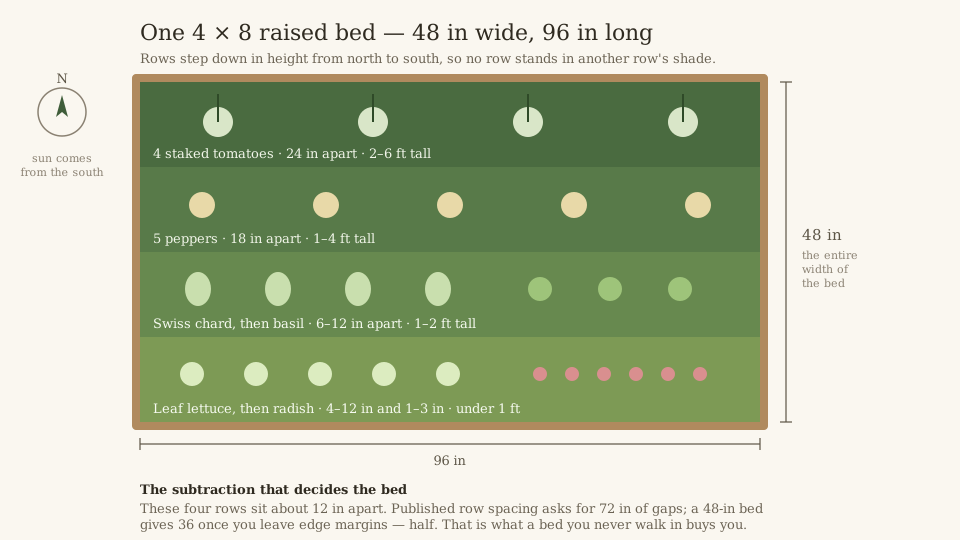
The four-row bed further down puts tomatoes, peppers, a chard-and-basil row and lettuce across those 48 inches. Their published row spacings start at 36, 18, 18 and 12 inches. Stack the three gaps between four rows and the smallest published arrangement needs 72 inches of gaps. A 48-inch bed, with a sensible six inches of margin at each edge, gives you 36. Our own recommended plan runs at half the row spacing our own database publishes.
We are printing that rather than quietly rounding it away, because the resolution is the useful part. Those figures assume a person walking between the rows. They are written by extension services for growers with a hoe and a field. In a four-foot bed you reach in from both sides and never set foot in it, so the walkway the number is reserving does not need to exist, and half is genuinely fine.
What is not fine is doing that without knowing. Shave a number you have seen and you are making a decision; shave one you never met and you are guessing and calling it a plan. So the subtraction is on this page, including where it goes against us.
Four example layouts you can copy
Each one is a real bed with real counts. The spacing column is our sourced figure for that crop, and the counts come from dividing the bed by it — so you can check every row of this table against the plan.
| Where in the bed | What goes there | Why that many |
|---|---|---|
| North edge | 4 staked tomatoes | Sourced at 18–36 in apart in the row. At 24 in, four fit across the 96-inch length — and they are the tallest thing here, so they shade the fence rather than the bed. |
| Second row | 5 peppers | 12–24 in apart in the row. At 18 in that is five, and peppers top out at 1–4 ft — under the tomatoes, over everything after them. |
| Third row | Swiss chard and basil | Both 6–12 in apart in the row. Chard runs 1–2 ft tall and basil 12–18 in, so they sit below the peppers and above the last row. |
| South edge | Leaf lettuce, then a short row of radish | Lettuce 4–12 in, radish 1–3 in. The two shortest crops on the sunniest edge, and the two you pick most often — so they are also the ones nearest where you stand. |
| Deliberately absent | Cucumbers, squash, pole beans | Cucumbers want 48–72 in between rows and squash 36–48. Either one takes the bed on its own. They are a second bed, not a corner of this one. |
Why that order, in one line
Tomatoes 2–6 ft, peppers 1–4 ft, chard 1–2 ft, lettuce 6–12 in. The bed steps down from north to south, so no row is ever standing in the row behind it. Where height and convenience disagree — a tomato is a daily pick and it still belongs at the back — height wins, because a shaded row loses all season and a few extra steps cost you nothing.
The other three layouts
Same discipline as the bed above: real counts, and the arithmetic said out loud where it bites.
Two 4×8 beds, with the rotation built in
Bed one is the plan above. Bed two is where the crops that would not fit go — and that is the whole reason for a second bed, rather than a vague wish for more room.
Put summer squash at one end: at 24–36 inches in the row it gives you three or four plants across the 96-inch length, and that is genuinely all it gives you. Cucumbers take the north side on a trellis. Going vertical is what buys back the row spacing — a cucumber sprawls 3 to 8 feet across the ground and almost none of that width if you send it up.
Then next spring, swap the two beds. You are not memorizing a rotation chart, you are moving two labels, and the families end up where they should be because there are only two places they can go.
A 10×10 in-ground plot
Ten feet of width is the first size where you can honor the published row spacing instead of negotiating with it. A 120-inch width takes two tomato rows at their widest published spacing, or three at their tightest — and two cucumber rows, which is exactly the thing a 4-foot bed cannot do. That is the real difference between a bed and a plot, and it is worth knowing before you decide which you are building.
Tall crops in the northern third, the heavy feeders through the middle where you will be adding compost anyway, and the quick crops on the south edge where you can get at them. Two 24-inch paths cost you 20 of your 100 square feet — a fifth of the plot, which sounds like a lot right up until August, when the version without paths is the one you have stopped weeding.
Small space — containers plus one bed
The honest patio version. One bed for the crops that repay the space, containers for the ones that genuinely do not care where they live.
A five-gallon bucket is the right size for bush beans, carrots, Swiss chard, cherry tomatoes and cabbage, and too small for summer squash. It is not a compromise for those five — it is the published figure. The full working-through, including the four crops for which five gallons is a floor rather than an answer, is in what to grow in a five-gallon bucket.
The advantage nobody mentions: a container has no row spacing at all. Every figure on this page exists to reserve ground between rows, and a bucket you can pick up and move has none to reserve. In the tightest spaces that makes containers not the consolation prize but the more efficient choice.
How to plan your own layout, step by step
Five steps, in this order. The order matters more than any individual choice — every step below constrains the next one, and doing them backwards is how people end up moving a bed.
- Map the sun before you decide anything. Look at the spot at nine, one and five on one clear day and note where the shade falls. Six to eight hours is the target for fruiting crops. This is the only step you cannot fix later with effort.
- Pick four to six crops you will actually eat. Not what looks good in a plan. A bed of four crops you cook with beats one of twelve you admire. Fewer crops also means fewer spacing rules to hold in your head.
- Run the spacing math, rows first. For each crop, find the between-rows figure, not just the in-row one. Divide your bed's WIDTH by it. That tells you how many rows the bed can hold, which is usually fewer than you hoped, and it is better to learn it now than in July.
- Sketch it on paper, tallest to the north. Actual pencil, actual rectangle. Put the tall crops on the north edge, work south by height, and draw the paths in before you fill the space — paths added last are always too narrow.
- Check pairings and dates before you buy. Two last passes: which of your crops should not sit next to each other, and whether each one can still be planted where you live. Both are quick and both are cheaper to answer now than after the receipt.
A working rule for that third step, from the arithmetic further up this page: in a bed you never walk in, about half the published row spacing is fine. That is what our own recommended plan does — 36 inches of gaps where the published figures ask for 72.
Where halving stops working is sprawl. A cucumber's 48-to-72-inch row figure is not reserving a walkway, it is describing a vine that runs three to eight feet across the ground. You cannot reach-in your way out of that, which is why cucumbers and squash get their own bed rather than a tightened row.
Layout mistakes that cost a season
None of these are stupid. Every one of them is a reasonable decision made without a number in front of you.
Crowding. The commonest and the most expensive. Plants at half their spacing do not give you half the harvest each — they shade each other, hold damp air between them, and give you a fraction from every plant. We crowded a bed once and got roughly a third of what the same plants gave the next year with room.
Tall crops on the south edge. Easy to do in April, when the tomato is eight inches high and shades nothing. In July it is six feet and everything behind it has been in shade since June.
A bed you cannot reach the middle of. Four feet wide is the standard for a reason: two feet of reach from either side. Five feet looks like more growing space and is mostly space you stop maintaining.
Sowing the whole packet. A packet holds far more seed than a bed holds room. Sowing it all is how a carefully spaced plan becomes a thicket in three weeks, and thinning feels like destroying something you grew, so most people do not.
Planning for the sun you wish the spot had. The one mistake that no amount of care downstream repairs.
Write down what went where
A layout only pays you back if you can remember it next spring. Which bed had the tomatoes, what actually did well, what you swore you would move. By March it is gone, and most gardeners rebuild last year's plan from a photograph and a guess.
Paper is fine. A photo of your sketch on the fridge is fine. The point is that a rotation is only possible if you know what was there, and the honest version of this page ends by saying that a plan you did not record is a plan you will draw again from scratch.
We are building an app that remembers what you planted where, so next spring's plan starts from what actually happened rather than from memory. The free tools on this page are the first pieces of it.
Questions about laying out a vegetable garden
What's the best vegetable garden layout for beginners?
One 4×8 raised bed with five or six crops, tallest on the north edge. Four staked tomatoes along the north end, a row of peppers, a row of lettuce and chard, then basil and radish on the south side where you stand. That is a bed you can plan in an evening and still be weeding in August. Leave cucumbers and squash out of it — at their sourced row spacing of 48 to 72 and 36 to 48 inches, either crop takes a 48-inch-wide bed on its own.
Should rows run north-south or east-west?
North to south, for most beds. Rows running north-south let the sun cross them through the day, so plants shade each other less than rows running east-west, where the row in front holds its shadow on the one behind it all morning. The exception is a bed on a slope, where you run rows across the slope regardless, because losing soil to runoff costs more than the light does. And in a bed only four feet wide the effect is small either way — the height rule matters far more than the direction one.
How many plants fit in a 4×8 raised bed?
It depends entirely on the crop, and the honest answer is fewer than most plans show. A 4×8 bed is 48 by 96 inches. Staked tomatoes at their sourced 18 to 36 inch in-row spacing give you three to five along the 96-inch side. Peppers at 12 to 24 inches give four to eight. Lettuce at 4 to 12 inches gives eight to twenty-four in a row. But the limit is usually the row spacing across the 48-inch width, not the plant spacing along the length — which is the arithmetic this page exists to show.
Which vegetables shouldn't be planted next to each other?
The pairings worth avoiding are mostly about competition and shared pests rather than folklore. The bigger and more checkable issue in a small bed is size: anything that sprawls will take the space of whatever is beside it regardless of whether they are botanically compatible. Our <a href="/tools/companion-planting-chart/">companion planting chart</a> covers the pairings, and it is worth reading alongside the spacing figures rather than instead of them.
Sources
Every planting date, depth, and temperature on this page traces to these university extension guides. Where they differ, the ranges above hold the whole spread.
- University of Maryland Extension — Growing Cucumbers in a Home Garden
- University of Minnesota Extension — Growing cucumbers
- Utah State University Extension — How to Grow Cucumber in Your Garden
- Clemson Cooperative Extension HGIC — Cucumber
- University of Maryland Extension — Growing Summer Squash (Zucchini) in a Home Garden
- Clemson Cooperative Extension HGIC — Tomato
- University of Minnesota Extension — Growing beans in home gardens
- University of Maryland Extension — Growing Swiss Chard in a Home Garden
- GardenTrack plant database — Sourced spacing records for 153 crops
The four rules do most of the work: sun first, tall to the north, real spacing, paths you can kneel in. Everything else is preference.
Two free tools do the arithmetic on this page for you — the plant spacing calculator for how many fit, and the companion planting chart for what goes beside what.